Introduction
Welcome back to your course on Cloud Computing. In our last lesson, we examined the three-layer architecture of cloud storage: the Physical, Control, and Application layers. We established that the Control Layer is the "brain" responsible for managing data, which includes the critical task of protecting it from hardware failure.
This lesson drills down into that specific function. We will address the learning outcome: Explain synchronous and asynchronous data replication, outlining the trade-offs between consistency and performance.
Data replication is the process of creating and maintaining multiple copies of data on different storage devices. It is fundamental to achieving the high availability and durability that cloud services promise. We will explore the two primary strategies for this, understand how they work, and analyze the critical trade-offs each one forces you to make. Mastering this topic is essential for your exams, as it forms the basis for understanding data consistency in distributed systems.
What is Data Replication?
Before we compare the two methods, let's establish why data replication is necessary in the first place. Cloud providers need to ensure that your data is safe even if a server, a disk, or an entire data center fails. They also want to improve performance by placing data closer to users.
The following video provides an excellent, concise introduction to the concept of data replication and its primary benefits.
System Design - Database Replication | Synchronous vs Asynchronous
To start, let's watch the beginning of the video 'System Design - Database Replication' from the Code with Irtiza channel. This will explain what replication is and the key reasons it's used in large-scale systems.
Watch the video from the beginning until the timestamp 03:01. Focus on the three main reasons for replication: lower latency, data proximity, and data safety.
As the video explained, replication is about keeping multiple copies of the same data. This leads to:
- High Availability & Data Safety: If the primary storage device fails, a replica can take over, preventing data loss and downtime.
- Better Performance: Read requests can be distributed across multiple replicas, reducing the load on a single server and providing faster responses to users who are geographically closer to a replica.
Now, let's look at how this replication is performed.
Synchronous vs. Asynchronous Replication: The Core Difference
The fundamental difference between synchronous and asynchronous replication lies in when the system considers a write operation to be complete.
- Synchronous Replication: A write is considered successful only after the data has been written to both the primary storage and all its replicas. The application has to wait for confirmation from all copies.
- Asynchronous Replication: A write is considered successful as soon as the data is written to the primary storage. The data is then copied to the replicas in the background, without making the application wait.
The diagram below provides a clear visual of these two workflows.

To see these processes explained in more detail, let's return to the video.
System Design - Database Replication | Synchronous vs Asynchronous
The rest of the video clearly explains the process, advantages, and disadvantages of both synchronous and asynchronous replication.
Please watch from 03:01 to the end of the video (07:53). From 03:01 to 06:12, focus on how synchronous replication works, its 'blocking' nature, and the problems of slower writes and write failures. From 06:12 to the end, focus on how asynchronous replication is non-blocking, its performance benefits, and its main drawback: potential data inconsistency and loss.
The Trade-off: Consistency vs. Performance
As you saw in the video, the choice between synchronous and asynchronous replication is a classic engineering trade-off. You cannot have both maximum performance and maximum consistency simultaneously.
-
Synchronous replication prioritizes consistency over performance. It guarantees that all replicas are perfectly in sync with the primary copy at all times. The cost of this guarantee is higher latency for write operations.
-
Asynchronous replication prioritizes performance over consistency. It provides very low write latency because the application doesn't have to wait for replicas. The cost is that there's a small window of time where replicas might be out of sync, leading to potential data loss if the primary fails.
These two approaches lead to different consistency models.
Synchronous Replication vs. Asynchronous Replication
To formalize this for your exam, let's read a short section that defines the consistency models associated with each replication type. This text clearly connects the concepts.
Please read the section titled 'Consistency Models'. Focus on the definitions of 'Strong Consistency' and 'Eventual Consistency' and how they relate directly to synchronous and asynchronous replication, respectively.
From the reading, we get these critical definitions:
- Strong Consistency: An outcome of synchronous replication. It ensures that any read operation will always return the most recently written data, because all copies are updated before the write is acknowledged.
- Eventual Consistency: An outcome of asynchronous replication. It guarantees that, if no new updates are made, all replicas will eventually reflect the last written value. However, for a short period after a write, a read operation might return stale (old) data.
Summary for Exam Revision
This topic is a common source of exam questions. The key is to clearly articulate the definitions, processes, and trade-offs. The infographic and table below summarize everything you need to know.
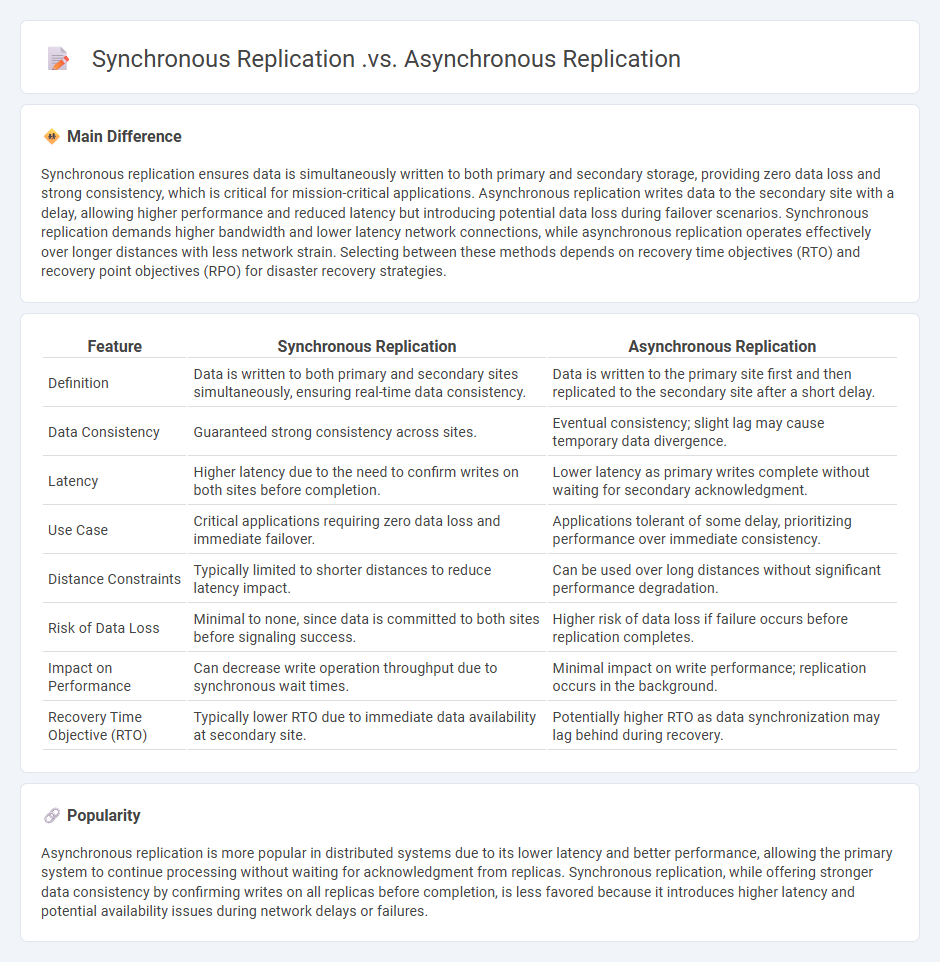
For detailed revision, use the following table.
| Attribute | Synchronous Replication | Asynchronous Replication |
|---|---|---|
| Write Acknowledgment | Acknowledges success to the application only after data is written to all replicas. | Acknowledges success to the application after data is written to the primary only. |
| Performance (Latency) | High latency. Slower write performance because it must wait for network round-trips to all replicas. | Low latency. Fast write performance as it does not wait for replicas. |
| Data Consistency | Strong Consistency. All replicas are always identical to the primary. | Eventual Consistency. Replicas may temporarily lag behind the primary. |
| Risk of Data Loss (RPO) | Zero or Near-Zero RPO. No data is lost if the primary fails, as replicas are up-to-date. | Non-Zero RPO. Data written since the last replication cycle can be lost if the primary fails. |
| Fault Tolerance | Write operations can fail if a replica is unavailable. | Write operations can succeed even if replicas are temporarily unavailable. |
| Network Requirements | Requires a high-speed, low-latency, and highly reliable network. | Can tolerate higher latency and less reliable networks. Works well over long distances. |
| Use Cases | Critical transactional systems: banking, e-commerce order processing, inventory management. | Disaster recovery, geographically distributed read replicas, analytics, services where performance is key. |
| Complexity & Cost | More complex and expensive due to strict network requirements. | Simpler and less expensive to implement, especially over long distances. |
RPO (Recovery Point Objective): This is an important term. It defines the maximum acceptable amount of data loss measured in time. Synchronous replication has an RPO of (or near) zero. Asynchronous replication has an RPO equal to the time since the last successful replication.
Conclusion
In this lesson, we explored the two primary methods of data replication used in cloud storage to ensure durability and availability.
Key Takeaways:
- Synchronous Replication guarantees strong consistency by confirming writes across all replicas before acknowledging success. This eliminates data loss in a failover (zero RPO) but comes at the cost of higher write latency and lower performance.
- Asynchronous Replication prioritizes high performance by acknowledging writes immediately after the primary copy is updated. This results in low write latency but creates a window for potential data loss (non-zero RPO) and leads to eventual consistency.
- The choice between them is a fundamental trade-off between consistency and performance, dictated by the application's specific requirements.
Preview of the Next Lesson:
We've now introduced the concepts of strong and eventual consistency. In the next lesson, we will focus directly on this topic, formally defining eventual consistency and strong consistency as data consistency models in distributed storage. This will build upon the foundation we've laid today, preparing you to answer more detailed questions about how distributed databases and storage systems behave.