Introduction
Welcome to the first lesson of our module on Kernel Concurrency and Synchronization. In our previous lesson, we diagnosed a complex scheduling problem—a priority inversion scenario—that was ultimately caused by contention for a lock. That was a perfect preview for this module, where we will dive deep into the mechanisms the kernel uses to manage concurrent access to shared data.
Today, we'll start with the most fundamental concept, addressing the learning outcome: Identify potential race conditions in kernel code and explain why user-space primitives are insufficient.
We will first define what a race condition is and look at how these bugs manifest in code. Then, we will explore the specific sources of concurrency within the kernel that make it a much more challenging environment than typical user-space programming. Finally, we'll establish exactly why the synchronization tools you might use in an application, like pthreads, are fundamentally unsuitable for use within the kernel.
Mastering this topic is non-negotiable for any serious kernel developer. It forms the basis for understanding how to write safe, correct, and performant code in a highly concurrent environment, a skill that is heavily scrutinized in senior-level interviews.
1. What is a Race Condition?
At its heart, a race condition is a bug where the outcome of an operation depends on the unpredictable timing of concurrent events. It occurs when multiple threads of execution access shared data, and at least one of them is writing to it.
The following video provides an excellent and intuitive introduction to the concept.
The Weirdest Bug in Programming - Race Conditions
This video from Core Dumped, titled 'The Weirdest Bug in Programming - Race Conditions', clearly illustrates the nature of race conditions with practical examples.
Please watch the following segments: Introduction (00:00 - 00:50): Introduces concurrency and race conditions. Non-atomic Operations (00:55 - 01:42): Explains the critical concept that a single line of high-level code often compiles to multiple, interruptible CPU instructions. Reader/Writer Example (03:30 - 05:46): A great demonstration of data corruption when one thread writes while others read. Counter Example (14:26 - 16:38): A classic example showing how a simple increment operation (++) can fail under concurrency, leading to lost updates.
The video highlights two key patterns that are classic indicators of a potential race condition:
- Read-Modify-Write: A thread reads a value from shared memory, modifies it, and writes it back. If another thread can access the same memory between the read and the write, the first thread's modification may be based on stale data, and its write may overwrite the second thread's changes. The counter increment (
i++) is a perfect example of this. - Check-Then-Act: A thread checks a condition (e.g.,
if (pointer == NULL)) and then takes an action based on that check (e.g.,pointer = malloc(...)). A race condition occurs if a second thread can change the condition between the check and the action, invalidating the premise of the first thread's action.
Let's see how this "Check-Then-Act" pattern can manifest in a kernel driver.
[PDF] Concurrency and Race Conditions - LWN.net
The following text, from chapter 5 of 'Linux Device Drivers, 3rd Edition', uses the scull driver to demonstrate a race condition in a realistic kernel code snippet.
Please read the section 'Pitfalls in scull' (page 107). It provides a concrete example of a race condition leading to a memory leak in a device driver.
The scull example is a perfect illustration of the "Check-Then-Act" problem. Two processes check if a pointer is NULL at the same time. Both conclude they need to allocate memory. The first process allocates memory and stores the pointer, but its work is immediately overwritten by the second process. The memory allocated by the first process is lost forever—a memory leak.
Identifying these patterns—accessing shared data from potentially concurrent contexts—is the first step to preventing race conditions.
2. Sources of Concurrency in the Kernel
In a user-space application, concurrency usually comes from multiple threads or processes. The Linux kernel, however, has many more sources of concurrent execution, which is what makes it a far more complex environment.
Your background in embedded systems gives you a strong intuition for interrupt-driven concurrency. The kernel formalizes this and adds several other layers.
[PDF] Concurrency and Race Conditions - LWN.net
The same document provides a concise list of these concurrency sources.
Please read the section 'Concurrency and Its Management' on pages 107-108. Focus on the list of concurrency sources.
Let's summarize these kernel-specific sources of concurrency:
- Multiple user-space processes: System calls from different processes can execute concurrently on different CPUs and access the same kernel data structures (as in the
scullexample). - Symmetric Multiprocessing (SMP): Kernel code can be executing on multiple CPUs simultaneously.
- Kernel Preemption: On a preemptive kernel, a task running in the kernel can be interrupted to allow a higher-priority task to run. This new task could then enter the same section of kernel code. This effectively creates SMP-like concurrency even on a single-core processor.
- Device Interrupts (Hard IRQs): A hardware interrupt can occur at any time, pausing the currently executing code and running an interrupt service routine (ISR). The ISR might access the same data that the interrupted code was using.
- Deferred Work (Softirqs, Tasklets, Workqueues): To keep ISRs short, much of the work is deferred to a "bottom half" context like a softirq or workqueue. These can run at almost any time, introducing another vector for concurrent access. For instance, a network driver's ISR might put a received packet on a queue, and a softirq later processes it. A system call might also need to access data related to that packet queue, creating a race between the process context and the softirq context.
Understanding these different execution contexts is crucial because, as we'll see next, they dictate which synchronization mechanisms are safe to use.
3. Why User-Space Primitives are Insufficient
A common question for developers new to the kernel is, "Why can't I just use a flag variable, or a pthread_mutex-like primitive?" The answer lies in the unique constraints imposed by the kernel's execution contexts.
Problem 1: Software-only "Locks" are Not Atomic
A naive attempt to create a lock using a simple flag variable fails because the lock operations themselves are not atomic. They suffer from the same "Check-Then-Act" race condition we discussed earlier. The video "The Weirdest Bug in Programming" demonstrates this perfectly in the section from 12:06 to 13:59. Two threads can check the flag, both see it as "unlocked," and both proceed as if they have acquired the lock.
Problem 2: The Prohibition on Sleeping
User-space primitives like pthread_mutex are typically built on top of kernel system calls like futex. When a thread tries to acquire a locked mutex, the kernel puts that thread to sleep and schedules another one to run.
However, large parts of the kernel are not allowed to sleep. This is known as running in an atomic context. The most common atomic contexts are:
- Interrupt handlers (hard IRQs)
- Softirqs and tasklets
- Code holding a spinlock
Why is sleeping forbidden here? Imagine an interrupt handler tries to acquire a lock that is already held. If it were to sleep, which process should the scheduler run instead? The system is in an interrupt context, which is not associated with any specific process. The system would grind to a halt.
The document "Unreliable Guide To Locking" contains a useful (though not exhaustive) list of common kernel functions that can sleep. Any function that might allocate memory (kmalloc) or copy data from user space (copy_from_user) is a potential sleeper. Calling any of these from an atomic context is a critical bug. Since user-space primitives are designed to make threads sleep, they are completely unsuitable for use in any of the kernel's atomic contexts.
Problem 3: Unawareness of Kernel-Specific Contexts
Even if sleeping weren't an issue, user-space primitives are oblivious to hardware interrupts. If a process holds a lock and a hardware interrupt occurs, the interrupt handler might try to acquire the same lock. If the handler spins waiting for the lock, it will spin forever, because the interrupted process code can't resume to release the lock until the interrupt handler finishes. This is a classic deadlock.
To solve this, the kernel provides special primitives that combine locking with disabling interrupts on the local CPU (e.g., spin_lock_irqsave()). This ensures that an interrupt handler cannot preempt code that holds a lock it might also need.
The Fundamental Building Block: Hardware Atomics
If a simple software flag doesn't work, how are reliable locks built? The answer is that all correct synchronization primitives are ultimately built upon atomic operations provided by the CPU hardware. These are instructions guaranteed by the processor to be indivisible.
This final video explains why these atomic instructions are the essential foundation.
how does a Mutex even work? (atoms in the computer??)
The video 'how does a Mutex even work?' gets to the heart of the matter, showing why you can't build a mutex from regular instructions and how atomic CPU instructions solve the problem.
Please watch the following segments: The Paradox (01:33 - 01:49): Poses the key question: how does a lock itself avoid a race condition? Atomic Operations (02:07 - 02:35): Introduces atomic operations as the solution. Correct Implementation (03:16 - 03:55): Shows how an atomic 'compare-and-swap' instruction can be used to build a reliable lock.
The Linux kernel provides a wrapper around these hardware capabilities with the atomic_t type and functions like atomic_inc() and atomic_cmpxchg(), which you can find described in the ch05.pdf document under "Atomic Variables". These are the low-level building blocks for the more complex spinlocks and mutexes we will study next.
4. Interview Scenario: Analyzing a Real-World Race Condition
Let's apply these concepts to a real-world scenario. The following image describes CVE-2023-6200, a race condition vulnerability discovered in the kernel's IPv6 networking stack.
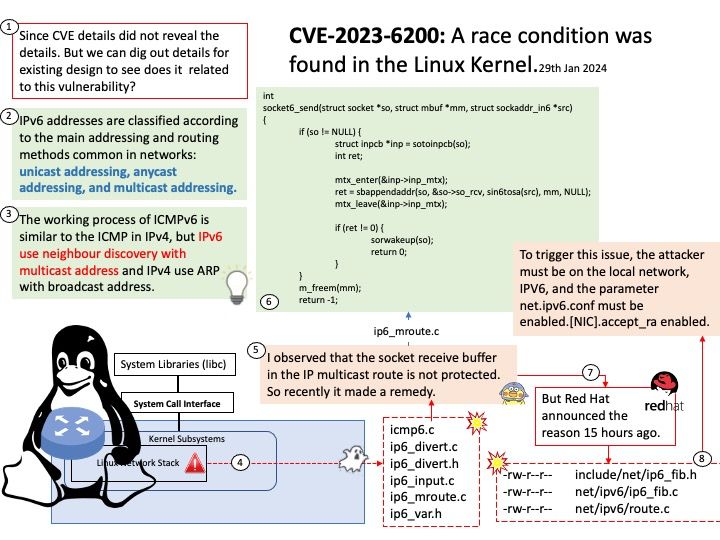
Scenario Question:
An interviewer presents you with this CVE summary and asks:
"Looking at this CVE, it describes a race condition in the network stack related to updating a socket receive buffer. What kind of concurrent execution contexts would you suspect are involved here, and why would a standard user-space mutex be completely inappropriate to fix this, even if you could use it in the kernel?"
Your Thought Process:
- Identify the Subsystem: This is the IPv6 network stack. Network packet reception is a classic example of code that runs in both hard IRQ and softirq contexts. The hard IRQ handler (the NIC driver) receives the packet and schedules a softirq (
NET_RX_SOFTIRQ) to do the heavy processing. - Identify Potential Contenders:
- Contender 1 (Softirq Context): An incoming multicast packet is being processed by the
NET_RX_SOFTIRQ, which needs to access the socket's receive buffer. - Contender 2 (Process Context): A user-space application is interacting with the same socket via a system call (e.g.,
setsockoptto change multicast settings, orcloseto destroy the socket). This system call runs in process context.
- Contender 1 (Softirq Context): An incoming multicast packet is being processed by the
- Synthesize the Answer:
"This race condition likely involves concurrent access between code running in softirq context to process an incoming packet, and code running in process context from a system call operating on the same socket. A standard user-space mutex is inappropriate for two main reasons. First, the softirq context is an atomic context where sleeping is forbidden, but a user-space mutex would attempt to put the task to sleep if the lock is contended. This would crash the system. Second, the primitive must protect against preemption by the softirq itself. The correct fix would involve a kernel-specific lock, likely a
spinlock_bh, which disables softirqs on the local CPU before acquiring the lock, thus preventing this specific race."
Conclusion
This lesson laid the critical groundwork for our study of kernel synchronization. You can now identify the patterns that create race conditions and, crucially, understand the unique challenges of the kernel environment that render user-space solutions inadequate.
Key Takeaways:
- Race Conditions result from uncontrolled concurrent access to shared data, often following "read-modify-write" or "check-then-act" patterns.
- Kernel Concurrency is complex, arising from SMP, kernel preemption, hard interrupts (IRQs), and deferred work (softirqs, tasklets, workqueues), not just user processes.
- User-space primitives are insufficient because they may cause the caller to sleep, which is illegal in atomic contexts like interrupt handlers. They are also unaware of kernel-specific contexts like IRQs and softirqs.
- Hardware Atomic Operations are the indivisible CPU instructions that form the fundamental basis for all correct locking primitives.
Now that we have a firm grasp of the problem, our next lesson will explore the kernel's primary solutions: spinlocks and mutexes. We will compare their behavior, learn when to use each, and see how they solve the problems we've discussed today.