Introduction
Hello! In our last lesson, you did a fantastic job arranging your sculpted forms into a compelling composition, thinking about balance, flow, and framing. You’ve successfully moved from creating an object to curating a scene.
This lesson is the capstone for our abstract sculpture project. Today, you will step back and critique your final abstract composition based on the principles of form, balance, and flow.
Critique is a fundamental part of any artistic practice, something you're well-acquainted with from your experience in fine arts and physical sculpture. It's the process of intentional analysis that turns intuition into skill and good work into great work. We'll build a structured vocabulary for this critique and apply it directly to the scene you created.
1. Building a Vocabulary for Critique
To critique a work effectively, we need a shared language. While terms like "balance" and "form" are intuitive, formalizing their definitions helps us analyze a piece with more precision.
The following resource provides an excellent breakdown of the core principles of 3D design. It's written for a sculpture course, so it will resonate with your background while providing clear, applicable definitions for our digital context.
This guide, 'Key Principles of 3D Design' from Fiveable, organizes the core concepts of sculpture into logical groups. It will serve as our primary reference for the vocabulary of critique.
Please read through the article, paying close attention to these sections and principles: Structural Principles: Focus on Balance and Form. Visual Flow Principles: Focus on Rhythm and Movement. Note the distinction between the two. Relational Principles: Focus on Contrast and Unity. Spatial Principles: Focus on Space (positive and negative). Finally, review the Quick Reference Table at the end. It's a great summary that you can use as a checklist.
This article gives us the "what"—the specific principles we can use to evaluate your composition.
2. The Sculptor's View: Beyond the Frame
In the last lesson, we focused on composing a shot from the camera's perspective—a fixed, 2D frame. But sculpture, whether physical or digital, exists in three dimensions. A truly successful sculptural composition should be compelling from multiple angles, not just the "money shot."
This video offers a fascinating perspective on how to look at sculpture, distinguishing between pieces that work from one angle and those that demand to be explored.
How to Look: Sculpture 2D vs 3D
The video 'How to Look: Sculpture 2D vs 3D' by The Two Percent introduces a powerful concept for evaluating sculpture. It will encourage you to think about your digital creation as a true 3D object.
Please watch the entire video (it's short). As you watch, consider: The distinction between a sculpture that communicates through shadow from one viewpoint (a '2D sculpture') and one that reveals its form as you move around it (a '3D sculpture'). How this applies to your work in Blender. Your camera view is the '2D' view, but orbiting your model in the viewport allows you to experience it in '3D'.
3. The Art of Self-Critique
Now that you have the vocabulary and the right perspective, how do you apply it to your own work constructively? Critique should be an objective process, not a session of harsh self-judgment. The goal is to identify what's working, what could be improved, and why.
This next article provides a simple, effective method for creating a "crit sheet" to guide your self-evaluation.
How to Make A Crit Sheet to Self-evaluate Your Own Artwork
This article, 'How to Make A Crit Sheet to Self-evaluate Your Own Artwork' from EmptyEasel, offers a practical framework for structured self-critique.
Read the sections titled: 'Second, DON’T allow harsh self-criticism': This is an important mindset to adopt. 'OK – ready to create your own crit sheet?': Read through the 5 steps to understand the process. We will adapt this for our critique task.
To reinforce a couple of key compositional ideas that are particularly relevant for abstract work, this final short video provides clear visual examples of achieving balance and using contrast effectively.
3 Rules for Better Composition in Your Art
The video '3 Rules for Better Composition in Your Art' by Artwod visually demonstrates two key concepts we'll use in our critique.
Watch the following two segments: Visual Weight (02:11 - 03:43): Pay attention to the idea of balancing your composition like a scale. Shape Contrast (03:55 - 05:02): Notice how contrasting different types of shapes (e.g., round vs. square) can create emphasis and interest.
4. Project: Critiquing Your Abstract Composition
It's time to apply these ideas. Open the Blender file containing the abstract composition you created in the last lesson. You will perform a self-critique by writing down your analysis.
Use the principles from the "Key Principles of 3D Design" article as your guide. I suggest creating a simple text document and answering the following questions.
Part A: The Framed Composition (The "2D" View)
First, look at your scene through the camera (Numpad 0). This is your final, intended image.
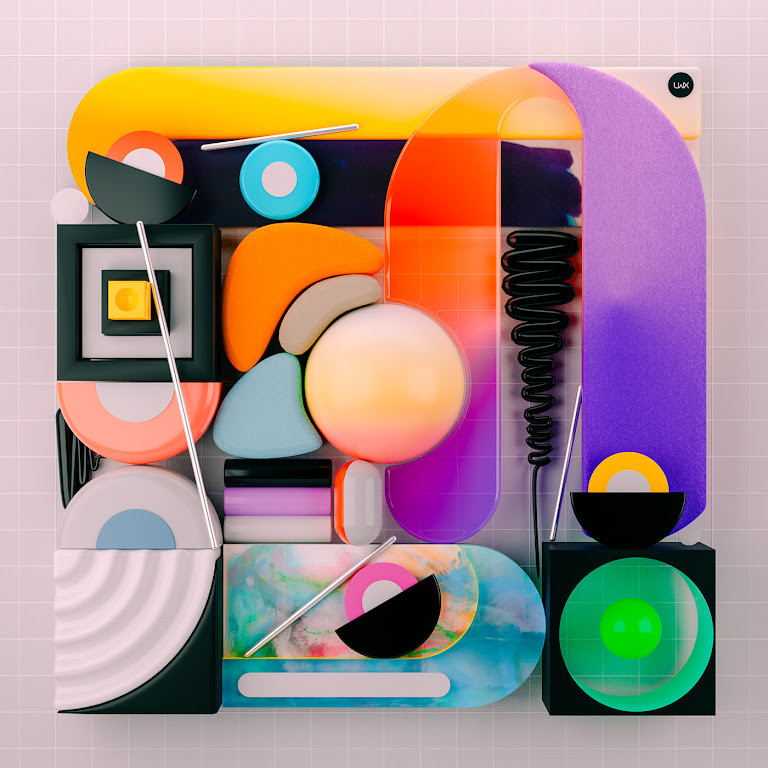
- Balance: Does the composition feel balanced? Is it symmetrical or asymmetrical? Imagine it on a scale as the video suggested. Is the visual weight distributed effectively, or does one side feel too heavy or empty?
- Flow & Emphasis: Where does your eye go first (the focal point)? How did you create this emphasis (e.g., through scale, placement, or contrast)? Do leading lines or repeated shapes (rhythm) guide the viewer's eye through the piece?
- Contrast: Is there effective contrast in your composition? Think about contrast in form (organic vs. geometric), scale (large vs. small), and texture (if you've used different brushes to create varied surfaces).
- Unity: Does the collection of objects feel like a single, cohesive artwork? Or does it feel like separate parts placed next to each other? What elements contribute to (or detract from) the sense of unity?
Part B: The Sculptural Form (The "3D" View)
Now, exit the camera view and orbit your composition freely in the 3D Viewport. Examine it from all sides—top, bottom, back, and various three-quarter views.

- Form & Space: How does the overall form change as you move around it? Are there interesting silhouettes from multiple angles? Pay attention to the negative space—the shapes of the voids created by and between your objects. Are these shapes as intentional as the objects themselves?
- "Dead Spots": Are there any angles from which the composition looks awkward, confusing, or simply uninteresting? (This is a common issue and identifying it is a huge step!)
- Discovery: Does viewing the sculpture "in the round" reveal new relationships between forms that weren't obvious from the camera view? Does it tell a different story?
Take about 20-30 minutes for this analysis. Be honest and objective. The goal isn't to judge your work as "good" or "bad," but to understand it more deeply.
Conclusion
Congratulations on completing your first major project module! Today, you've developed one of the most important skills an artist can have: the ability to analyze your own work with a critical, educated eye. You've learned to look at your creations not just as a final image, but as a three-dimensional object with form, balance, and flow that must be considered from all angles.
Key Takeaways:
- Critique requires a specific vocabulary: Using principles like Form, Balance, Flow, Contrast, and Unity allows for precise analysis.
- Sculpture lives in 3D: A successful digital sculpture is compelling both in its final framed render and when viewed "in the round" in the viewport.
- Self-critique is a structured process: By systematically evaluating your work against key principles, you can identify strengths and pinpoint specific areas for improvement.
Next Steps
You've now built a strong foundation in organic and abstract sculpting. In the next module, "Hard-Surface Foundations with Modifiers," we will pivot to a different style that aligns with your other interest. You'll learn about a non-destructive workflow using Blender's modifier stack to create the clean, precise base shapes needed for mechanical and architectural objects. The compositional skills you've just honed will be invaluable when you start arranging and presenting these new forms.