Hello! Welcome to the first lesson in our module on Cash Flow and Working Capital Management.
In our previous module, we focused on long-term strategic valuation. We culminated that work by creating a "football field" chart to summarize a company's implied value. Today, we pivot from that high-level, long-term perspective to the immediate, tactical world of short-term liquidity management. For an FP&A analyst, ensuring a company can meet its weekly obligations is a fundamental and critical responsibility.
Your learning outcome for this lesson is to build a detailed 13-week direct cash flow forecast to manage short-term liquidity. This model, often called the Thirteen-Week Cash Flow or "TWCF," is one of the most important tools in the corporate finance toolkit for monitoring a company's financial health and anticipating cash needs before they become crises. We will cover its purpose, its structure, and, most importantly, the mechanics of building a detailed forecast for its key components.
1. What is a 13-Week Cash Flow Forecast and Why is it Essential?
At its core, the TWCF is a projection of all cash coming into and going out of the business on a weekly basis for the next quarter (13 weeks). Unlike the formal Statement of Cash Flows you study in accounting, which is often prepared using the indirect method (starting with Net Income and adjusting for non-cash items), the TWCF is built using the direct method. This means we forecast the actual cash receipts and cash payments themselves—cash from customers, cash paid to suppliers, cash paid for payroll, etc.
This direct, cash-centric approach makes the TWCF an invaluable early warning system.
To start, let's get a clear overview of what the 13-week cash flow forecast is and the critical business questions it helps answer. Watch this video from the Corporate Finance Academy.
Please watch the following three segments: Introduction (00:00 - 01:29): Focus on the analogy of the 'check engine light' and why this tool is so critical for managing short-term liquidity. Purpose (01:29 - 02:54): Pay attention to the types of practical questions this forecast answers, such as making payroll, paying debt, or timing investments. Advantages (09:40 - 10:48): This section summarizes the key benefits, like identifying pressure points and driving performance.
As the video highlights, the TWCF provides visibility. It's not just an academic exercise; it's a decision-making tool. Its importance is magnified in volatile economic conditions or for companies facing financial strain. In fact, for companies undergoing restructuring or seeking emergency financing, a credible TWCF is often the most important document requested by lenders and investors. It provides the transparency and confidence they need to support the business.
2. The Structure of a Direct Cash Flow Forecast
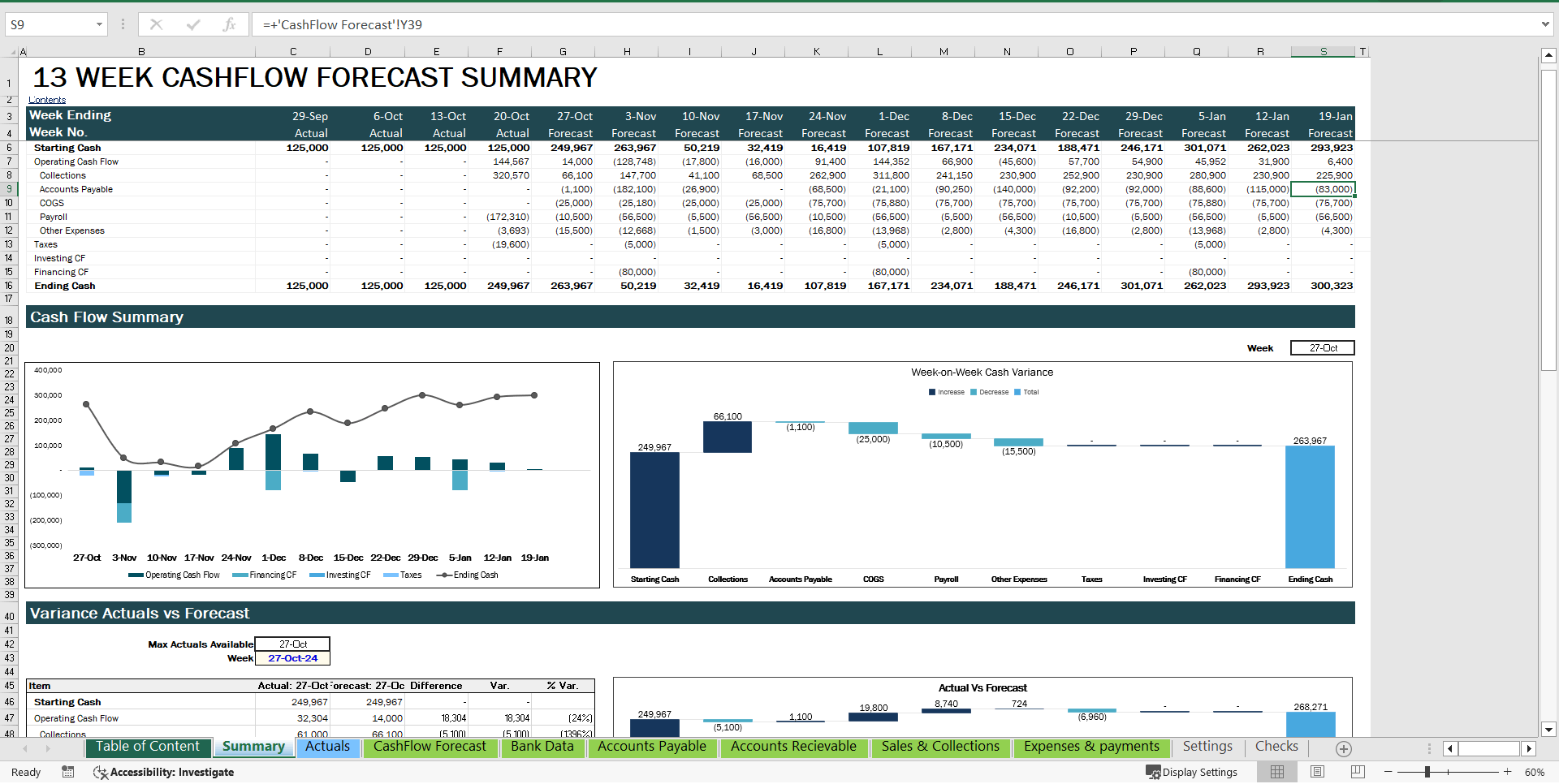
A standard TWCF model is typically built in Excel and follows a logical, intuitive structure. It rolls forward the cash balance from one week to the next.
The fundamental formula for each week is:
Ending Cash Balance = Beginning Cash Balance + Cash Inflows - Cash Outflows
The Ending Cash Balance of Week 1 becomes the Beginning Cash Balance of Week 2, and so on for 13 weeks.
Let's break down the components.
The Practical Guide to Building a 13-Week Cash Flow Model
This article from Dwight Funding, 'The Practical Guide to Building a 13-Week Cash Flow Model', provides a clear, step-by-step guide. We'll use it to understand the model's structure and the typical line items.
Please read 'Step 3: Set Up Your 13-Week Cash Flow Forecast Model'. Focus on the two main sections described: Cash Inflows: Note the examples, especially the distinction between Accounts Receivable collections and real-time sales (like e-commerce). Cash Outflows: See how operating expenses are broken down and how distinct items like capital expenditures and debt service are handled separately. This will give you a clear picture of the line items we need to forecast.
Here is an example of what this structure looks like in a finished model.
3. How to Build a Detailed Forecast
A truly useful TWCF goes beyond simple assumptions. Its power lies in the detailed, driver-based forecasting of its major components. This is where your analytical skills as an FP&A professional come into play. The most critical forecasts are tied to working capital balances.
This involves creating "roll-forward" schedules for key balance sheet accounts. A roll-forward schedule calculates the ending balance of an account based on its beginning balance and the activities that occurred during the period.
Let's explore how to build these crucial schedules.
13-Week Cash Flow Model (TWCF) | Template Example
The article '13-Week Cash Flow Model (TWCF)' from Wall Street Prep provides an excellent, in-depth explanation of the mechanics behind a professional-grade forecast. We will focus on the section explaining the working capital roll-forwards, which are the engine of a detailed TWCF.
Please read the section titled 'Working Capital Roll-Forward Schedule'. Pay close attention to the mechanics described for each of the following four roll-forwards. Understand how one schedule can feed into another: Accounts Receivable (A/R) Roll-Forward: See how new Sales increase A/R and Cash Collections decrease it. Inventory Roll-Forward: Note that Inventory Purchases increase inventory and COGS (Cost of Goods Sold) decreases it. Accounts Payable (A/P) Roll-Forward: This is key. Notice how Inventory Purchases from the inventory schedule increase A/P, and Cash Payments to Suppliers decrease it. This is how we forecast cash outflow for inventory. Accrued Wages Roll-Forward: Understand how Wage Expense increases this liability and Cash Paid for Wages decreases it.
The Logic of the Roll-Forward
Let's formalize the logic from the reading.
-
A/R Collections:
- A/R Roll-Forward:
Ending A/R = Beginning A/R + Credit Sales - Cash Collections - To forecast cash collections, you can use an assumption for Days Sales Outstanding (DSO) or analyze the aging of your A/R to predict when specific invoices will be paid. For a weekly model, you might assume that a certain percentage of the prior week's sales are collected this week, and so on.
- A/R Roll-Forward:
-
Payments to Suppliers (A/P):
- A/P Roll-Forward:
Ending A/P = Beginning A/P + Inventory Purchases - Cash Payments - Forecasting this requires two steps. First, forecast
Inventory Purchases(often based on a target Days of Inventory on Hand, or DIOH). Then, use a Days Payable Outstanding (DPO) assumption to forecast when you will pay for those purchases. For example, you might assume you pay for this week's purchases in 4 weeks' time.
- A/P Roll-Forward:
-
Payroll Payments:
- Accrued Wages Roll-Forward:
Ending Accrued Wages = Beginning Accrued Wages + Wage & Bonus Expense - Cash Paid for Payroll - This is often more straightforward.
Wage Expenseaccrues daily, but cash payments for payroll happen on a fixed schedule (e.g., bi-weekly or semi-monthly). You can model these discrete cash outflows on the specific weeks they are set to occur.
- Accrued Wages Roll-Forward:
Other outflows, like rent, utilities, and debt service payments, are typically contractual and can be scheduled into the forecast on their specific payment dates.
Test your understanding!
Let's model a simple A/R roll-forward for a company.
Assumptions:
- Beginning A/R for Week 1 is $50,000.
- Forecasted credit sales are $20,000 each week.
- The company collects 70% of any given week's sales in the following week (Week N+1).
- The remaining 30% is collected two weeks later (Week N+2).
- For simplicity, assume the Beginning A/R of $50,000 will all be collected in Week 1.
Calculate the Cash Collections and Ending A/R for Week 2.
Show answer
Week 1 Analysis (to find Beginning A/R for Week 2):
- Beginning A/R (W1): $50,000
- Credit Sales (W1): +$20,000
- Cash Collections (W1): -$50,000 (collection of opening balance)
- Ending A/R (W1) = $50,000 + $20,000 - $50,000 = $20,000
This Ending A/R for Week 1 becomes the Beginning A/R for Week 2.
Week 2 Analysis:
- Beginning A/R (W2): $20,000
- Credit Sales (W2): +$20,000
- Cash Collections (W2):
- This week, we collect 70% of Week 1's sales.
- Collection = 70% * $20,000 (W1 Sales) = $14,000
- Ending A/R (W2):
- Ending A/R = Beginning A/R (W2) + Credit Sales (W2) - Cash Collections (W2)
- Ending A/R = $20,000 + $20,000 - $14,000 = $26,000
So, for Week 2, the Cash Collections are $14,000 and the Ending A/R is $26,000. The remaining A/R consists of the uncollected portion of Week 1's sales ($6,000) and all of Week 2's sales ($20,000).
4. Implementing and Maintaining the Model
Building the model is the first step. A TWCF is a living document that requires a disciplined process to maintain its accuracy and usefulness.
The practical process generally involves these steps:
- Define Objective & Assign Accountability: Clearly state the goal (e.g., manage liquidity, test covenant compliance) and designate an owner (typically an FP&A analyst).
- Gather Data: Collect historical data on cash movements and key drivers (DSO, DPO, etc.) to inform your assumptions.
- Develop Assumptions: Create realistic, documented assumptions for every line item. Be prepared to explain and defend them. The article from Dwight Funding provides an excellent list of questions to consider for sales, expenses, etc. (Step 11 in the resource).
- Create the Forecast: Populate your Excel model.
- Weekly Review and Variance Analysis: Each week, update the model with actual results for the past week. Compare actuals to your forecast, understand the variances, and adjust your forward-looking assumptions accordingly. This feedback loop is what makes the tool so powerful.
Conclusion
Today we've taken a deep dive into one of the most practical and essential tools in an FP&A analyst's arsenal: the 13-week cash flow forecast. It is the heartbeat monitor of the business, providing crucial foresight into short-term liquidity.
Key Takeaways:
- The TWCF is a direct-method cash forecast that projects weekly cash inflows and outflows for a quarter.
- Its purpose is to provide an early warning system for potential cash shortfalls and to support short-term operational and financial decision-making.
- The core structure is a simple roll-forward: Ending Cash = Beginning Cash + Inflows - Outflows.
- A detailed and robust forecast is built upon working capital roll-forward schedules for A/R, A/P, and other key accounts, which translate accrual-based activity (like sales) into actual cash movements.
- The TWCF is a living document that must be updated and reviewed weekly to maintain its accuracy and relevance.
Preview of the Next Lesson:
We've seen today how critical working capital items like receivables and payables are to short-term cash flow. In our next lesson, we will build directly on this by learning how to calculate and interpret the cash conversion cycle. This key metric will allow us to diagnose the efficiency of a company's working capital management and identify specific opportunities for improvement, such as collecting cash faster or paying suppliers more slowly.