Здравствуйте! Welcome to our third lesson.
In our last session, we focused on asking about someone's day and giving a simple summary of your own. You learned key verbs for daily activities and even saw an example of how to structure your description: Утром я бегаю, а днём работаю (In the morning I run, and during the day I work).
Today, we will dive deeper into those crucial time words: у́тром, днём, and ве́чером. By the end of this lesson, you will be able to use these time-of-day expressions to structure your sentences and give a much clearer picture of when your daily activities happen. This will make your conversations with your in-laws more detailed and natural.
1. The Key Vocabulary: Morning, Afternoon, Evening, Night
In Russian, to say that something happens in the morning, you change the noun for "morning" into an adverb. The same pattern applies to the afternoon, evening, and night.
Let's look at this pattern.
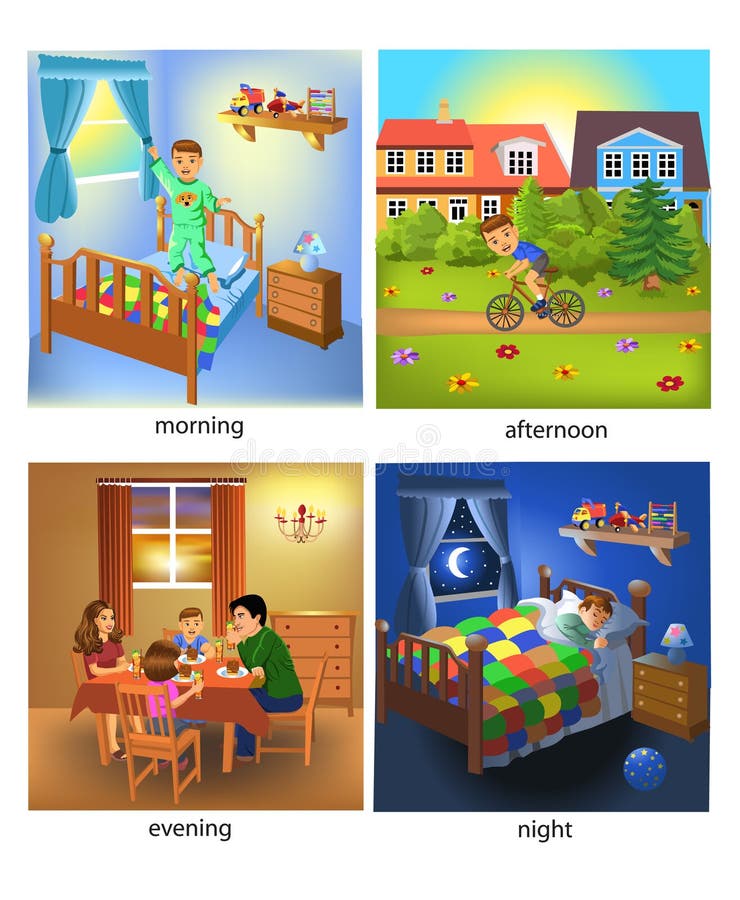
The conversion is simple and consistent. You just need to learn these four pairs:
| Noun (Что? - What?) | Adverb (Когда? - When?) | Translation |
|---|---|---|
| у́тро (OOT-ra) | у́тром (OOT-rom) | in the morning |
| день (dyen') | днём (dnyom) | in the afternoon / during the day |
| ве́чер (VYE-cher) | ве́чером (VYE-che-rom) | in the evening |
| ночь (noch') | но́чью (NOCH-yoo) | at night |
To see these words and hear their pronunciation, please study the following material.
My Day | Upper Elementary Russian Syllabus - aspirantum
The article 'My Day' from the Upper Elementary Russian Syllabus clearly lays out these time expressions.
Please read the section that starts with 'Когда?' (When?). It presents the four key pairs we've just discussed. Pay attention to the spelling and the example sentence provided: 'Утром я много сплю.' (In the morning, I sleep a lot).
To hear these words explained, the next video is very helpful. The presenter also introduces two very useful related words: ра́но (early) and по́здно (late).
Learn Time Expressions in Russian (Answering “when?”) | Boost your russian
This video from 'Russian in 7 minutes' clearly explains how to form these time expressions.
Watch the segment from 01:49 to 02:33. The speaker explains the 'утро -> утром' pattern. Don't worry about the grammatical term 'Instrumental case' she mentions; just focus on memorizing the word pairs. Note how she combines them to say 'рано утром' (early in the morning) and 'поздно вечером' (late in the evening).
2. Seeing Time Expressions in a Daily Routine
You might remember the video from our last lesson where a speaker described her entire day. Now that you know what to look for, let's watch it again. This time, your mission is to listen specifically for how and when she uses у́тром, днём, and ве́чером to structure her story.
How to Describe Your Day In Russian | Super Easy Russian 18
Let's revisit the 'How to Describe Your Day In Russian' video from Easy Russian. This time, focus on the time-of-day adverbs.
Watch the video from the beginning (00:07) to the end (08:03). Listen for the moments she says: 'утром' (in the morning) at the start. 'днём' (in the afternoon), which she uses when talking about work (around 04:02). 'вечером' (in the evening), which she uses when planning to go to a café (around 05:58). Notice how she places these words at the beginning of the sentence to set the scene.
As you saw, a very common way to structure a sentence is:
[Time Expression] + [Pronoun] + [Verb]
- У́тром я пью ко́фе. (In the morning, I drink coffee.)
- Днём я рабо́таю. (In the afternoon, I work.)
- Ве́чером я чита́ю. (In the evening, I read.)
3. Practice and Application
Now it's time to put this into practice.
Reading Practice
First, let's read a short text about a student named Pasha and his daily routine. This will help you see the time expressions used naturally in a paragraph.
My Day | Upper Elementary Russian Syllabus - aspirantum
In the same 'My Day' article we looked at earlier, there is a practice text about a student named Pasha.
Find 'Задание 2' (Task 2). Read the text about Pasha. As you read, identify all the time-of-day words. Then, try to answer the questions below the text: Когда Паша завтракает? Обедает? Ужинает? (When does Pasha have breakfast? Lunch? Dinner?) Что Паша делает днём? (What does Pasha do in the afternoon?) Когда Паша спит? (When does Pasha sleep?)
Your Turn to Describe Your Day
This is the most important step: applying this to your own life. Using the vocabulary from this lesson and the last, describe your own routine.
Look at Задание 1 in the "My Day" article. It provides prompts for you to create your own sentences.
- Утром...
- Днём...
- Вечером...
- Ночью...
Think about your own schedule, including your fitness activities. Try to write one simple sentence for each time of day. For example:
- Утром я бегаю. (In the morning, I run.)
- Днём я работаю в спортзале. (In the afternoon, I work at the gym.)
- Вечером я ужинаю с семьёй. (In the evening, I have dinner with family.)
- Ночью я сплю. (At night, I sleep.)
Try saying your sentences out loud. This will help you commit them to memory and feel more confident when you speak.
Key Takeaways
- To say when something happens, you use the adverbs
у́тром,днём,ве́чером, andно́чью. - These adverbs are usually placed at the beginning of a sentence to establish the time frame.
- You can add more detail with
ра́но(early) andпо́здно(late), for example:ра́но у́тром(early in the morning).
You can now describe your day with much more clarity and structure. Instead of just listing activities, you can organize them by the time of day, which is a big step toward sounding more natural in conversation.
In our next lesson, we will cover a very practical and necessary skill for any language learner: how to ask for clarification when you don't understand something, using phrases like Повтори́те, пожа́луйста (Repeat, please).