Welcome to the final module of your journey! You have come an incredibly long way, from Python fundamentals to deploying a scalable, monitored, multi-service application on AWS. You've built the technical foundation, and now it's time to bring everything together to build the capstone project and cultivate the professional mindset that will set you apart.
This first lesson of our final module shifts focus from how to build to what to build and why. In the startup world, and especially in a role like the one at Infilect, engineers are not just coders; they are partners in product development. This lesson directly addresses the job requirements of being able to "work with Product Managers" and having an "entrepreneurial mindset."
We will dive into the Agile framework that modern software teams use to translate high-level business goals into concrete, actionable work. You will learn how to take a broad product requirement, like the one for our capstone project, and systematically break it down into epics, user stories, and technical tasks. This process ensures that what you build is valuable, well-understood, and manageable.
1. The Hierarchy of Work: From Vision to Task
Imagine you're at a kickoff meeting for a new project. The Product Manager (PM) presents a big idea: "We need a system to analyze retail shelf images for our clients." As an engineer, your first thought shouldn't be "I'll start coding a Django model." It should be, "How do we break this massive idea into smaller pieces we can actually build and ship?"
This breakdown is often represented as a hierarchy. A large initiative is broken down into smaller and smaller pieces until you have tasks that a developer can complete in a day or two.
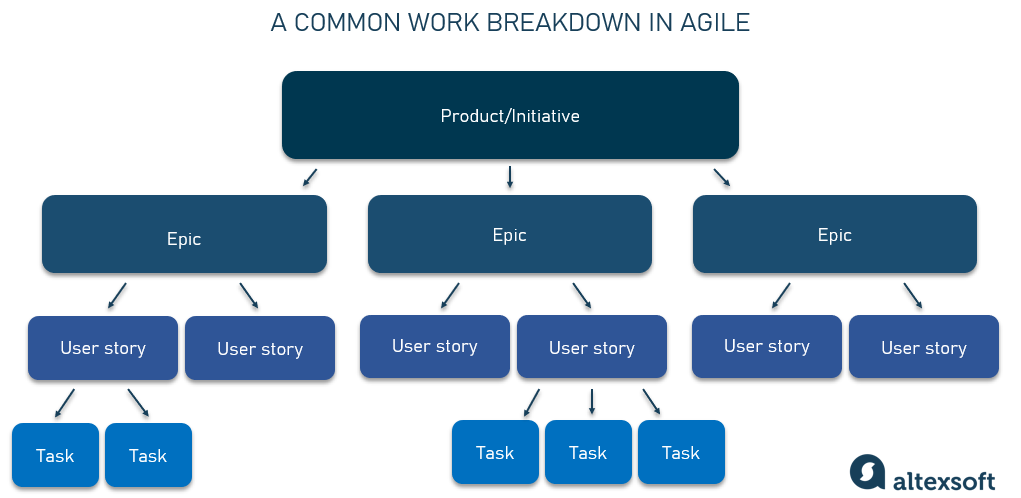
Let's define these terms. The following blog post provides an excellent, clear explanation of this hierarchy.
Epic vs. feature vs. user story vs. task: Understanding the differences | Plane Blog
This article from the Plane Blog offers a fantastic "zoom levels" analogy to understand how different work items relate to each other.
Please read the following sections to grasp the core definitions and their distinctions: Start with the mental model of the hierarchy. Read the definitions and examples for Epic, Feature, User story, and Task. Finally, review the comparison section and table, which provides a brilliant side-by-side summary of the key differences.
For a quick video summary of these concepts, the following explanation is very helpful.
Story vs Epic vs Task: What's the difference in Jira?
This video by Darcy DeClute provides a concise overview of epics, stories, and tasks, using a clear example.
Watch the full video, paying attention to how the speaker connects the product owner's vision to the developers' work. User Stories: Notice the format and how they focus on user benefit. Epics: Understand that an epic is just a large container for multiple stories. Tasks: See how stories are broken down into technical implementation steps.
2. Crafting Effective User Stories
Knowing the definition of a user story is one thing; writing a good one is a skill. A well-written user story is the cornerstone of communication between product managers and engineers. It ensures everyone is aligned on the who, what, and why before any code is written.

As you can see from the cheat sheet, a great user story follows the I.N.V.E.S.T. acronym:
- Independent: Can be developed and delivered on its own.
- Negotiable: It's a starting point for a conversation, not a fixed contract.
- Valuable: It delivers tangible value to an end-user.
- Estimable: The team can roughly size the effort required.
- Small: Small enough to be completed within a single sprint (typically a few days to 2 weeks).
- Testable: There are clear criteria to confirm when it's "done."
Often, a story is too big to fit in a sprint. The skill then becomes about splitting the story into smaller, valuable pieces. The video below provides excellent practical techniques for doing just that.
Split User Stories Techniques: Learn how to split Agile User Stories
"The Agile Scrum Channel" offers a masterclass in splitting user stories. As an engineer, understanding these patterns helps you suggest intelligent ways to break down work to deliver value faster.
First, watch the introduction to what makes a good user story, which covers the INVEST criteria. Then, skim through the different splitting techniques. Pay special attention to these three, as they are highly relevant for backend development: Split by workflows: (e.g., create account vs. change profile picture). Split by business rules: (e.g., validate payment first, then validate basket contents). Split by CRUD operations: (e.g., deliver the ability to 'Create' and 'Read' recipes first, and add 'Update' and 'Delete' later).
3. The Backend Engineer's Role in Defining API Stories
As a backend engineer, your most direct interaction with user stories will often be for APIs. While a PM might write a story like, "As a user, I want to see my profile information," you are responsible for the API that delivers that information.
This is where you collaborate to define the technical details. A well-defined API story includes more than just the "As a..., I want..., so that..." format. It includes details about the API contract.
This next resource is targeted at Business Analysts, but its content is precisely what a backend engineer needs to understand and contribute to when discussing requirements with a Product Manager.
Writing Effective User Stories for API Creation: A Guide for Business ...
This guide provides a structured approach to defining user stories specifically for APIs, which will be the core of your capstone project.
Read section 2, "Structure of an API User Story". Focus on these key components that you, as the backend engineer, would help define: Sequence Diagram: Visualizing how your API interacts with other services. API Contract: Defining the endpoint URL, method, request/response structure, and status codes. This is where your knowledge of DRF and API design is critical. Data Mapping: Specifying where the data for the API response comes from (which database tables and columns). Acceptance Criteria: Writing clear, testable conditions using the "Given-When-Then" format. This is how you confirm your API works correctly.
4. Hands-On Task: Plan Your Capstone Project
Now, let's apply these concepts. Your task is to take the high-level requirement for our capstone project and break it down into an epic, user stories, and technical tasks for one of those stories.
Product Requirement:
Build a "Retail Shelf Intelligence Backend." The system should allow product shelf images to be uploaded. These images will be processed by an asynchronous, simulated ML model. The system needs a workflow for managing dataset annotations and must provide REST APIs to serve key performance indicators (KPIs) per outlet/product.
Your Goal: Create a planning document (a simple text or Markdown file) that outlines the work for this project.
Instructions:
-
Define the Epic:
- Write a single epic that represents the entire capstone project. It should be a high-level title for the whole initiative.
- Example: "Implement the Retail Shelf Intelligence Backend Platform."
-
Decompose into User Stories:
- Think about the different users of this system (e.g., a
Data Operatorwho uploads and annotates images, anAnalystwho consumes the data). - Write at least four user stories in the "As a..., I want..., so that..." format.
- Here are some ideas for features to cover:
- Uploading an image.
- Checking the processing status of an uploaded image.
- Assigning an image to an annotator.
- Retrieving analytics for a specific retail outlet.
- Think about the different users of this system (e.g., a
-
Break a Story into Technical Tasks:
- Choose one of your user stories, preferably the one about uploading an image.
- Now, put on your backend engineer hat. Break that story down into the specific technical tasks required to implement it. These should be a list of concrete actions.
- Think about the stack you've learned. What needs to happen in Django, DRF, Celery, and AWS?
- Example Tasks for "As a data operator, I want to upload a shelf image, so it can be queued for analysis":
- Define a Django model
Imagewith fields likeimage_file,status,uploaded_at. - Create a DRF
ModelSerializerfor theImagemodel. - Implement a DRF
APIVieworViewSetwith an endpointPOST /api/images/. - Configure
boto3and Django settings to store uploaded files in your S3 bucket. - In the view logic, after saving the image instance, trigger a Celery task
process_image(image_id). - Write unit tests for the upload endpoint, covering success and failure cases (e.g., invalid file type).
- Define a Django model
This exercise in planning is the most important first step of any complex project. It forces clarity, exposes assumptions, and creates a clear roadmap for development.
Conclusion
Congratulations on completing this crucial planning lesson! You've stepped into the shoes of a senior developer or tech lead, translating a business need into a structured, actionable engineering plan. This ability to bridge the gap between product vision and technical execution is a highly valued skill.
Here are the key takeaways:
- Agile Hierarchy: Big ideas are broken down from Epics (large initiatives) to User Stories (user-centric features) and finally to Technical Tasks (developer work items).
- Effective User Stories: Good stories are user-focused, deliver value, and adhere to the INVEST criteria, making them small and testable.
- Engineer's Role: You are a key collaborator in refining stories, especially for APIs, by defining the API contract, data mappings, and concrete acceptance criteria.
You now have a preliminary plan for your capstone project. In our next lesson, we will put this plan into action. You'll start building the "Retail Shelf Intelligence Backend" by setting up the new Django project, creating the core models, and implementing the very image upload API you just planned.