Introduction
In our previous lessons, we built up the skills to create and defend a Principal-level design document. A critical part of that process, especially during a design review, is handling feedback that a particular part of your proposed system is too complex, monolithic, or not well-understood. The ability to take that feedback—or, more proactively, to start with a complex, ambiguous problem and break it down from the beginning—is a hallmark of a senior technical leader.
This lesson focuses on that exact skill: how to deconstruct a complex, ambiguous problem into a series of well-scoped technical components and interfaces. This isn't just about drawing boxes and lines; it's a strategic process of identifying the right "seams" in a system to manage complexity, enable parallelism in development, and build for future evolution. This is the foundational act of architecture.
For a Principal Engineer, this is where technical vision begins to take concrete form. You are given a vague business goal or a sprawling technical challenge, and your first job is to impose structure on it.
The Inevitability of Decomposition
At a certain scale, decomposition isn't a choice; it's a necessity. Systems that grow organically without deliberate partitioning eventually collapse under their own weight. The evolution of nearly every large-scale internet company tells this story.
Large-Scale Architecture: The Unreasonable Effectiveness of Simplicity • Randy Shoup • YOW! 2022
To set the stage, let's watch a segment from Randy Shoup's talk, "The Unreasonable Effectiveness of Simplicity." He recounts the architectural journeys of eBay and Amazon, which provide a compelling narrative for why decomposition is inevitable.
Watch the opening stories from the beginning. As you watch, consider the forces that pushed these companies from their initial monolithic architectures toward service-oriented ones. It wasn't an academic exercise; it was a response to tangible engineering pain: compiler limits, memory leaks, and an inability to release features quickly.
As the stories of eBay's 3.4-million-line C++ DLL and Amazon's obedos monolith illustrate, a single, tightly-coupled codebase eventually becomes a bottleneck to scaling both the system and the organization. The process of breaking these systems apart was fundamental to their continued growth. Our goal is to learn how to do this deliberately, rather than being forced into it by a crisis.
The Forces That Shape Boundaries
Decomposition is the process of drawing boundaries. But where do we draw the lines? The answer is found by analyzing a set of competing forces. A masterful architect understands these forces and makes conscious trade-offs between them.
The Art of Drawing Boundaries: Mastering Decomposition ... - Medium
The article "The Art of Drawing Boundaries" provides an excellent framework for understanding the forces that guide decomposition.
Please read the introduction and the first two major sections: "Software architecture..." through "Technical and Organizational Constraints". As you read, focus on the three primary drivers of decomposition: Domain Functionality: How business capabilities shape boundaries. Quality Attributes: How non-functional requirements like performance and security pull and push on those boundaries. Constraints: How teams and technology dictate the art of the possible.
Let's synthesize these forces:
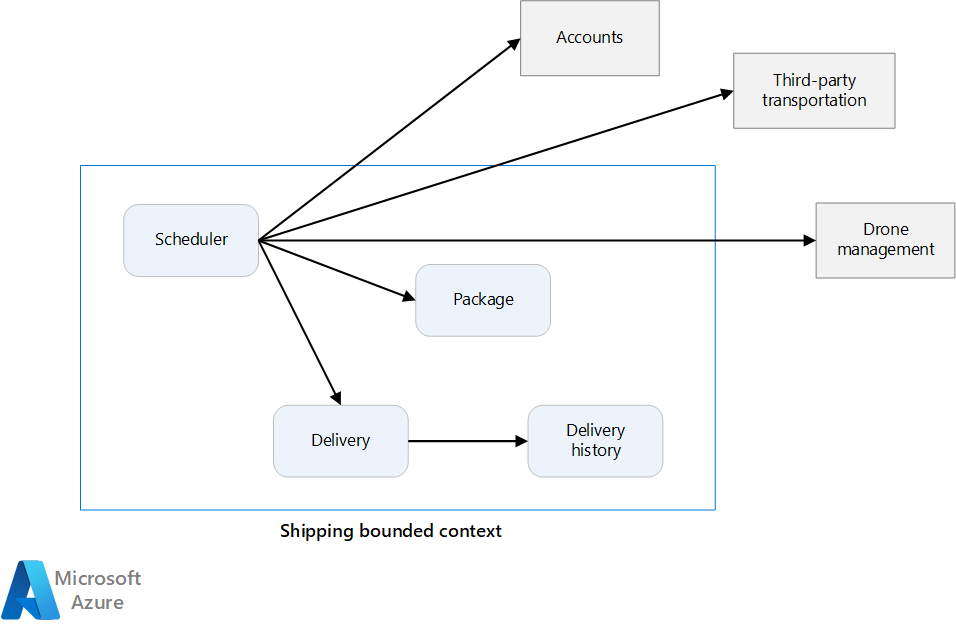
- Domain-Driven Boundaries (The "Business" Seams): This is often the most powerful starting point. Domain-Driven Design (DDD) provides a formal methodology for this, identifying "Bounded Contexts." A bounded context is a clear boundary within which a specific domain model applies. For an e-commerce platform,
Inventory,Pricing,Shipping, andUser Accountsare natural bounded contexts. Aligning your components to these business capabilities creates systems that are easier to understand, organize teams around, and evolve as the business changes.
-
Quality Attribute-Driven Boundaries (The "Technical" Seams): Non-functional requirements (NFRs) often create tension with pure domain boundaries.
- Scalability: A
User Profileservice might need to be split into aHot Profile(frequently accessed data like name/avatar) andCold Profile(infrequently accessed data like signup date) to scale the hot path independently. - Security: A
Paymentsdomain might be split intoPayment Instrument Management(handling sensitive credit card data) andTransaction Processingto apply stricter security controls to one part. - Performance: A
Recommendationsservice and aProduct Catalogservice might be merged, despite being separate domains, to avoid network latency if generating recommendations requires massive, low-latency lookups into the product data.
- Scalability: A
-
Constraint-Driven Boundaries (The "Pragmatic" Seams):
- Conway's Law: Your architecture will tend to mirror your organization's communication structure. If you have separate
Frontend,Backend, andSREteams, you're likely to develop boundaries between those layers. A Principal Engineer must be aware of this and either leverage it or work to change the organization to enable a better architecture. - Technology: If one part of a problem is best solved with a Python/ML stack and another with a Go-based real-time system, this technological difference creates a natural boundary.
- Conway's Law: Your architecture will tend to mirror your organization's communication structure. If you have separate
Deconstructing a problem begins with analyzing these forces. You might start with the domain, then adjust the boundaries based on critical NFRs, and finally make pragmatic compromises based on your team structure and tech stack.
Guiding Principles for Good Boundaries
Once you have a candidate decomposition, how do you evaluate if the boundaries are "good"? We use a set of timeless software design principles.
The Art of Drawing Boundaries: Mastering Decomposition ... - Medium
Let's continue with the same article, focusing on the principles used to evaluate boundaries.
Please read the sections "Additional Decomposition Drivers" through "Information Hiding and Interface Design". Pay close attention to the definitions of cohesion and coupling.
Here are the two most important principles:
-
High Cohesion, Low Coupling:
- High Cohesion: The elements inside a single component should be strongly related and focused on a single purpose. A component that manages
Users,Permissions, andLogin Sessionshas high cohesion. A component that managesUsersandProduct Pricinghas low cohesion. - Low Coupling: Components should be independent of each other. Changes in one component should not require changes in another. Communication should happen through stable, well-defined interfaces, without exposing internal implementation details.
- High Cohesion: The elements inside a single component should be strongly related and focused on a single purpose. A component that manages
-
The Dependency Rule & Information Hiding:
- A powerful way to achieve low coupling is to ensure dependencies point toward stability. Core business logic (e.g., how a trade is settled) is more stable than implementation details (e.g., which database or messaging queue is used). Therefore, your business logic components should not depend on your infrastructure components. This is the essence of patterns like Hexagonal Architecture or Clean Architecture.
- Interfaces are the tools that enforce this. A good interface hides the implementation details of a component and exposes only the contract needed by its consumers. This contract includes not just synchronous APIs (like gRPC/REST) but also the events a service produces or consumes.
These principles aren't just academic. A "distributed monolith" is the anti-pattern that results from ignoring them: services that are deployed separately but are so tightly coupled (e.g., through a shared database or chatty synchronous calls) that they can't be changed or scaled independently.
Deconstruction in Practice: Inverting Complexity
One of the most powerful techniques for deconstructing complex workflows in distributed systems is to transform a deep, synchronous call chain into an asynchronous, event-driven flow. This inherently creates loosely coupled components.
Large-Scale Architecture: The Unreasonable Effectiveness of Simplicity • Randy Shoup • YOW! 2022
Randy Shoup's talk provides a brilliant, real-world case study of this technique in action. He first describes the patterns and then shows how Walmart used them to re-architect a critical, highly complex system.
Please watch the following segments: First, understand the tools: watch the section on simple interactions, which covers event-driven models, immutable logs, and embracing asynchrony. Next, see how these tools solve common distributed problems. Watch the segment on handling shared data, joins, and transactions using sagas and materialized views. Finally, watch the Walmart case study. This is a perfect example of deconstructing a complex synchronous problem into a simple, resilient, asynchronous solution.
The Walmart "item availability" system is the quintessential example of this lesson's outcome.
- The Complex, Ambiguous Problem: Answer the question: "Is this item available to ship to this customer?" This simple question involved 23 nested synchronous service calls, creating a fragile and expensive system.
- The Deconstruction: The team inverted the architecture. Instead of a client triggering a deep call graph to pull information, the sources of truth at the bottom of the graph push changes as events.
- A warehouse inventory change publishes an
InventoryUpdatedevent. - A logistics service consumes this, calculates new shipping estimates, and publishes a
ShippingEstimateUpdatedevent. - Services higher up the chain consume these events and maintain their own local, pre-calculated "materialized views" of the data they need.
- A warehouse inventory change publishes an
- The Result: The synchronous "hot path" for answering the customer's query was reduced from 23 services to just two. The system became massively more resilient, cheaper, and simpler to reason about. Each service became a well-scoped component with an event-based interface.
This pattern—decomposing a complex synchronous workflow into a saga or an event-driven data flow—is one of the most important tools in a distributed systems architect's toolkit.
A Framework for Action
So, when faced with an ambiguous problem, how do you methodically proceed? Whether in an interview or on the job, a structured approach is essential.
Palantir Decomposition Interview Process, Interview Questions and Tips
This short video on the Palantir Decomposition Interview provides a simple, effective framework for tackling ambiguous problems.
Watch the entire video, which is quite short. Focus on the five-step process described from the recommended approach. Then, consider the sample problem about taxi data.
Let's adapt that framework for our purposes:
- Clarify and Scope: Start by asking questions to understand the goals and constraints. What is the business objective? What are the key non-functional requirements (scale, latency, availability)? Use the example taxi data problem: "A solution that can be developed and deployed in one week" is a critical constraint that dramatically shapes the decomposition. You might choose a modular monolith over microservices. "Beneficial for taxi drivers" implies user-facing features.
- Identify Core Capabilities (Top-Down): Brainstorm the major business capabilities needed. For the taxi problem, this might be
Trip Ingestion,Fare Calculation,Driver Analytics/Dashboard, andPassenger Insights. These are your initial candidate components. - Define Components and Interfaces (Bottom-Up): For each capability, define the component and its interface.
Trip Ingestion Service: Exposes an API endpoint to receive trip data. Internally, it validates and stores the raw data. It publishes aNewTripRecordedevent.Fare Calculation Service: ConsumesNewTripRecordedevents. It might call an externalGeoServiceto calculate surge pricing zones. It publishes aTripFareCalculatedevent.Driver Analytics Service: ConsumesTripFareCalculatedevents. It maintains materialized views of a driver's daily earnings. It exposes an API for the driver dashboard.
- Iterate and Refine: Review the decomposition. Is there tight coupling? Is the cohesion low in any component? Are you meeting the NFRs? Maybe
Fare CalculationandTrip Ingestionshould be merged for simplicity given the one-week deadline. - Document: The result of this process is the core of your design document. You've identified the components (the boxes) and their interfaces (the lines), which can be captured in a system-context diagram and API/event definitions.
Conclusion
The ability to deconstruct a complex, ambiguous problem into well-scoped components is not a mechanical task but a strategic one. It requires a deep understanding of the business domain, technical trade-offs, and even organizational dynamics. By mastering this skill, you move from being an implementer of systems to being their architect.
Here are the key takeaways:
- Decomposition is driven by forces: Business domains, quality attributes, and real-world constraints all pull and push on where you draw boundaries.
- Good boundaries have high cohesion and low coupling: This makes components easier to understand, maintain, and scale independently.
- Invert synchronous complexity: Transforming deep, synchronous call graphs into asynchronous, event-driven data flows is a powerful pattern for building resilient and scalable systems.
- Follow a structured process: Start by clarifying the problem, then identify high-level capabilities, define components and interfaces, and iterate.
This lesson concludes our module on "The Craft of Principal-Level Design." You now have a framework for conceiving an architecture, documenting it, defending it, and breaking it down into buildable parts.
Our final module, "Technical Strategy & Leadership," will build directly on this foundation. In the next lesson, we will learn how to analyze business requirements and technology trends to inform a platform's technical vision. We'll zoom out from designing a single system to setting the technical direction for an entire organization over a multi-year horizon.