Introduction
In our previous lesson, we established the crucial first step in strategic leadership: analyzing business needs and technology trends to formulate a compelling technical vision. That vision acts as your organization's North Star—the destination you are steering towards. Now, with the destination set, we turn to the practical challenge of charting the course.
This lesson directly addresses the learning outcome: Structure a multi-year technical roadmap by breaking a vision into phased initiatives and milestones. We will bridge the critical gap between high-level strategy and concrete execution. You will learn to translate an ambitious, multi-year vision into a coherent, actionable roadmap that guides engineering efforts, aligns teams, and delivers measurable progress. This is the mechanism by which a Principal Engineer transforms vision into reality.
A Roadmap is Strategy, Not a Plan
Before we start building, it's vital to clarify what a roadmap is and, more importantly, what it isn't. A common pitfall is to create a detailed, multi-year project plan and call it a roadmap. This conflates planning with strategy, leading to documents that are rigid, quickly outdated, and fail to communicate the "why." A true roadmap is an artifact of strategy.
To internalize this distinction, let's watch this classic explanation by Roger Martin from the Harvard Business Review. He argues that most "strategic planning" is just planning—a list of activities—and lacks a true strategic core.
Watch these key segments: First, understand the core argument in this section, where he distinguishes a list of activities from a coherent strategy. Next, listen to his explanation of why planning feels comfortable (you control costs) while strategy feels uncertain (you don't control customers/outcomes) from this segment. See how this plays out in the real world with the powerful Southwest Airlines example, which illustrates a coherent set of choices that constitute a winning strategy. Finally, absorb his advice on how to start thinking strategically by laying out your logic and accepting uncertainty.
As Martin explains, a strategy is an "integrative set of choices that positions you...in a way that you win." A technology roadmap is the document that articulates these choices over time. It is not a list of features or tasks.
How to craft a realistic technology roadmap - LeadDev
This LeadDev article provides a practical definition tailored for engineering leaders. It sharpens the distinction between roadmaps and plans.
Please read the introduction up to the end of the section "A roadmap is not a plan." Pay close attention to the differentiation between product and technology roadmaps and the central idea that a roadmap outlines the "why," "what," and "when" of the "big rocks," not the "individual pebbles" of a detailed plan.
To make this concrete, here is a visual representation of a well-structured roadmap.
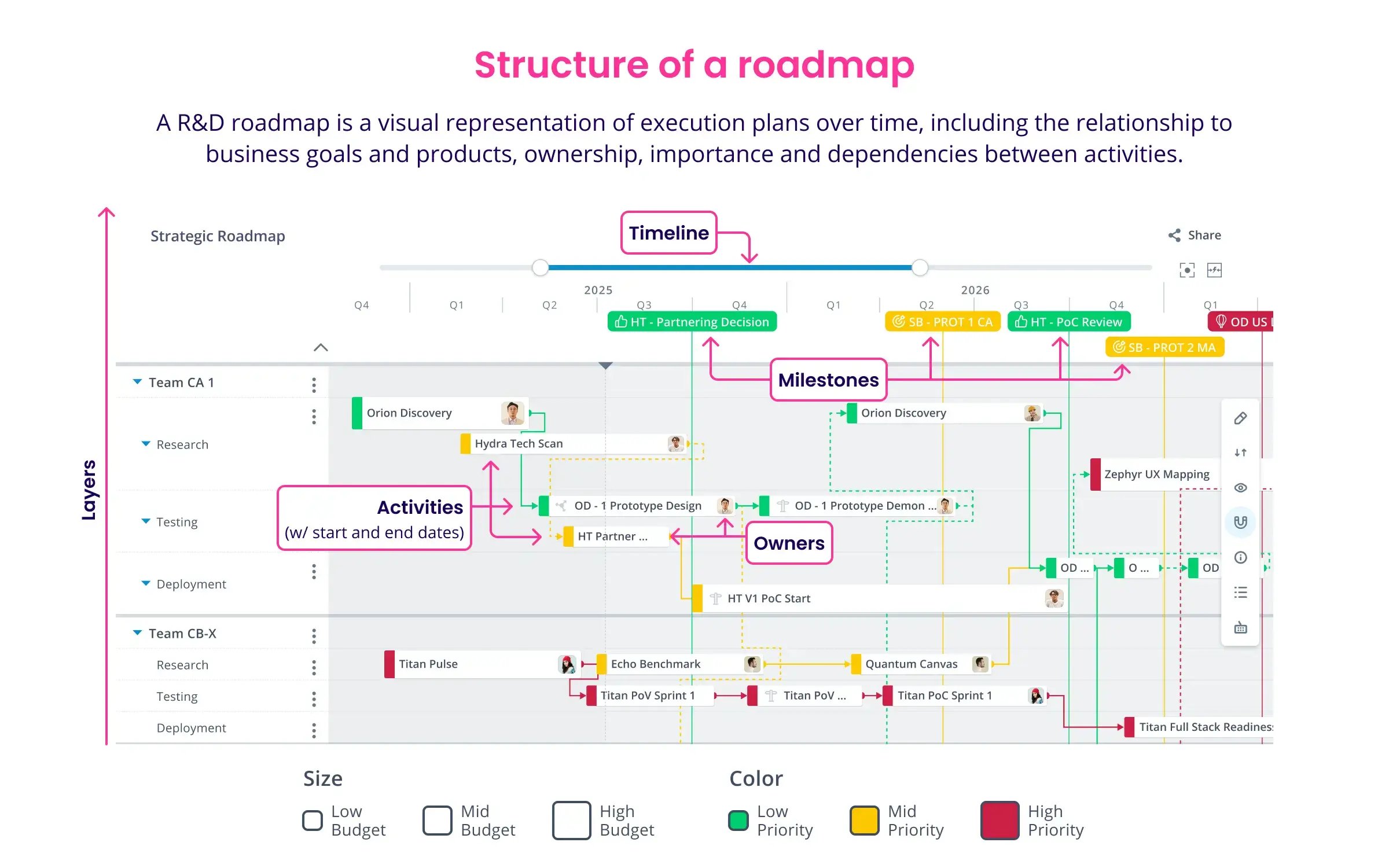
This is our target format: a strategic document that communicates intent, sequence, and dependencies without being a brittle, low-level plan.
The "Golden Thread": Decomposing the Vision
The hardest part of roadmapping is translating a grand vision statement (e.g., "Enable developer self-service to achieve 10x productivity") into the "big rocks" or initiatives you see on a roadmap. Simply brainstorming a list of projects often leads to a disconnected set of activities. A more systematic approach is needed to create what is often called a "golden thread" from strategy to execution.
This involves identifying the core capabilities your organization must build or enhance to make the vision a reality. Capabilities are durable, high-level abilities, such as "Automated Canary Deployments," "Real-time Cost Attribution," or "Customer Identity Management." They are the bridge between what the business wants to do (the vision) and the work required to do it.
From Vision to Execution: Mastering Strategy with Business Architecture | Whynde Kuehn EA Forum 2024
This presentation by Whynde Kuehn on business architecture provides an excellent model for this process. While it uses the term "business architecture," the concepts are directly applicable to technical strategy.
Watch the segment from this part of the video, where she introduces the idea of the "golden thread." Focus on how she inserts a "Stage 2" (architecting the change) between the big ideas and the list of initiatives. This stage is all about identifying the impacted capabilities and value streams. Then, watch the real-world example from a Fortune 500 company. Notice how they organize their strategic roadmap and even their teams around maturing specific capabilities over time. This is a very mature, Principal-level way to structure strategic work.
Let's apply this. Imagine your vision is: "Our platform will be so reliable and efficient that it becomes a competitive advantage, enabling new product lines that are currently infeasible."
Instead of jumping to projects like "Migrate to Kubernetes" or "Adopt Istio," you first decompose the vision into the underlying capabilities required:
- Capability 1: Proactive Failure Detection. The ability to identify and mitigate issues before they cause user-impact.
- Capability 2: Multi-Region Active-Active Resiliency. The ability to serve traffic from multiple regions simultaneously and survive a full regional outage without downtime.
- Capability 3: Fine-Grained Resource Isolation. The ability to prevent "noisy neighbors" from impacting other tenants in a multi-tenant system.
- Capability 4: Automated Capacity Management. The ability to scale resources predictively based on business forecasts, not just reactively.
These capabilities now become the organizing themes for your roadmap. The initiatives you define will be projects aimed at creating or maturing these capabilities. For example, under "Proactive Failure Detection," you might have initiatives like "Implement a Phi Accrual Failure Detector" and "Build a Chaos Engineering Framework."
Structuring the Roadmap: Themes, Phases, and Fidelity
With your vision broken down into capability-driven initiatives, the next step is to structure them across a multi-year timeline.

Here are the key best practices for structuring the roadmap itself, drawing from our earlier reading.
How to craft a realistic technology roadmap - LeadDev
Let's revisit the LeadDev article to extract actionable best practices for structuring the roadmap.
Read the section "Best practices for developing a solid technical roadmap." Focus on the principles of ruthless prioritization, building in flexibility, and proactively managing technical debt.
Applying these principles, a good multi-year roadmap is structured with:
-
Thematic Phasing: Instead of a flat list of projects, group initiatives into themes that tell a story. This communicates the strategic intent for each phase.
- Year 1: Foundational Stability. Focus on initiatives that reduce outages and pay down critical tech debt (e.g., improve resiliency, enhance core monitoring).
- Year 2: Developer Velocity. With a stable foundation, shift focus to initiatives that accelerate development (e.g., build CI/CD platform, streamline environment provisioning).
- Year 3: Intelligent Optimization. Leverage the stable, fast platform to build advanced capabilities (e.g., automated cost optimization, AIOps).
-
Variable Fidelity: Acknowledge that the future is uncertain. Your roadmap should reflect this with decreasing levels of detail over time.
- 0-6 Months (The Quarter): High fidelity. Initiatives are well-defined, broken into epics, with clear team ownership and quarterly goals (OKRs).
- 6-18 Months (The Year): Medium fidelity. Initiatives are defined at a high level. The goal is to secure alignment and budget, not to have a detailed project plan. Dependencies are identified.
- 18-36 Months (The Vision): Low fidelity. Expressed as strategic goals or themes. This part of the roadmap signals long-term direction and influences major architectural decisions made today.
-
Explicit Trade-offs: The roadmap is where you make choices. Clearly state what you are not doing. A theme of "Foundational Stability" implies you are intentionally deprioritizing some new feature work. This manages stakeholder expectations and defends the strategy.
The Principal Engineer's Role: Owner, Sponsor, Consultant
Creating the roadmap document is only the beginning. A Principal Engineer's primary job is to drive the outcomes it describes. A useful mental model for your engagement with various initiatives on the roadmap is to classify your role.
Advice for New Principal Tech ICs (i.e., Notes to Myself)
Eugene Yan's excellent collection of advice for new Principal Engineers provides a powerful framework for thinking about your role in executing a large-scale strategy.
Read point #28, which outlines the "owner, sponsor, consultant" model. This is a practical way to manage your time and impact across a broad portfolio of work. Also, re-read point #27 before it, on autonomy and accountability, which is the context for this model.
Applying this to your roadmap:
- Owner: You personally lead the design and execution of 1-2 of the most critical, complex, or ambiguous initiatives on the roadmap. This is likely a major architectural evolution that no one else is equipped to lead. You are "borderline obsessed" with its success.
- Sponsor: You champion 2-3 other important initiatives led by other teams. You aren't in the weeds, but you use your influence to unblock them, build alignment across teams, review their high-level designs, and advocate for their importance to leadership.
- Consultant: For the remaining initiatives, you act as a trusted advisor. You participate in design reviews, offer guidance based on your broad context, and ensure the work aligns with the overall vision, but you are not driving it day-to-day.
This framework allows you to scale your impact across the entire multi-year roadmap, driving some parts, influencing others, and guiding the rest.
Conclusion
You have now learned how to translate an abstract vision into a concrete, multi-year technical roadmap. This process is a cornerstone of the Principal Engineer role, moving you from an implementer of strategy to a creator and driver of it.
Here are your key takeaways:
- A Roadmap is a Strategic Artifact: It communicates the "why," "what," and "when" of your most important technological choices, distinct from a tactical plan that details the "how."
- Use Capabilities as the "Golden Thread": Decompose your vision into the core capabilities needed to achieve it. These capabilities become the organizing principle for your roadmap's initiatives.
- Structure with Themes and Variable Fidelity: Group initiatives into narrative themes across a multi-year horizon. Decrease the level of detail for future phases to embrace uncertainty and maintain flexibility.
- Define Your Role: As a Principal Engineer, you drive the roadmap by acting as an Owner, Sponsor, or Consultant for its various initiatives, scaling your influence across the organization.
In our next lesson, we will zoom in on a single initiative from our new roadmap and ask a critical question: should we build it, buy a commercial solution, or adopt an open-source project? We will explore how to create a framework for evaluating build versus buy versus adopt decisions for infrastructure components, adding another crucial tool to your strategic toolkit.