Introduction
In our previous lesson, we explored how to design systems for graceful evolution, focusing on migration strategies like the Strangler Fig pattern and learning from Google's GFS-to-Colossus journey. We established that a successful architecture is not static but must adapt and grow over time. However, even the most evolvable system is vulnerable if it's not built on a foundation of trust and resilience. This brings us to the core of today's lesson.
We will now turn our attention to how you can analyze and mitigate cross-cutting technical risks, specifically focusing on security, data privacy, and disaster recovery. These are not features to be added but fundamental properties of a well-designed system. For a Principal Engineer, thinking about these risks from the outset is non-negotiable. It is what separates a functional design from a robust, trustworthy, and production-ready one. We will explore how to build security from first principles, examine its implementation at Google's scale, and then broaden our definition of risk to include large-scale outages and disaster scenarios.
Security by Design: The Primacy of Understandability
The foundation of a secure system is not a complex web of defenses, but rather its opposite: simplicity and understandability. Complexity is the enemy of security. If you cannot reason confidently about your system's behavior, you cannot secure it. This principle is central to how Google approaches building secure and reliable systems.
To formalize this, we think in terms of system invariants: properties that must always hold true, regardless of external inputs or internal state changes. For example, "only an authenticated user can access their own data" is a security invariant. A vulnerability is simply a scenario where an invariant is violated.
Chapter 6: Building Secure and Reliable Systems
To build our foundational understanding, let's turn to Chapter 6 of Google's book, Building Secure and Reliable Systems. This chapter articulates the deep connection between a system's design and its security posture.
Please read the following sections: Start with the introduction to see why understandability is a prerequisite for security. Next, read the definition and examples of System Invariants. This gives us a precise language for defining security goals. Finally, read the section on Mental Models. This explains why complexity is so damaging—it breaks the mental models engineers rely on to reason about the system, especially under unusual conditions like an attack.
With this foundation, how do we design systems that are understandable and therefore securable? The key lies in architecture. We must actively manage complexity by creating clear boundaries.
Architectural Patterns for Security
The most powerful tools for managing complexity are architectural. By decomposing a system and defining strong interfaces, we can reason about its security properties in a modular way. This leads us to the concept of the Trusted Computing Base (TCB): the set of components whose correct functioning is sufficient to enforce a security policy. A core principle of secure design is to make the TCB for any given policy as small as possible.
Chapter 6: Building Secure and Reliable Systems
Let's continue in the same chapter to explore the architectural patterns that enable security. We'll focus on how decomposition and well-defined boundaries help shrink the TCB.
Please read these two sections: First, review the section on Breaking Down Complexity. This connects the idea of understandability to component-based architecture. Next, read the entire section on Security Boundaries. Pay close attention to the widget-selling application example. It perfectly illustrates how moving from a monolith to a microservices architecture dramatically shrinks the TCB for sensitive data, thereby reducing the "blast radius" of a vulnerability in a less-sensitive component.
The widget-selling example shows that a vulnerability in the product catalog service of a monolith could compromise user payment data. By splitting the system into microservices with their own databases and strong API boundaries, the catalog service is no longer part of the TCB for payment information. This is a profound architectural shift that enhances security without adding complex security "features."
A Layered Defense: Google's Infrastructure Security
The principles of understandability, small TCBs, and strong boundaries are not just theoretical. They form the basis of Google's own infrastructure security. Google's approach is to build security in progressive layers, from the physical hardware up to the application framework.

This layered model implements a zero-trust philosophy: no component or user is trusted by default, whether inside or outside the network. Trust must be established and continuously verified.
Google Infrastructure Security Design Overview
This whitepaper provides a high-level overview of how the principles we've discussed are put into practice at Google. It's a valuable look into a mature, at-scale security architecture.
Focus on these two key areas: Read the section titled Service identity, integrity, and isolation. This describes how Google implements a zero-trust model using cryptographic service identities (via ALTS), strong isolation, and sandboxing. This is the practical implementation of the "Security Boundaries" concept. Then, jump to the "Operational Security" section and read the part on Reducing insider risk. This is a critical cross-cutting concern for any Principal Engineer, as it involves both technical controls (e.g., automation, limited APIs) and process controls (e.g., two-party approvals).
Data Privacy and Lifecycle Management
A critical aspect of security and a major cross-cutting risk is data privacy. This goes beyond just preventing unauthorized access; it also involves managing the entire lifecycle of data, especially its secure deletion. For a user, "deleting" their data means it should be gone forever. In a complex, replicated, and backed-up distributed system, ensuring this is a significant engineering challenge.
Google Infrastructure Security Design Overview
The same whitepaper has a concise section on data deletion that outlines the high-level process.
Please read the short section titled Deletion of data. Notice the strategy of first marking data for deletion, which provides a recovery window for accidental deletions, before the actual cryptographic or physical destruction occurs.
This multi-stage process provides a clear mental model for this complex operation.
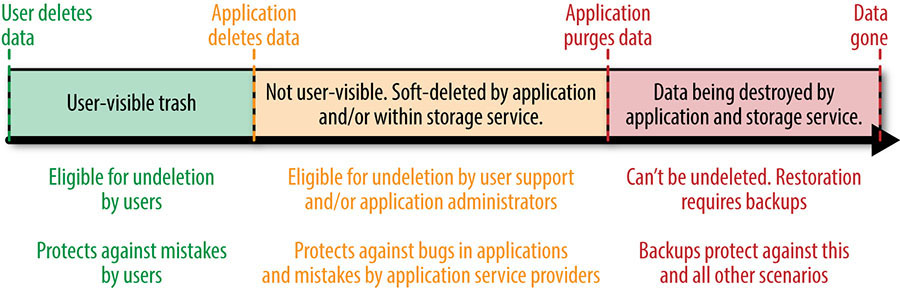
Beyond Security: Designing for Disaster Recovery
Our discussion of risk so far has focused on confidentiality and integrity. But another critical risk is availability in the face of large-scale disasters, such as a data center or regional outage. This is the domain of Disaster Recovery (DR). A Principal Engineer's design must account for what happens when entire parts of the infrastructure disappear.
The two most important metrics in any DR plan are:
- Recovery Time Objective (RTO): How quickly must the service be restored after a disaster? (e.g., 1 hour)
- Recovery Point Objective (RPO): How much data loss is acceptable? (e.g., 5 minutes of transactions)
These business-driven metrics dictate the technical strategy you must adopt.
🔥 The Ultimate Guide to Disaster Recovery: RTO, RPO, & Failover!
This video provides an excellent, concise overview of the core concepts and strategies in Disaster Recovery.
Please watch the following two segments: First, watch the explanation of RTO and RPO. These are the fundamental terms you'll use to discuss DR with business stakeholders. Next, watch the overview of the four main DR strategies: Backup and Restore, Pilot Light, Warm Standby, and Hot Standby (Active-Active). Pay attention to the trade-offs between cost and recovery time for each.
Choosing a DR strategy is a classic engineering trade-off. An active-active setup offers near-zero RTO/RPO but is the most expensive, as it effectively doubles your infrastructure cost. A simple backup-and-restore is cheap but may have an RTO of hours or days.
At Google, the philosophy of designing for failure is deeply ingrained. A common rule of thumb for capacity planning and redundancy is the N+2 rule.
SREcon19 Americas - SRE Classroom - How to Design a Distributed System in 3 Hours
This clip from an SREcon talk gives a glimpse into the SRE mindset at Google, where failure is not an option, but a certainty.
Watch the segment from N+2 redundancy. The speaker explains the rationale: if it takes N capacity to serve peak load, you run N+2. One unit of spare capacity is for planned maintenance (like a data center drain), and the other is for unplanned failures (like the proverbial backhoe). This is a concrete DR strategy implemented through capacity planning.
The N+2 model ensures that the system can lose an entire redundancy unit for planned reasons and another for unplanned reasons and still continue to operate without being overloaded. This is a powerful, though expensive, way to build resilience against large-scale failures.
Conclusion
Today, we've navigated three critical, cross-cutting risks that are paramount in any large-scale system design: security, data privacy, and disaster recovery. As a Principal Engineer, you are responsible for ensuring that the systems you design are not just functional and scalable, but also fundamentally trustworthy and resilient.
Here are the key takeaways:
- Security Starts with Understandability: The most secure systems are those that are simple enough to be reasoned about. Use architectural patterns like modularity and microservices to create strong security boundaries and minimize your Trusted Computing Base (TCB).
- Defense in Depth is Key: A mature security posture, like Google's, uses a layered approach. It applies a zero-trust model where trust is never assumed and security is enforced from the hardware up to the application layer.
- Manage the Full Data Lifecycle: True data privacy includes robust and verifiable processes for data deletion, a non-trivial problem in distributed systems.
- Plan for Disaster: All systems fail. A robust DR plan is defined by clear business objectives (RTO/RPO) and implemented via a chosen technical strategy (e.g., active-passive, active-active). Principles like N+2 redundancy translate this strategy into concrete capacity plans.
In our journey through principal-level design, we have now covered how to synthesize novel designs, how to evolve them, and how to protect them from critical risks. The final step is to communicate these complex designs and trade-offs effectively. In our next lesson, we will focus on how to produce a Principal-level technical design document, bringing together all the concepts we've learned into a coherent and persuasive artifact.