Welcome back. In our previous lesson, we examined how objects persist through change, contrasting the perdurantist's "spacetime worm" with the endurantist's "wholly present" object. That discussion centered on the being of a single object over time. Now, we shift our focus to the interactions between objects and events. When one billiard ball strikes another, we say the first caused the second to move. This seems simple, but what exactly is this causal "glue" that connects the two events? Is it a real, observable force, or something else entirely?
This lesson delves into one of the most profound and influential problems in metaphysics: the problem of necessary connection in causation. We will trace this problem to its source in the work of the great empiricist philosopher David Hume. His skeptical critique dismantled the common-sense notion of causation, forcing philosophy to grapple with the question of whether our belief in causal necessity has any rational foundation at all. For a physicist accustomed to laws of nature that govern interactions, Hume's argument presents a fundamental challenge to the very meaning of those laws.
1. Hume's Fork: The Empiricist's Toolkit
To understand Hume’s attack on causation, we must first grasp his fundamental epistemological distinction, now famously known as Hume's Fork. Hume argued that all objects of human reason or enquiry can be divided into two exclusive and exhaustive categories: relations of ideas and matters of fact.
-
Relations of Ideas are propositions whose truth can be known a priori, simply by inspecting the ideas or concepts involved. The classic example is "All bachelors are unmarried." We don't need to conduct a survey of bachelors to know this is true; it's true by definition. The truths of mathematics and logic (e.g., ) fall into this category. The denial of a true relation of ideas results in a logical contradiction.
-
Matters of Fact are propositions about the world that can only be known a posteriori, through experience. "The sun will rise tomorrow" is a matter of fact. Its truth isn't guaranteed by logic alone; its denial ("The sun will not rise tomorrow") is not a contradiction, however unlikely it may seem. All scientific claims about the world are matters of fact.
This distinction is the primary tool Hume uses to dissect philosophical concepts. The following video provides an excellent summary of this crucial framework.
This clip from a lecture by the University of Oxford introduces Hume's distinction between relations of ideas and matters of fact.
Please watch the segment from the introduction of the distinction. Notice how claims about the physical world, like a pen falling, are categorized as matters of fact because their opposite is always conceivable.
With Hume's Fork in hand, the first question to ask about causation is: Is "A causes B" a relation of ideas or a matter of fact? As the video suggests, it must be a matter of fact. We can easily conceive of the first billiard ball striking the second and the second remaining stationary, or even turning into a frog. There is no logical contradiction in imagining a different outcome. Therefore, any knowledge we have of causation must, for Hume, be derived from experience.
2. The Search for an Impression
Hume's empiricism comes with a strict rule: the Copy Principle. Every meaningful idea in our mind must be a copy of some prior sensory experience, or "impression." If we have an idea of "causal necessity," we must be able to trace it back to a specific impression. So, what do we actually experience when we observe what we call a "cause and effect" event?
Let's return to the billiard balls. Hume observes that we can identify three elements in our perception of the event:
- Contiguity: The two balls are close to each other in space and time.
- Temporal Priority: The motion of the first ball precedes the motion of the second.
- Constant Conjunction: In our past experience, every time we have seen an event of type A (one ball striking another), it has been followed by an event of type B (the second ball moving).
This is all we perceive externally. Look as hard as you can, Hume insists, and you will never find an impression of the connection itself—the "power," "force," or "efficacy" by which the cause brings about the effect. We see a sequence of events, but never the glue that binds them together.
The following reading explains this core argument and its revolutionary consequences.
Hume, David: Causation | Internet Encyclopedia of Philosophy
This article from the Internet Encyclopedia of Philosophy details Hume's analysis of our idea of causation and his search for the impression of necessary connection.
Please read section 2. Necessary Connections and Hume’s Two Definitions. Focus on the argument that Hume makes about the origin of our idea of necessity.
3. Hume's "Solution": A Psychological Projection
As you just read, Hume is left with a puzzle. We have a very strong idea of necessary connection, yet we can find no external impression for it. His ingenious solution is to look inward. The "impression" of necessity, he argues, is not a perception of something in the world, but an internal impression—a feeling or determination of the mind.
Here is how it works:
- We observe a constant conjunction between two types of events, A and B.
- After repeated observations, our mind develops a habit of association.
- When we next observe an A, our mind is automatically carried to the idea of B, anticipating it with a feeling of certainty.
- This internal feeling—this psychological expectation or "determination of the mind"—is the true origin of our idea of necessity.
- We then project this internal feeling outward, mistakenly believing it to be a property of the external world itself.
For Hume, the necessary connection isn't a feature of the objects; it's a feature of our psychology. This startling conclusion led him to propose his famous two definitions of a cause, which capture the two sides of his account: one looking at the world, the other at the mind.
- (D1) The World-Facing Definition: "An object precedent and contiguous to another, and where all the objects resembling the former are placed in like relations of precedency and contiguity to those objects that resemble the latter." (This describes constant conjunction).
- (D2) The Mind-Facing Definition: "An object precedent and contiguous to another, and so united with it, that the idea of the one determined the mind to form the idea of the other, and the impression of the one to form a more lively idea of the other." (This describes the psychological habit).
Hume believed both were "just" definitions, offering different views of the same object. But he also expressed dissatisfaction, recognizing that this account leaves our idea of causation much weaker than we intuitively feel it is.
4. The Aftermath: Responding to Hume's Challenge
Hume's analysis didn't just redefine a word; it created a foundational crisis for philosophy and science. If causation is just a psychological habit projected onto a regular sequence, what becomes of scientific laws? What justifies our belief that these regularities will continue into the future? (This latter question is Hume's famous problem of induction, which is inseparable from his account of causation).
Philosophers since Hume have been trying to respond to his challenge. The image below provides a useful map of the main lines of response.
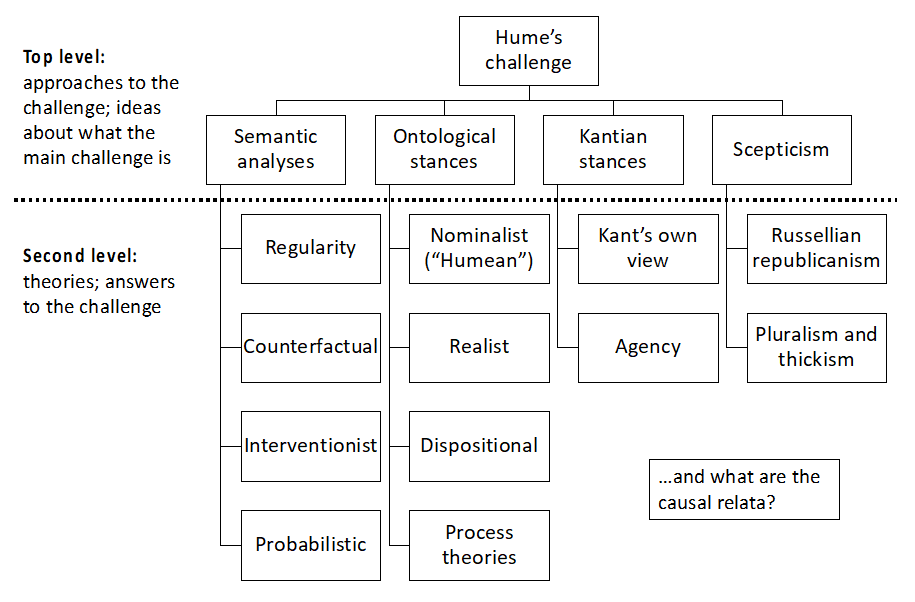
Let's briefly explore two of the most significant interpretations of Hume's project, which correspond to different branches on this map.
A. The Regularity Theory of Causation
The most direct legacy of Hume's thought is the regularity theory. Proponents of this view, often called "Humeans," accept the core of his analysis. They agree that the concept of a "thick" metaphysical connection is empty and that causation in the world is nothing more than regular, law-like succession.
Regularity and Inferential Theories of Causation
This entry from the Stanford Encyclopedia of Philosophy formalizes the Humean Regularity Theory (HRT) and explains its core tenets and consequences.
Please read the introduction and section 1.1 Humean Regularity Theory. Pay attention to how the theory reduces causation to three non-causal components.
The regularity view essentially "bites the bullet" on Hume's skeptical argument. It accepts a "thin" conception of causation, but it faces significant problems, such as distinguishing genuine causal regularities from accidental or spurious ones (e.g., night regularly follows day, but day doesn't cause night).
B. The Skeptical Realist Interpretation ("The New Hume")
A more recent and subtle interpretation, known as Skeptical Realism or the "New Hume" view, argues that the traditional reading gets Hume wrong. According to this view, Hume was not offering a metaphysical reduction of what causation is. He was making a purely epistemological claim about the limits of what we can know.
The core idea is that Hume was a skeptical realist:
- Realist: He believed that there likely is a real, mind-independent causal power or necessary connection in the world that explains the regularities we observe.
- Skeptical: He believed that we are fundamentally ignorant of the nature of this power. Our senses and reason cannot give us any insight into it.
On this view, Hume's psychological account isn't meant to explain away causation, but to explain how we form a concept of something ("that which lies behind regularity") whose true nature is hidden from us. Your physics background provides a powerful analogy: we postulate theoretical entities like quarks or the wave function to explain observable phenomena, even though we cannot directly perceive them and their ultimate nature remains a subject of interpretation. The "New Hume" interpretation suggests Hume viewed causation in a similar way.
The Nature of Causation: The Necessary Connection Analysis
This video discusses Galen Strawson's influential "New Hume" interpretation, contrasting it with the traditional regularity view.
Please watch from the introduction of the "new interpretation" to understand the basic distinction between the traditional reductive realist and the new "skeptical realist" Hume. Then, watch the explanation of how causation can be seen as a "relative" or "theoretical" idea from this segment.
This interpretation reframes Hume's project. The problem of necessary connection is not that it doesn't exist, but that it is fundamentally unknowable to us, lying beyond the limits of empirical investigation.
Conclusion
We have explored the depths of the problem of necessary connection, a puzzle that remains central to metaphysics today. Hume's rigorous application of empiricist principles forces us to confront the uncomfortable possibility that one of our most fundamental concepts for understanding the world lacks a clear basis in either logic or experience.
- Key Takeaways:
- The problem of necessary connection arises from David Hume's argument that we have no sensory impression (experience) of the "power" or "efficacy" that connects a cause to its effect.
- Hume distinguished between relations of ideas (knowable a priori) and matters of fact (knowable a posteriori). Causal claims are matters of fact.
- Hume's "solution" was psychological: the idea of necessity is an internal impression—a feeling of expectation—that the mind projects onto the world after observing a constant conjunction of events.
- This has led to two main interpretations of Hume's view: the regularity theory, which reduces causation to mere regular succession, and skeptical realism, which holds that a real causal power exists but is unknowable to us.
Hume's challenge threw down a gauntlet that philosophers are still trying to meet. If the "connection" isn't a demonstrable logical link or an observable worldly property, what is it?
Preview of the Next Lesson:
In our next lesson, we will examine one of the most powerful and influential modern responses to Hume's problem: the counterfactual theory of causation. This approach, championed by philosophers like David Lewis, sidesteps the search for a "connection" in the actual world. Instead, it attempts to define causation by appealing to what would have happened in other possible worlds if the cause had not occurred, directly linking the metaphysics of causation to the modal logic we studied earlier.