Welcome back. In our last lesson, we confronted David Hume's profound skepticism about causation. He argued that we never observe a "necessary connection" between events, only their constant conjunction. This leaves us with a stark choice: either causation is just this regular succession of events (the regularity theory), or it involves a real but unknowable power (skeptical realism). Hume's challenge essentially asks: if the causal glue isn't in the world for us to see, what justifies our powerful intuition about it?
This lesson explores one of the most influential modern responses to Hume: the counterfactual theory of causation. Instead of searching for a mysterious connection in the actual chain of events, this approach takes a radical detour. It defines causation not by what did happen, but by what would have happened in its absence. To do this, it leverages the formal apparatus of possible worlds semantics, which we encountered in our study of modal logic, thereby building the very bridge between logic and metaphysics you were interested in exploring. Our goal is to understand how "If C had not occurred, E would not have occurred" became the foundation for a new, powerful analysis of causation.
1. From an Overlooked Hint to a Modern Theory
Hume himself provided the seed for this idea in his "other" definition of a cause: "...where, if the first object had not been, the second never had existed." For nearly two centuries, this counterfactual formulation was largely ignored. The primary reason was its apparent lack of empirical rigor. What does it mean to talk about what "would have" happened? How can we have knowledge of merely possible, unactualized scenarios? For empiricists following Hume, such talk seemed metaphysically suspect.
The game changed in the 1970s with the work of philosopher David Lewis. The key development was the rigorous formalization of possible worlds semantics for modal logic, which provided a way to give clear truth conditions for counterfactual statements. This analytical tool transformed counterfactuals from obscure hypotheticals into objects of precise logical analysis.
The following video segment introduces this historical transition, showing how the counterfactual idea implicit in Hume was revitalized by the philosophical tools developed by figures like Rudolph Carnap and, most notably, David Lewis.
The Nature of Causation: The Counterfactual Theory of Causation
This excerpt from "The Nature of Causation" explains how Hume's second definition of causation prefigured the counterfactual theory and how the development of possible worlds semantics made this approach philosophically viable.
Please watch from Hume's two definitions to see the origin of the counterfactual idea. Then, continue from the discussion on semantics to understand how philosophers like Carnap, Stalnaker, and Lewis developed a formal semantics for counterfactuals, making them respectable tools for analysis.
As the video explains, by grounding the meaning of counterfactuals in a systematic theory, philosophers could finally explore Hume's alternative definition seriously. This laid the groundwork for Lewis's influential theory.
2. The Semantics of "What If": Closeness Between Worlds
So, how do possible worlds give meaning to counterfactuals? The core idea is surprisingly intuitive and rests on a notion of comparative similarity, or "closeness," between worlds.
A counterfactual statement like, "If I had not dropped this pen, it would not have fallen," is true if and only if:
In the closest possible world (or worlds) where I did not drop the pen, it did not fall.
To evaluate this, we imagine the world as it is, but we make the smallest possible change needed to make the antecedent ("I did not drop the pen") true. We then see if the consequent ("it did not fall") also holds true in that minimally-changed world. Intuitively, a world where the pen floats in mid-air in defiance of gravity is "further away" from reality—a more drastic departure—than a world where it simply rests in my hand. Therefore, the counterfactual is true.
This concept of "closeness" allows us to analyze counterfactuals, which in turn allows us to define a key causal relationship: causal dependence.
Let's make this more precise with a reading from the Stanford Encyclopedia of Philosophy. This text lays out Lewis's original 1973 theory, connecting the possible worlds semantics for counterfactuals directly to the definition of causal dependence.
Counterfactual Theories of Causation
This reading formalizes the ideas we've just discussed, presenting David Lewis's theory in its original form.
Please read the introduction, "1. Lewis’s 1973 Counterfactual Analysis", and pay close attention to subsection 1.1 Counterfactuals and Causal Dependence. Focus on: The truth condition for a counterfactual, defined in terms of comparative similarity. The resulting definition of causal dependence. The crucial constraint on which counterfactuals we are allowed to use: the rejection of "backtracking" counterfactuals.
The point about non-backtracking counterfactuals is vital. When we evaluate "If c had not occurred...", we imagine a world that matches ours up to the moment of c, then a small "miracle" prevents c, and the future unfolds from there. We don't want to reason backwards and change the past before c. This restriction ensures the temporal asymmetry we associate with causation.
3. The Problem of Preemption and Chains of Dependence
With this machinery, we have a provisional theory: causation is causal dependence. However, this simple identity faces a major challenge: preemption.
Consider a classic example:
Suzy and Billy, two expert rock-throwers, stand before a bottle. Suzy throws her rock, and it shatters the bottle. Billy, seeing her throw, does not. If Suzy hadn't thrown, Billy would have, and the bottle would have shattered anyway.
Here, the bottle's shattering does not causally depend on Suzy's throw. The counterfactual "If Suzy hadn't thrown, the bottle wouldn't have shattered" is false. Yet, we are certain Suzy's throw caused the shattering. This shows that while causal dependence is sufficient for causation, it is not necessary.
Lewis's initial solution was to propose that causation is not simple dependence, but the ancestral of that relation. In other words:
C causes E if and only if there is a chain of stepwise causal dependencies from C to E.
In the example, Suzy's throw (C) causes her rock to be in mid-flight a moment later (D). The bottle's shattering (E) causally depends on the rock being in mid-flight (D), because by that point, Billy has decided not to throw. So we have a chain C → D → E, even though E does not depend directly on C. This elegant solution handles this "early preemption" case by ensuring transitivity.
However, more complex cases soon emerged. What about late preemption, where Billy's rock is already in the air and would have hit a split-second after Suzy's? Or trumping preemption, where a sergeant and a major both shout "Advance!", and the soldiers advance because they obey the major, "trumping" the sergeant's identical command?
The video below lucidly explains these problems, which have driven much of the discussion in causation for the past 50 years.
The Nature of Causation: The Counterfactual Theory of Causation
This video walks through the standard problems for the counterfactual theory and Lewis's evolving solutions.
Watch the segment explaining why counterfactual dependence isn't necessary, using the early preemption example. Then, see how Lewis's initial solution, chains of dependence, handles this. Finally, understand the more difficult challenges of trumping and late preemption, which motivated further refinements like the theory of 'influence' (alterations and stepwise influence).
4. A More Formal Approach: Structural Equations
The persistent difficulty of preemption cases led philosophers to seek more precise and powerful formalisms. The most prominent of these is the Structural Equations Framework (SEF), also known as causal modeling. This approach, which has roots in computer science and econometrics, represents causal structures using a system of equations that directly encode basic counterfactuals.
Given your background in physics and programming, this framework should feel quite natural. It treats a causal scenario as a system of variables and functions, much like a physical model.
Let's use the late preemption case (both Suzy and Billy throw). We can define a set of binary variables:
- ST = 1 if Suzy throws, 0 otherwise. (Actual value: 1)
- BT = 1 if Billy throws, 0 otherwise. (Actual value: 1)
- SH = 1 if Suzy's rock hits, 0 otherwise.
- BH = 1 if Billy's rock hits, 0 otherwise.
- BS = 1 if the bottle shatters, 0 otherwise.
The causal structure is then captured by these equations:
- SH = ST (Suzy's rock hits if and only if she throws)
- BH = BT AND (NOT SH) (Billy's rock hits if and only if he throws AND Suzy's rock doesn't hit first)
- BS = SH OR BH (The bottle shatters if either rock hits)
This system can be represented by a directed graph:
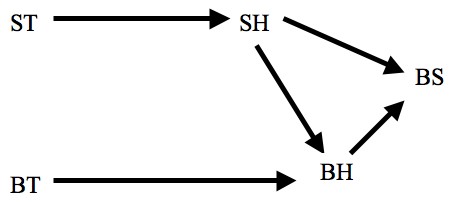
To evaluate a counterfactual, we perform a "surgical intervention" on the model. To ask "What if Suzy hadn't thrown?", we replace the equation for ST with ST = 0, and re-calculate the values through the system. This gives us a precise, algorithmic way to assess counterfactual claims and resolve complex dependencies.
Counterfactual Theories of Causation
This reading introduces the Structural Equations Framework, a formally rigorous approach that dominates contemporary discussions of counterfactual causation.
Please read section 5. The Structural Equations Framework, focusing on subsection 5.1 SEF: The Basic Picture. Pay attention to: The core components: variables and equations. How the equations are interpreted as basic counterfactuals. The example model for the Suzy/Billy case. The procedure for evaluating complex counterfactuals via "surgical intervention".
5. Counterfactuals and the Arrow of Time in Physics
Let's take a step back. The restriction to non-backtracking counterfactuals might seem like an ad-hoc philosophical rule, but it connects directly to deep issues in physics. Why does it feel natural to say "if the past were different, the future would be different," but strange to say "if the future were different, the past would have to have been different"?
This reflects the asymmetry of time, and it's something your physics background gives you a unique perspective on. While most fundamental dynamical laws (like those of mechanics or electromagnetism) are time-reversal symmetric, the macroscopic world is not. This thermodynamic arrow of time is generally believed to emerge from a special, low-entropy initial condition of the universe—the Past Hypothesis.
This cosmological fact underpins what philosophers of physics call the asymmetry of overdetermination. A single event now (like an explosion) has countless traces spreading into the future (light, sound, debris, memories). But for that same explosion to occur, it requires a precise configuration of causes from the past. A small change in the present (preventing the explosion) requires only a small "miracle." But to make the present different while keeping the future exactly the same would require a vast, coordinated conspiracy of "miracles" to erase every single trace—an event of spectacular improbability.
This is the physical grounding for Lewis's notion of "closeness." A world that diverges from ours via a small miracle in the past is "closer" than one that requires a massive, coordinated convergence miracle to keep the future fixed. Thus, the temporal direction of causation, as captured by counterfactuals, may ultimately be grounded not in the laws themselves, but in the universe's boundary conditions. Cosmological frameworks like the "Mentaculus" (which combines the Past Hypothesis with statistical mechanics) explicitly aim to derive a future-branching tree structure of possibilities that can ground a Lewisian counterfactual asymmetry. This shows a direct and active line of research connecting these metaphysical theories to fundamental physics.
Conclusion
Today, we've seen how philosophy has moved beyond Hume's impasse by redefining the problem. The counterfactual theory of causation, powered by the logic of possible worlds, sidesteps the hunt for a physical "connection" and instead analyzes causation in terms of modal relationships.
- Key Takeaways:
- Counterfactual theories analyze "C causes E" via the statement "If C had not occurred, E would not have occurred."
- Possible worlds semantics gives this rigorous meaning: a counterfactual is true if its consequent holds in the closest possible world where its antecedent is true.
- Simple causal dependence is insufficient due to preemption, leading to refinements like chains of dependence and the more formal Structural Equations Framework (SEF).
- SEF provides a powerful, algorithmic method for modeling causal systems and evaluating counterfactuals through "surgical interventions."
- The asymmetry of causation is captured by using non-backtracking counterfactuals, a feature that may be grounded in the thermodynamic arrow of time and the universe's initial low-entropy state.
This concludes our module on metaphysics. We've journeyed from the nature of being and identity to the fabric of time and the structure of causation. These are some of the deepest and most challenging questions in philosophy, and as you've seen, they often lead right to the doorstep of fundamental physics.
Preview of the Next Module:
We will now pivot from questions about what is to questions about what ought to be. Our next module begins our exploration of ethics. We will start with normative ethics, examining the major theoretical frameworks philosophers have proposed for distinguishing right actions from wrong ones, beginning with Immanuel Kant's deontological system.