Welcome to the fifth lesson in our module on reading philosophy. In our previous lessons, we've built a foundational toolkit for argument analysis. We've distinguished between deductive and inductive arguments, learned to evaluate deductive arguments for validity and soundness, and most recently, mastered the crucial distinction between necessary and sufficient conditions.
Today, we will integrate these skills into a practical and powerful procedure: reconstructing a philosopher's argument from a passage of prose into standard form. This is a core competency in academic philosophy. It involves taking an argument as it appears in natural language—often with rhetorical flourishes, unstated assumptions, and complex sentence structures—and translating it into a clear, logical format that makes its structure and content transparent. For someone with your background in formal systems and programming, you can think of this as analogous to reverse-engineering a program to produce clean, structured pseudocode that reveals its underlying algorithm.
1. What is Standard Form?
At its heart, "standard form" is simply a conventional way of presenting an argument to make it easy to analyze. It consists of numbering the premises, drawing a line beneath them, and then stating the conclusion.
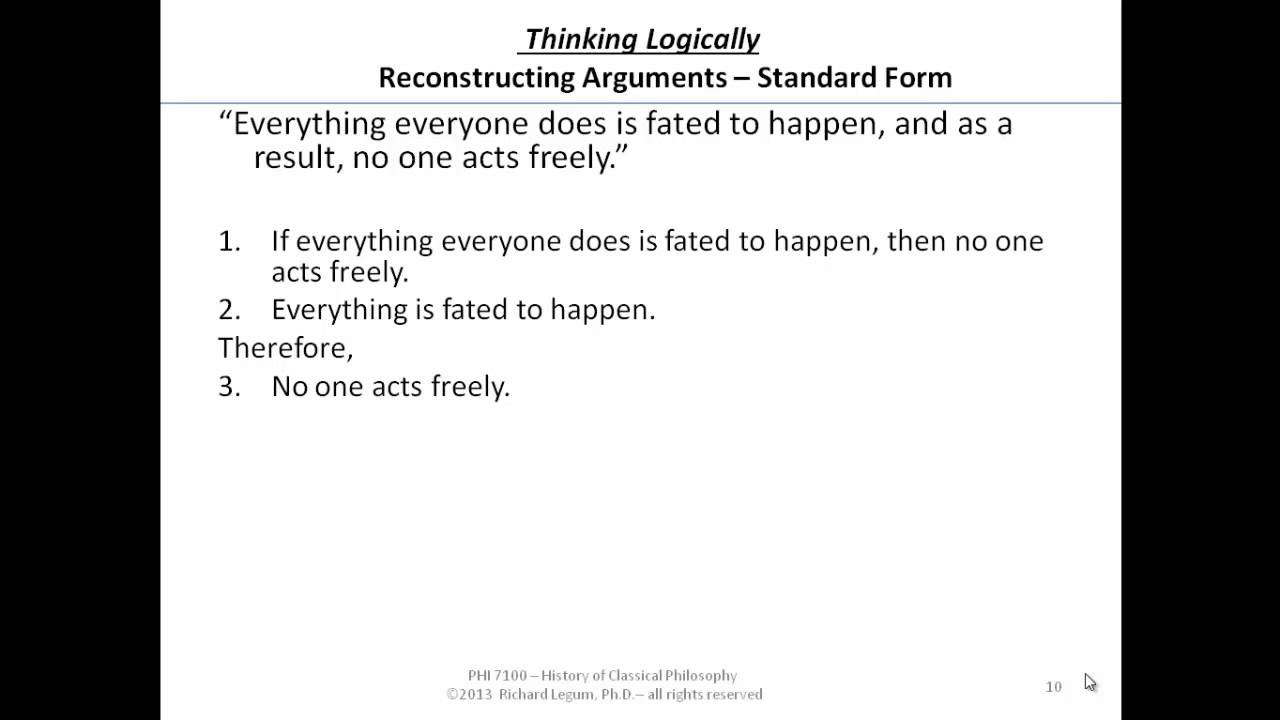
To get a more formal introduction, let's watch a short video that defines the concept and explains its benefits.
Argument Standard Form - Definition, Examples, Benefits
This video from the "Logic & Philosophy" channel provides a clear definition of argument standard form and its purpose.
Please watch the following sections: Definition: This part defines the structure (P1, P2, ... / C). First example: Observe how a short prose argument is broken down into its constituent parts. Benefits: Pay close attention to why this format is so useful. It makes premises and conclusions explicit, filters out irrelevant material, and, most importantly, allows for precise evaluation.
As the video highlights, putting an argument into standard form is not about judging it, but about clarifying it. This clarity is the essential prerequisite for the critical evaluation we discussed in previous lessons (checking for validity, soundness, etc.).
2. The Core Task: Finding Premises and Conclusions
The most challenging part of reconstruction is accurately identifying the premises and the main conclusion within a prose passage. Philosophers don't always label their arguments neatly.
A useful strategy is to first hunt for indicator words. Certain words and phrases signal that a conclusion or a premise is about to be stated.

The following video provides a more detailed guide on using indicator words and what to do when they are absent.
Identifying Premises and Conclusions
In this video, Kevin deLaplante explains the practical techniques for identifying the parts of an argument in natural language.
As you watch, focus on these key strategies: Conclusion indicators: Note words like 'therefore', 'so', and 'hence'. The example "Abortion is wrong because all human life is sacred" shows how an indicator word like "because" can link a conclusion to a premise. Arguments without indicators: When there are no indicator words, you must ask: What is the main point the author is trying to convince me of? The other claims will be the reasons offered in support of that main point. Premise indicators: Note words like 'since', 'if', and 'because', which often introduce reasons. Summary: A concise recap of the overall strategy.
3. A Systematic Procedure for Reconstruction
Now, let's combine these ideas into a formal, step-by-step procedure. The following reading provides a comprehensive method that is standard practice in philosophy. Given your analytical background, you should find its procedural nature very effective.
McCormick Philosophy - Reconstructing Arguments
This text lays out a detailed, nine-step process for argument reconstruction, complete with justifications for each step and worked examples. It's a powerful guide to the entire process.
Please read through the sections outlining the "Procedure for reconstructing arguments." I've highlighted the key sections below. Don't worry about memorizing every detail right away; focus on understanding the purpose of each major step. Read section A, "Be charitable": We will cover this principle in detail in the next lesson. For now, understand it as the principle of trying to make the argument as strong as possible. This is often called "steel manning." Read section B, "Finding Conclusions": This expands on the video's techniques, emphasizing that finding the conclusion is the anchor for the whole reconstruction. Read sections C and D, "Finding Explicit Premises" and "Finding Implicit Premises": This is a crucial step. Arguments often rely on unstated assumptions. To make an argument valid, we often need to add these implicit premises. Notice how the "God and suffering" example is initially ill-formed until an implicit premise is added to create a valid Modus Tollens argument. Read sections E and F, "Make charitable revisions in language" and "Make the language between premises and the conclusion match": Clarity and consistency are key. The goal is to remove ambiguity. Pay attention to the "God and suffering" example again, where the conclusion is refined to "no loving, all-powerful, all-knowing God" to logically match the premise. Read sections G and H, "Put argument into standard form" and "Add justifications": This covers the final formatting. Adding justifications like (EP) for explicit premise, (IP) for implicit premise, and (1, 2, MT) for an inference from lines 1 and 2 via Modus Tollens, adds a layer of formal rigor. Finally, read the bulleted list under "Procedure for Reconstructing Arguments" at the very end of the article for a concise summary of the nine steps.
4. Worked Example
Let's apply this procedure to an argument. Consider the following passage:
"Every event in the natural world is caused. Human actions are events in the natural world, which means they must be caused too. If our actions are caused, then they can't be free. Therefore, free will is an illusion."
Let's reconstruct this step-by-step.
-
Find the Conclusion: The indicator word "Therefore" makes this easy.
- Conclusion: Free will is an illusion.
-
Find Explicit Premises: What reasons are explicitly given?
- Every event in the natural world is caused.
- Human actions are events in the natural world.
- If our actions are caused, then they can't be free.
-
Look for Implicit Premises/Sub-arguments: The argument seems to jump from "human actions are caused" to "if our actions are caused, then they can't be free." Let's look closer. The first two premises logically lead to an intermediate conclusion.
- (P1) Every event in the natural world is caused.
- (P2) Human actions are events in the natural world.
- From these, we can infer a sub-conclusion: Human actions are caused.
-
Assemble in Standard Form and Refine Language: Now we can build the full argument, ensuring the language is consistent.
- Every event in the natural world is caused.
(EP) - Human actions are events in the natural world.
(EP) - Therefore, all human actions are caused.
(from 1, 2) - If an action is caused, it is not free.
(EP, rephrased for clarity) - Therefore, no human action is free.
(from 3, 4, Modus Ponens) - If no human action is free, then free will is an illusion.
(IP - a plausible assumption linking the concepts) - Therefore, free will is an illusion.
(from 5, 6, Modus Ponens)
- Every event in the natural world is caused.
This reconstruction reveals a multi-step argument with sub-conclusions. It is now in a form where we can begin to evaluate it. For instance, is premise 4 true? What about premise 6? Is "caused" the opposite of "free"? The reconstruction doesn't answer these questions, but it makes them possible to ask with precision.
For a more complex, real-world example from a primary philosophical text, you can review the worked reconstruction of Berkeley's argument in the PDF resource LINK. This shows how the same principles are applied in advanced philosophical analysis, aligning with your goal of learning to tackle primary sources.
Conclusion
Today we've learned a foundational skill for serious philosophical engagement. By translating messy prose into the clean structure of standard form, we can see the logical bones of an argument, making it ready for rigorous evaluation.
Key Takeaways:
- Standard Form organizes an argument into numbered premises and a final conclusion, separated by a line.
- The reconstruction process involves identifying the conclusion and explicit premises, adding necessary implicit premises, and refining language for clarity and logical consistency.
- This process is not about evaluating the argument, but preparing it for evaluation by making its structure transparent.
- The goal is to produce the clearest and logically strongest version of the argument that is consistent with the author's intent.
Preview of the Next Lesson:
The first and most important step in our reconstruction procedure was to "be charitable." This isn't just a suggestion to be nice; it's a crucial methodological principle in philosophy. In our next lesson, we will focus entirely on this Principle of Charity, exploring why you must always strive to engage with the strongest possible version of an opponent's argument (a "steel man") rather than a weak caricature (a "straw man").