Hello! Welcome back to our course on formal philosophy.
In our last lesson, we developed a systematic procedure for reconstructing arguments from prose into standard form. We noted that the very first step in that procedure is to "be charitable." Today, we'll unpack that crucial instruction. Our learning outcome is to be able to apply the principle of charity when interpreting a philosophical argument.
You'll discover that this principle is far more than a simple suggestion to be polite. It is a fundamental methodological rule for productive philosophical inquiry. We'll explore what the principle is, the powerful reasons for adopting it, and even look at a more technical version of it used in the philosophy of language that might resonate with your background in formal systems. This lesson will equip you to move beyond simply identifying premises and conclusions to interpreting them in the most intellectually honest and fruitful way.
1. What is the Principle of Charity?
At its core, the principle of charity directs you to interpret a speaker's or writer's statements in the most rational, sensible way possible. When reconstructing an argument, this means you should strive to formulate the strongest and most persuasive version of that argument that is consistent with the text.
This approach is the direct opposite of the "straw man" fallacy, where you deliberately misrepresent an argument to make it weaker and easier to defeat. The principle of charity, in contrast, sometimes requires you to "steel man" an argument—that is, to build it into its strongest possible form before you engage with it.
Let's watch two short videos that introduce this core concept.
This video by Kane B provides a concise definition of the principle of charity and contrasts it with "straw-manning" and "steel-manning."
Please watch the first minute, from the introduction. Notice the key instruction: "attribute the strongest possible argument to the author."
This video by John Corvino reinforces the definition and emphasizes the ultimate goal of philosophical argumentation.
Watch the first 35 seconds. The central point here is that the purpose of argument is to get at the truth, and engaging with the strongest version of the other side is the best way to do that.
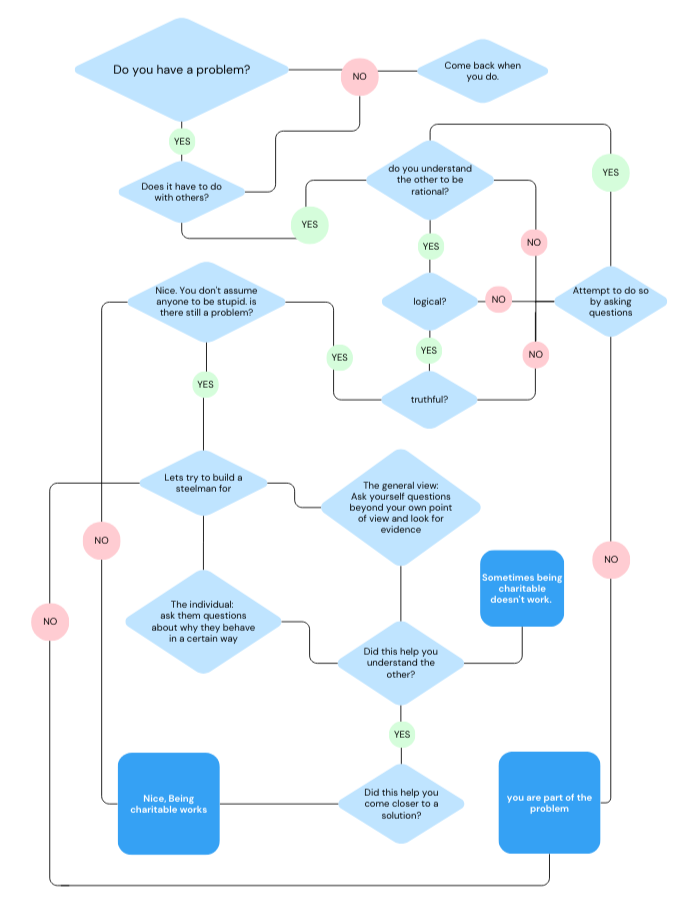
These videos establish the fundamental idea: charity is a tool for truth-seeking, not just for winning a debate. The following flowchart visualizes how you might apply this principle in a practical situation.
2. Justifications and Nuances of Charity
Why should we bother making an opponent's argument stronger? There are several powerful justifications, which can be broadly categorized as moral, epistemic (related to knowledge), and pragmatic.
Let's return to the Kane B video, which lays out the two most common defenses.
In this section, Kane B explains the two main arguments in favor of applying the principle of charity.
Please watch the segment from the defenses of charity. As you watch, identify the two primary reasons for being charitable: The Moral Reason: Based on fairness and reciprocity. The Epistemic Reason: Based on the goal of finding truth and rigorously testing your own beliefs. This connects to John Stuart Mill's classic defense of free speech.
The video highlights a crucial epistemic point: by engaging with the very best version of an opposing view, you either discover the flaws in your own position and correct them, or you develop a much stronger, more resilient defense of your own views.
Maximal vs. Sub-maximal Charity
This raises a subtle but important question. When we are being charitable, are we trying to find the best version of the argument the author actually made, or are we creating the best possible argument for their position, even if they didn't articulate it perfectly?
A recent paper in the journal Argumentation provides a useful framework for thinking about this. It introduces several criteria for a charitable reconstruction and distinguishes between two levels of charity.
[PDF] Charity Principles in Philosophical Argumentation
This academic paper by R. A. J. Shields provides a formal taxonomy of charity principles. It will help us add precision to our understanding.
Please read the following sections: Section 2, "Charity Criteria in Argumentation": Skim this section to familiarize yourself with the criteria used to judge a charitable interpretation, such as accuracy (does the author recognize it?), fairness, and plausibility. Section 3, "Principles Maximal and Sub-Maximal": Read this short section carefully. It defines the key distinction between maximal and sub-maximal principles. Section 4, "Principles of Charity: A Taxonomy": Read the first few paragraphs that provide examples of maximal and sub-maximal principles in action.
Let's summarize the key distinction from the reading:
- Maximal Charity: This is the "steel man" approach. You construct the strongest possible argument for the author's conclusion, even if it requires significant revisions or additions to what was explicitly written. The goal is to engage with the best possible version of the position.
- Sub-maximal Charity: This approach prioritizes fidelity to the text and the author's apparent intent. You create the strongest argument that is consistent with the evidence in the text, preserving flaws if they seem intentional or central to the author's reasoning. The goal is to engage with the best possible version of the author's argument.
The choice between these depends on your goal. If you are a historian of philosophy trying to understand exactly what Descartes argued, sub-maximal charity is more appropriate. If you are a metaphysician trying to solve the mind-body problem, you might use Descartes' work as a starting point and apply maximal charity to build the strongest possible dualist argument to test against physicalist theories.
3. A Formal Application: Davidson's Principle of Charity
So far, we've treated charity as a valuable heuristic. However, the 20th-century philosopher Donald Davidson gave it a much more fundamental role in his philosophy of language and mind. For him, charity isn't just a good idea for interpreting arguments; it's a necessary precondition for interpretation itself.
Given your background, this formal application of the principle should be particularly interesting. Davidson tackled a foundational problem:
How is it possible to understand what a person's words mean if you don't know what they believe, and how can you figure out what they believe if you don't know what their words mean?
This is a classic circularity problem. Imagine you are a field linguist encountering a speaker of a completely unknown language—a situation Davidson calls radical interpretation. You see a rabbit hop by, and the speaker utters "Gavagai." Do they mean "Rabbit"? "Lo, food"? "That's a white, fluffy thing"? "An animal is running"? You can't know the meaning without knowing their belief, and vice versa.
Davidson's solution is that you must break the circle by assuming from the outset that the speaker is rational and that their beliefs are largely coherent and true (by your own standards). This assumption is Davidson's Principle of Charity. It's not a choice you make; it's a constraint you must accept to even begin the project of interpretation.
Donald Davidson - Stanford Encyclopedia of Philosophy
This entry from the Stanford Encyclopedia of Philosophy explains Davidson's technical use of the principle of charity in the context of his theory of radical interpretation.
Please read the subsection titled "Radical Interpretation." Focus on these key points: The description of the central problem: "one cannot assign meanings to a speaker's utterances without knowing what the speaker believes, while one cannot identify beliefs without knowing what the speaker's utterances mean." The role of the Principle of Charity (or "rational accommodation") as the solution. Notice how it enjoins us to "optimise agreement" and interpret speakers as holding true beliefs. The idea that charity is not a mere heuristic but a "presupposition of any interpretation whatsoever."
Davidson's model is often visualized as a triangle, where the meaning of our thoughts and words is fixed by the interaction between two speakers and a shared world. Charity is what allows this "triangulation" to work.

For Davidson, we can't make sense of someone as having massively false or irrational beliefs, because belief and meaning are determined by mapping their utterances onto a shared, public world under an assumption of rationality. If we can't find a charitable interpretation, we can't conclude the person is irrational; we must conclude we have failed to understand them at all.
Conclusion
Today, we've explored the Principle of Charity as a cornerstone of philosophical method. It's a principle that guides us to engage with arguments in the most intellectually productive way.
Key Takeaways:
- The Principle of Charity directs us to interpret an argument in its strongest, most rational form. This is the opposite of the "straw man" fallacy.
- The primary justifications for charity are epistemic (it's the best way to find truth and test our own views) and moral (it's a matter of fairness).
- We can distinguish between maximal charity (improving an argument to its strongest possible form) and sub-maximal charity (making an argument as strong as is consistent with the text).
- In its most formal sense, as seen in the work of Donald Davidson, charity is a necessary presupposition for the very possibility of linguistic interpretation and understanding.
Preview of the Next Lesson:
Having established the importance of being charitable, we are now perfectly positioned to examine what happens when this principle is violated. In our next lesson, we will identify and analyze common informal fallacies. You will see that many fallacies, like the "straw man," are fundamentally failures of charity. Understanding how to be charitable is your best defense against committing these errors and your sharpest tool for spotting them in the arguments of others.