Welcome back. In our previous lesson, we explored the crucial distinction between de re and de dicto modal claims, learning how to formalize them by managing the scope of modal operators and quantifiers. This gave us finer control over the meaning of statements within the Kripke semantics framework.
Now that we have this semantic apparatus, a natural question arises: which modal statements should be considered universally valid? For instance, is it always true that if something is necessary, then it is the case? Or that if something is necessary, it is necessarily necessary? Different answers to these questions give rise to different systems of modal logic. Today, we will compare the most important of these systems: the foundational system K and its key extensions T, S4, and S5. Our goal is to understand their characteristic axioms and, most importantly, to see how these syntactic rules correspond to specific, intuitive properties of the accessibility relation in possible worlds semantics.
1. The Foundation: System K
All "normal" modal logics begin with a base system called K, named after Saul Kripke. System K includes all the tautologies of propositional logic and the rule of modus ponens. It adds to this foundation one new rule of inference and one new axiom schema.
-
The Necessitation Rule (NR): If is a theorem, then is also a theorem.
- The intuition here is that any truth of pure logic is not just contingently true but necessarily true. Mathematical theorems, for example, are considered necessary truths.
-
The Distribution Axiom (K):
- This axiom states that the necessity operator "distributes" over implication. If it's necessary that implies , and itself is necessary, then it follows that must also be necessary.
System K also defines the possibility operator, , in terms of the necessity operator, : . This is formally analogous to the way the existential quantifier () can be defined from the universal quantifier () in predicate logic: .
The following video introduces the core components of System K.
This video from Carneades.org provides a concise introduction to modal logic and the foundational system K.
Watch the initial overview from the introduction, and then focus on the explanation of System K's components from this section. Pay close attention to the Necessitation Rule and the Distribution Axiom.
Semantically, System K makes no assumptions about the accessibility relation . A formula is valid in K if and only if it is true in every possible world of every Kripke model, regardless of the structure of its accessibility relation. This makes K a very general but also very weak system. For instance, in K, can be true while is false. This is because K does not require a world to be accessible from itself. For many interpretations of necessity, especially the idea of "truth in all possible worlds," this is a significant limitation.
2. From K to T: Adding Reflexivity
To build a more intuitive logic for necessity, we often want to ensure that whatever is necessary is actually true. This is accomplished by adding a new axiom, which gives us System T.
- Axiom T (also known as M):
- Intuition: "Whatever is necessary, is." If it must be true, then it is true.
Adding this axiom to K creates System T. The semantic consequence of this addition is profound: Axiom T is valid if and only if the accessibility relation is reflexive.
- Reflexivity: For every world in the set of worlds , . (Every world is accessible from itself).
The connection is straightforward: If is true at a world , it means is true at all worlds accessible from . If the accessibility relation is reflexive, then is accessible from itself, so must be true at . This is precisely what Axiom T asserts.
The following video explains this connection between the axiom and the semantic property of reflexivity very clearly.
Modal logic 2.1 - the systems M, B, S4 & S5
This video by Kane B focuses on the semantic properties that define different modal systems, starting with System M (T).
Please watch the segment from the beginning, which explains how adding the condition of reflexivity to the accessibility relation gives us System M (T) and validates the axiom "If necessarily A, then A".
3. System S4: Iterated Modality and Transitivity
What happens when we apply modal operators to statements that are already modal? For instance, if a statement is necessary, is it necessarily necessary? System S4 addresses this by adding another axiom to T.
- Axiom 4:
- Intuition: "Whatever is necessary is necessarily necessary." This axiom implies that iterating modal operators of the same kind is redundant. For example, logically collapses to just .
System S4 is defined as T + Axiom 4. The semantic property corresponding to Axiom 4 is transitivity.
- Transitivity: For any worlds , if and , then .
Let's trace why this works. Assume Axiom 4 holds. We want to show the frame is transitive. (This direction is more advanced, but the other direction is intuitive). Let's consider why a transitive frame validates Axiom 4.
Assume our frame is transitive and that is true at world . To show that is true at , we must show that for any world accessible from , is true at . So, let's pick such a . Now we must show that for any world accessible from , is true at . By the definition of transitivity, since and , it follows that . And since we assumed is true at , must be true at . Thus, holds at , and therefore holds at .
An S4-frame is one that is both reflexive and transitive—a structure known in mathematics as a preorder or quasi-order.
4. System S5: The Logic of Equivalence
The most powerful and, for many purposes, most useful system is S5. It is often considered the logic of metaphysical necessity. S5 can be formed by adding a new, very strong axiom to T.
- Axiom 5:
- Intuition: "Whatever is possible is necessarily possible." This means that possibility and necessity are not perspective-dependent. If a world is accessible from , then any world accessible from is also accessible from .
System S5 is defined as T + Axiom 5. (It turns out that Axiom 5 is strictly stronger than Axiom 4, so any theorem of S4 is also a theorem of S5). The semantic property corresponding to Axiom 5 is that the accessibility relation is Euclidean.
- Euclidean Property: For any worlds , if and , then .
A relation that is both reflexive (from Axiom T) and Euclidean (from Axiom 5) is also guaranteed to be symmetric and transitive. A relation that is reflexive, symmetric, and transitive is an equivalence relation.
This has a powerful simplifying effect: the set of possible worlds is partitioned into disjoint sets (equivalence classes), and within each set, every world is accessible from every other world. In a model with just one such partition, simply means " is true in all possible worlds," and means " is true in at least one possible world."
5. A Map of Modal Logics
We have now constructed a hierarchy of increasingly strong logical systems. Each system is an extension of the one before it, meaning it proves everything the weaker system proves, plus more. The relationship can be visualized as a nested structure: K ⊂ T ⊂ S4 ⊂ S5.
The following resource from the Stanford Encyclopedia of Philosophy provides a superb, detailed summary of these systems, their axioms, and their corresponding frame conditions.
Modal Logic - Stanford Encyclopedia of Philosophy
This article provides a rigorous overview of the systems we've just discussed, cementing the connection between the axiomatic systems and their Kripke semantics.
First, read section 2, "Modal Logics", which introduces K, M(T), S4, and S5 and their characteristic axioms. Then, study section 7, "Modal Axioms and Conditions on Frames", which explains the crucial correspondence between axioms and properties of the accessibility relation. Finally, look at the diagram and table in section 8, "Map of the Relationships Between Modal Logics".
The diagram from the SEP article illustrates the inclusion relations between the various systems. A similar diagram, sometimes called the "cube of modal logics," provides a clear map of this logical space.
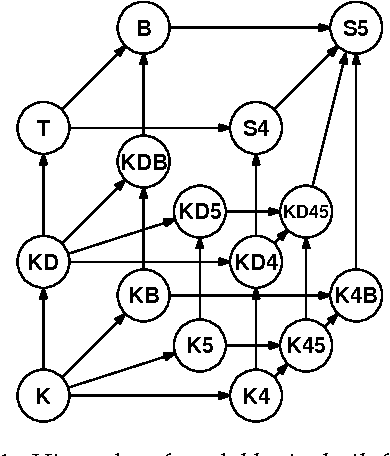
The following table summarizes the systems we have covered:
| System | Axioms Added | Characteristic Axiom | Frame Property | Intuition about Necessity |
|---|---|---|---|---|
| K | (K), (NR) | None | Basic closure properties | |
| T | K + (T) | Reflexive | What is necessary is true | |
| S4 | T + (4) | Reflexive, Transitive | Necessary truths are necessarily necessary | |
| S5 | T + (5) | Equivalence Relation | Possibility is not relative/contingent |
The choice of which system to use depends on the concept one is trying to formalize. For physical necessity, S4 might seem appropriate. For logical or metaphysical necessity, the powerful and simple structure of S5 is often preferred. For deontic logic (the logic of obligation), where means "it is obligatory that," Axiom T () is undesirable—just because something is obligatory does not mean it is true! This is why a weaker system, often KD (K plus the axiom ), is used.
Conclusion
In this lesson, we have navigated the landscape of the most prominent systems of propositional modal logic. We've seen that these systems are not arbitrary collections of rules but are built systematically, with each axiom reflecting a specific philosophical intuition about necessity and possibility.
Key Takeaways:
- Normal modal logics are extensions of the basic system K, which contains the Necessitation Rule and the Distribution Axiom (K).
- Stronger systems are formed by adding new axioms. The most important are:
- T: Adds , corresponding to a reflexive accessibility relation.
- S4: Adds to T, corresponding to a reflexive and transitive relation.
- S5: Adds to T, corresponding to an equivalence relation (reflexive, symmetric, and transitive).
- This demonstrates a fundamental duality in modal logic: axiomatic principles (syntax) correspond directly to properties of frames in possible worlds semantics (semantics).
- The choice of a logical system depends on the specific type of modality (e.g., metaphysical, physical, epistemic, deontic) being modeled.
Preview of the Next Lesson:
We have now defined several formal systems axiomatically and described their semantics in terms of Kripke frames. This leads to a crucial meta-logical question: For a given system, say S4, can we prove that its axioms are sufficient to derive every formula that is valid on all reflexive and transitive frames? And can we be sure that it only derives formulas that are valid on such frames? These are the questions of completeness and soundness. In our next lesson, we will explore the philosophical significance of these powerful metalogical theorems.