Welcome back. In our previous lesson, we introduced the fundamental concepts of modal logic—necessity, possibility, and contingency—and began using the idea of "possible worlds" as an intuitive framework for understanding them. We noted that a necessary truth holds in all possible worlds, while a possible truth holds in at least one.
Today, we will formalize this intuition. Our goal is to learn how to translate modal reasoning into the rigorous language of possible worlds semantics, also known as Kripke semantics. This is a crucial step in moving from philosophical concepts to a mathematical structure that allows for formal proofs and analysis. We will see how modal logic, which appears to be intensional (the truth of a modal statement isn't just a function of the truth of its parts), can be given a semantics that is itself fully extensional, a move that will likely appeal to your background in mathematical physics.
1. The Central Translation: Modal Operators as Quantifiers
The key insight, developed by Saul Kripke and others, is to treat modal operators not as strange truth-functional connectives, but as quantifiers over a domain of possible worlds. This is the heart of the "translation" process. Just as predicate logic uses ("for all") and ("there exists") to quantify over individuals, modal logic uses and to quantify over worlds.
The following reading from the Stanford Encyclopedia of Philosophy explains this pivotal conceptual move, which allows us to regain a form of extensionality in our semantic theory for modal logic.
Possible Worlds - Stanford Encyclopedia of Philosophy
This section, "Extensionality Regained," from the SEP entry on Possible Worlds, articulates the core idea of interpreting modal operators as quantifiers over worlds.
Please read the introductory paragraphs of section 1.2, focusing on the two main principles presented. You can read from the beginning of the section. Pay close attention to the informal principles labeled Nec and Poss.
As the reading highlights, the translation works like this:
- A statement of the form ("Necessarily ") is true if and only if is true in every possible world.
- A statement of the form ("Possibly ") is true if and only if is true in some possible world.
This reframing turns a problem of modality into a problem of quantification, familiar territory from first-order logic. However, this simple picture needs one more piece of crucial machinery to become a fully-fledged logical system: the notion of accessibility.
2. The Formal Apparatus: Kripke Models
To make the quantificational approach precise, we need a formal structure. This structure is called a Kripke model (or relational model). It consists of three components, which together define a "universe" of possibilities. A Kripke model is an ordered triple: .
- W: A non-empty set of worlds (or states, or points). These are the fundamental entities over which we quantify. You can think of each world as a complete "way things could be."
- R: An accessibility relation between worlds. This is a binary relation on , so . If we have , which we often write as , it means that world is "possible relative to" world . This is a critical refinement; instead of quantifying over all worlds, we only quantify over the ones that are considered possible from our current standpoint. Different kinds of necessity (logical, physical, etc.) can be modeled by imposing different constraints on this relation, a topic we will explore in a future lesson.
- V: A valuation function. This function tells us what is true at each world. For every atomic proposition (like "it is raining") and every world , assigns a truth value. We can define this as a function that returns true or false, or as a function that for each proposition , returns the set of worlds where is true.
The following videos provide an excellent introduction to this formal structure, one giving a more visual and intuitive feel, the other a more formal presentation.
Modal Logic Semantics | Attic Philosophy
First, let's watch a clip from Attic Philosophy's "Modal Logic Semantics" for an intuitive picture of Kripke models as "blobs and arrows."
Watch the section from the introduction to get a feel for relational structures. Then, watch the more detailed explanation of the model's components—W, R, and V—from this segment. Notice the analogy of "following the arrows."
A Quick Introduction to Modal Logic, part 1
Now, for a more formal and systematic definition, let's turn to Eric Pacuit's "A Quick Introduction to Modal Logic."
Please watch the segment from this point, where the lecturer explains the components of a Kripke structure using a concrete diagram. Then, continue with the formal definition of a Kripke model from the next section.
3. Defining Truth: Kripke Semantics
With the formal model in place, we can now define precisely what it means for a formula to be true at a world in that model. This is denoted as .
The rules for atomic propositions and Boolean connectives are straightforward and local to the world of evaluation:
- if and only if the valuation function makes true at .
- if and only if it is not the case that .
- if and only if and .
(And similarly for other connectives like and .)
The "translation" happens in the rules for the modal operators, which depend on the accessibility relation :
-
Necessity (): if and only if for every world such that , it holds that .
- In words: is true at a world if is true in all worlds accessible from .
-
Possibility (): if and only if there exists at least one world such that and it holds that .
- In words: is true at a world if is true in at least one world accessible from .
Let's watch a final video segment that clearly lays out these crucial semantic clauses.
A Quick Introduction to Modal Logic, part 1
This clip from Eric Pacuit's video formally defines the truth conditions for all formulas, with a special focus on the modal operators.
Please watch from this timestamp. The lecturer provides a clear, step-by-step definition of truth at a world, culminating in the rules for box and diamond.
4. An Example in Action
Let's apply these rules to a concrete example. Consider the following Kripke model, represented graphically. The circles are the worlds, the arrows are the accessibility relation, and the formula inside each circle indicates whether the atomic proposition is true at that world.
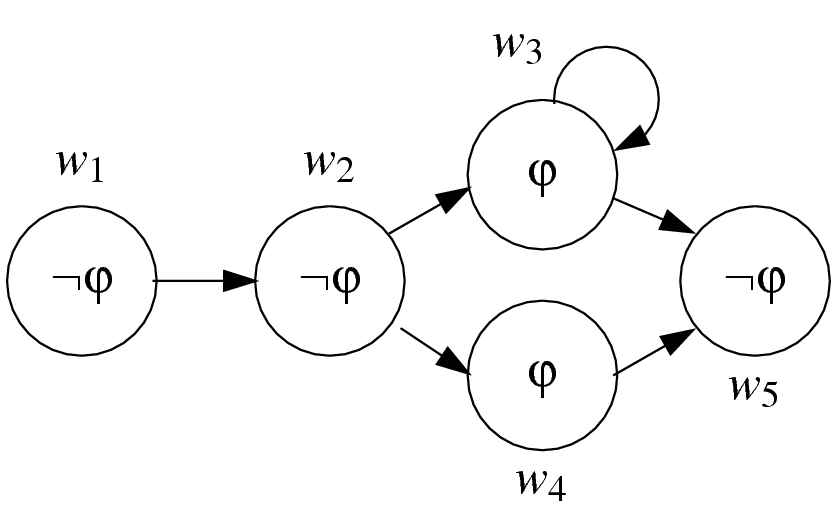
Let's evaluate some modal formulas at different worlds in this model .
-
Is true at ? (i.e., does hold?)
- We need to check if there is any world accessible from where is true.
- The only world accessible from is .
- At , is true, meaning is false.
- Since there is no accessible world where is true, the statement is false.
-
Is true at ? (i.e., does hold?)
- We need to check if is true in all worlds accessible from .
- The worlds accessible from are and .
- At , is true.
- At , is true.
- Since is true in all accessible worlds, the statement is true.
-
Is true at ? (i.e., does hold?)
- We need to check if is true in all worlds accessible from .
- The worlds accessible from are itself (due to the loop) and .
- At , is true.
- At , is true, so is false.
- Since is not true in all accessible worlds, the statement is false.
-
Is true at ? (i.e., does hold?)
- This is an iterated modality. We first apply the rule for : we need to be true in all worlds accessible from .
- The only world accessible from is . So, we must check if .
- To check if , we see if there is a world accessible from where is true.
- From , we can access and . is true at both. So yes, .
- Since the formula holds in all worlds accessible from (namely, just ), the statement is true at .
This process of "following the arrows" is the mechanical procedure for translating modal logic into the semantics of Kripke models.
Conclusion
Today we have built the formal foundation for modal logic. We moved from the intuitive idea of possible worlds to a rigorous mathematical structure—the Kripke model—that allows us to define truth for modal formulas with precision. This is the core skill required to analyze and construct proofs in modal systems.
Key Takeaways:
- Kripke semantics "translates" modal logic by interpreting the operators and as universal and existential quantifiers over a set of possible worlds.
- A Kripke Model formalizes this idea with a set of worlds (), an accessibility relation (), and a valuation function ().
- The truth of a modal formula is always relative to a specific world in a model .
- is true at if is true in all worlds accessible from .
- is true at if is true in at least one world accessible from .
Preview of the Next Lesson:
Now that we have the semantics, we can explore its subtleties. One of the most important is the scope of the modal operator. Does "The President of the US is necessarily a US citizen" mean that the individual who is currently president must be president? Or does it mean that whoever holds the office of president must be a citizen? This ambiguity is captured by the crucial distinction between de re (concerning the thing) and de dicto (concerning the statement) modality. In our next lesson, we will unpack this distinction and see how it is represented within Kripke semantics.