Welcome to the first lesson of our second module. In our previous lesson, we established the crucial distinction between an argument's formal structure (syntax) and its truth-based content (semantics). You'll recall that we identified validity as a purely syntactic property, dependent only on the argument's form.
Today, we begin the practical work of formal logic by learning how to bridge the gap between ordinary language and this formal structure. Our learning outcome is to translate natural language sentences into propositional logic. This process involves stripping away the ambiguity and rhetorical nuance of English to reveal the precise logical relationships between statements. This skill is foundational; it's the equivalent of setting up a problem in physics by choosing a coordinate system and defining your variables before you can apply the laws of motion.
1. The Building Blocks: Propositions and Connectives
Propositional logic (also called sentential logic) is a formal system that deals with propositions and the logical relationships between them.
A proposition is the basic unit of meaning. It is a declarative sentence that can be assigned a truth value of either "true" or "false". For example, "Copper is a metal" is a proposition. "Where are you?" is not, because it is a question.
In propositional logic, we symbolize these simple, or atomic, propositions with capital letters (e.g., ). These act as variables, analogous to how you might use variables in a program or a physical equation.
Introduction to Propositional Logic Translations
The video "Introduction to Propositional Logic Translations" by TrevTutor provides a clear definition of a proposition and illustrates how to assign symbolic variables.
Please watch the segment from the beginning. This will clarify what counts as a proposition and the convention for symbolizing them.
Complex, or compound, propositions are formed by combining atomic propositions using logical connectives (also called operators). There are five standard connectives in propositional logic.
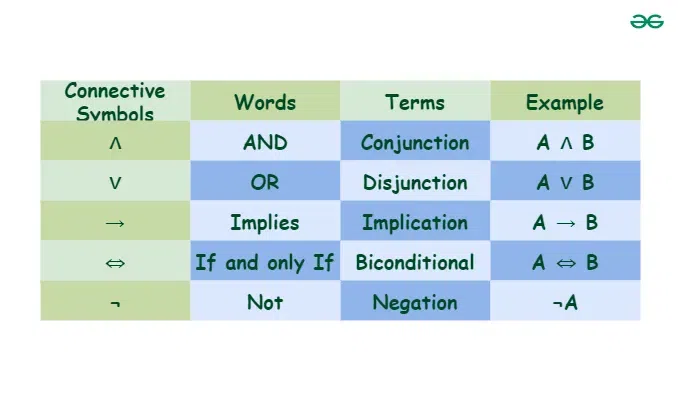
A quick note on symbolism: The symbols in the table above () are common, but you will encounter variations in different texts. For instance:
- Negation () is often written with a tilde ().
- Conjunction () can be a dot () or an ampersand (&).
- The conditional () is often a horseshoe ().
- The biconditional () can be a triple bar ().
The underlying logic is identical, so it's a matter of getting used to different notations, much like the variations between notations in vector calculus or quantum mechanics (e.g., Dirac notation). We will stick to the set .
2. A Tour of the Connectives
The main task in translation is to correctly identify the logical connective being used in an English sentence. Let's examine each one, paying special attention to the subtleties of natural language.
Negation ()
This is the most straightforward connective. It corresponds to "not" or "it is not the case that".
- "It is raining."
- "It is not raining."
By convention, we always define the capital letter to stand for the affirmative statement.
Introduction to Propositional Logic Translations
The TrevTutor video provides a good overview of negation.
Watch the section on the negation operator. Notice the important point that propositions should be defined in the affirmative.
Conjunction ()
This operator corresponds to "and". A conjunctive statement is true if and only if both and are true.
- "The sky is blue and the grass is green."
English has many words that are truth-functionally equivalent to 'and', even if they carry different connotations. Words like but, although, however, moreover, yet all function as conjunctions.
- "It is raining, but I am happy."
The nuance of surprise conveyed by "but" is part of the sentence's rhetoric, not its logical structure.
Be cautious, however. Sometimes 'and' does not function as a logical connective joining two propositions. Consider "Jay and Kay are roommates." This cannot be broken down into "Jay is a roommate and Kay is a roommate" without losing the meaning that they are roommates to each other. This is a relational use of 'and', and in propositional logic, such a statement is treated as a single atomic proposition.
TRANSLATIONS IN SENTENTIAL LOGIC
This text from a UMass course provides a detailed look at the nuances of translating 'and'.
Please read the sections Disguised and Relational 'And' and The Relational Use of 'And'. This will help you distinguish cases where 'and' is a true logical connective from cases where it describes a relationship.
Disjunction ()
This corresponds to "or". A disjunctive statement is true if at least one of or is true. This is the inclusive 'or' (P or Q or both).
- "I will have coffee or tea."
Sometimes, English uses an exclusive 'or' (P or Q, but not both), as in "The final will be on Tuesday or Thursday." In logic, you would express this as . Unless specified, you should assume 'or' is inclusive.
A common phrase involving disjunction is "neither...nor". The statement "Neither P nor Q" is a negation of a disjunction: . By De Morgan's laws (which we'll cover in detail later), this is equivalent to . Both are valid translations.
Introduction to Propositional Logic Translations
The TrevTutor video covers disjunction and related terms like 'unless' and 'neither...nor'.
Watch the segment on the disjunction operator.
Conditional ()
This is the most complex and often counter-intuitive connective. represents "if P, then Q".
- is the antecedent (the condition).
- is the consequent (the result).
The statement is false only when the antecedent is true and the consequent is false. In all other cases, it is true. This leads to the "paradoxes of material implication" (e.g., a false antecedent implies anything), which we will explore later. For now, we focus on translation.
Many English phrases map to the conditional. Here are the most crucial ones:
| English Phrase | Example | Translation | Logic |
|---|---|---|---|
| If P, then Q | If it's raining, the ground is wet. | If R, then G. | |
| Q if P | The ground is wet if it's raining. | If R, then G. | |
| P only if Q | It's a cat only if it's a mammal. | If C, then M. | |
| P is sufficient for Q | Being a cat is sufficient for being a mammal. | If C, then M. | |
| Q is necessary for P | Being a mammal is necessary for being a cat. | If C, then M. | |
| P unless Q | I will pass unless I fail the final. | If I don't fail the final, then I will pass. |
The translation of "P only if Q" as is notoriously tricky. Think of it this way: "P only if Q" means that the only way for P to be true is for Q to also be true. If Q is false, P must be false. This relationship, if not-Q then not-P (), is the contrapositive of, and thus logically equivalent to, .
Similarly, "unless" is best translated as "if not". The statement "I will play tennis unless it rains" means "If it does not rain, then I will play tennis" (). This is logically equivalent to .
For a deeper dive into these crucial conditional translations, the following text is invaluable.
TRANSLATIONS IN SENTENTIAL LOGIC
This text provides excellent, detailed explanations for the most difficult conditional phrases.
Please read the following four sections: ‘Only If’: This carefully explains why 'A only if B' translates to '~B → ~A', which is equivalent to 'A → B'. ‘Unless’: This section formalizes the translation of 'unless' as 'if not'. Necessary Conditions: This shows that 'A is necessary for B' translates to '~A → ~B'. Sufficient Conditions: This shows that 'A is sufficient for B' translates to 'A → B'.
Biconditional ()
This corresponds to "if and only if" (often abbreviated "iff"). The statement is true when and have the same truth value (both true or both false).
It is logically equivalent to .
- "A polygon is a triangle if and only if it has three sides."
This connective also expresses that a condition is both necessary and sufficient.
- "Being divisible by 2 is a necessary and sufficient condition for being an even number."
3. Structure, Ambiguity, and Well-Formed Formulas (WFFs)
When translating complex sentences with multiple connectives, structure is paramount. Just as in mathematics or programming, parentheses are used to eliminate ambiguity and define the scope of each operator. A syntactically correct expression in logic is called a well-formed formula (WFF).
For example, the string is ambiguous. Does it mean or ? These have different meanings.
The main connective of a formula is the operator whose scope covers the entire expression—it's the last one you would evaluate. In , the main connective is the conditional ().
Given your background in programming, this is directly analogous to operator precedence and using parentheses to force a specific order of operations. In logic, we don't rely on a predefined precedence hierarchy (like PEMDAS); we must use parentheses explicitly.
The video "6.1 Symbols & Translation" by Mark Thorsby has an excellent discussion on the importance of structure.
Watch these two segments: Identifying the main operator: This part explains why parentheses are critical for avoiding ambiguity and creating well-formed formulas (WFFs). Translation examples: This section shows how punctuation in English, like commas, can signal which operator is the main connective.
A Systematic Approach to Translation
For complex sentences, a step-by-step process is highly effective.
- Identify and abbreviate the atomic propositions, making sure each is a complete, affirmative declarative sentence.
- Identify all connectives in the sentence.
- Identify the main connective. Punctuation (commas) and the overall sentence structure are key guides.
- Write a hybrid formula, using parentheses to represent the main structure.
- Recursively translate the smaller constituent parts within the parentheses.
- Combine the parts into a final, purely symbolic WFF.
- Check your work by translating the formula back into English to see if it preserves the original meaning.
Example: "If Jones will work only if Smith is fired, then we should fire Smith if we want the job finished."
-
Atomic Propositions:
- J: Jones will work.
- F: Smith is fired.
- S: We should fire Smith.
- W: We want the job finished.
-
Main Connective: The overall structure is "If [complex proposition A], then [complex proposition B]". So the main connective is the first "if...then" ().
-
Hybrid Formula (Step 1):
( only if ) ( if ) -
Translate the Antecedent: "J only if F" becomes .
-
Translate the Consequent: "S if W" becomes .
-
Final Formula: Substitute the parts back in:
Conclusion
You have now learned the fundamental principles for translating statements from the rich, often ambiguous context of natural language into the precise, syntactically defined language of propositional logic. This process of formalization is the first and most critical step in logical analysis.
Key Takeaways:
- Translation involves breaking down sentences into atomic propositions (symbolized by capital letters) and linking them with five standard connectives ().
- Many different English words can map to the same logical connective. Special attention must be paid to conditional phrases like "only if", "unless", and expressions of "necessity" and "sufficiency".
- Parentheses are essential for creating unambiguous, well-formed formulas (WFFs) by defining the scope of each connective and establishing the main connective of a complex proposition.
Preview of the Next Lesson:
Now that we can represent the structure of individual statements, we are ready to analyze the structure of entire arguments. In our next lesson, we will learn how to construct truth tables to determine the validity of propositional arguments. This method provides a mechanical, semantic procedure for checking whether an argument's conclusion is a logical consequence of its premises.