Welcome back. In our last lesson, you learned to formalize natural language statements, translating their content into the precise syntax of propositional logic. This crucial skill allows us to strip away ambiguity and represent arguments as well-formed formulas (WFFs). Now that we can capture the structure of an argument, we will turn to evaluating its quality.
This lesson addresses a central task in logic: determining whether an argument is valid. We will delve into the semantic method for this, using truth tables. The learning outcome for this lesson is to construct truth tables to determine the validity of propositional arguments. This method provides a mechanical, exhaustive procedure to check if an argument's conclusion is a guaranteed consequence of its premises. This is analogous to a brute-force computation, which, while sometimes inefficient, provides a definitive answer by checking every possible state of the system.
1. The Definition of Validity via Truth Tables
In our first module, we defined a valid deductive argument as one where it is impossible for the premises to be true and the conclusion false. The truth table method operationalizes this definition. Each row of a truth table represents a distinct "possible situation" or "possible world"—a unique assignment of truth values to the atomic propositions that constitute the argument.
An argument is logically valid if and only if there is no row in its complete truth table where all premises are true and the conclusion is false.
Conversely, an argument is invalid if there is at least one row where all premises are true and the conclusion is false. Such a row is called a counterexample or an invalidating assignment. Finding even a single counterexample is sufficient to prove an argument invalid.
Testing for Validity with Truth Tables in Statement Logic
To begin, watch the first part of the video "Testing for Validity with Truth Tables in Statement Logic" from the channel Philologick.
This segment, from the start of the video, provides a concise and clear explanation of the core definition of validity as it applies to the truth table method.
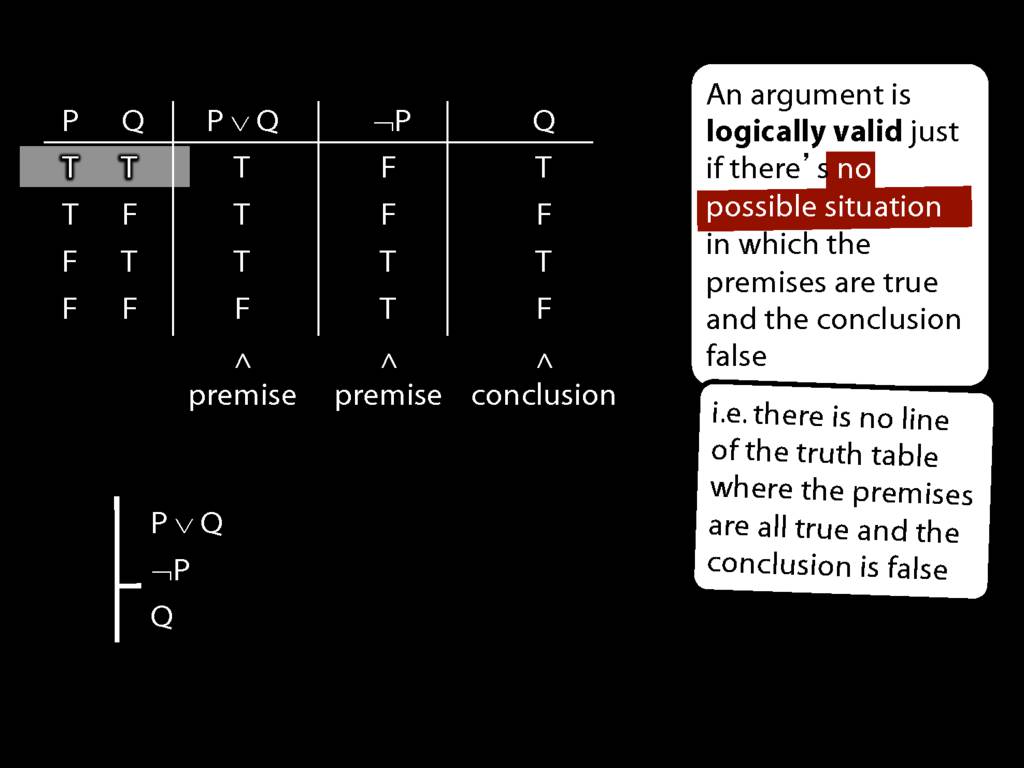
The image below illustrates this principle for the argument form known as Disjunctive Syllogism: . Notice the third row: it's the only one where both premises ( and ) are true. In that specific row, the conclusion () is also true. Since no row shows true premises and a false conclusion, the argument is valid.
2. A Systematic Procedure for Constructing Truth Tables
Your background in physics and programming has prepared you well for the procedural nature of truth table construction. The process is algorithmic and can be broken down into four distinct steps.
Step 1: Set up the Table Structure
- Identify Atomic Propositions: List all unique atomic propositions (e.g., ) present in the argument. Let the number of unique propositions be .
- Determine the Number of Rows: The table must cover every possible combination of truth values. For propositions, there are combinations. An argument with 2 variables needs rows; one with 3 variables needs rows.
- Create Columns: Create a "base column" for each atomic proposition, followed by a column for each premise and a final column for the conclusion.
Step 2: Fill the Base Columns
To ensure all combinations are listed systematically, follow this procedure:
- In the rightmost base column, alternate truth values on every row: T, F, T, F, ...
- In the column to its left, alternate in pairs: T, T, F, F, ...
- In the next column to the left, alternate in groups of four: T, T, T, T, F, F, F, F, ...
- Continue this pattern, doubling the group size for each column as you move left.
This procedure is identical to counting in binary, where T can be represented by 1 and F by 0.
4.5 Testing for Validity in SL – An Introduction to Logic
This resource from An Introduction to Logic provides an excellent, detailed walkthrough of setting up and filling in a truth table.
Focus on the section Example 1. Pay close attention to the systematic method for filling the base columns and then calculating the values for the compound sentences. The images provide a clear, step-by-step visualization of the process.
Step 3: Evaluate the Compound Formulas
For each row, calculate the truth value of each premise and the conclusion. This uses the skills you developed in the previous lesson.
- Start with the given truth values in the base columns for that row.
- For complex formulas with multiple connectives (e.g., ), identify the main connective.
- Calculate the truth values of the sub-formulas first, working from the innermost parentheses outward, until you determine the truth value of the main connective. This value represents the truth value of the entire formula for that specific row.
Step 4: Search for a Counterexample
Scan the completed table row by row. Look for a row where the columns for all the premises show 'T' and the column for the conclusion shows 'F'.
- If you find one or more such rows, the argument is invalid.
- If you find no such rows, the argument is valid.
3. An Example with a Complex Premise
Let's test a more complex argument to see Step 3 in action.
Argument: (~P • Q) ∨ ~R, Q ⊃ P, /∴ ~R
(Note: Here, • is used for conjunction and ⊃ for the conditional ).
This argument has 3 atomic propositions (P, Q, R), so we need a table with rows.
4.5 Testing for Validity in SL – An Introduction to Logic
The same resource provides an excellent walkthrough for a more complex, 3-variable argument.
Please read Example 2. This section is particularly valuable as it demonstrates how to compute the truth values for a complex formula like (~ p • q) ∨ ~ r in stages. Notice how the calculation mirrors the evaluation of a nested function, a concept familiar from mathematics and programming.
As you saw in the reading, the final table shows that in the three rows where both premises are true (rows 2, 4, and 8), the conclusion is also true. There are no counterexamples. Therefore, the argument is valid.
This image from Britannica illustrates a similarly complex table. The numbers below the columns indicate the order of calculation, moving from the atomic parts to the main connective.

4. The Problem of Scale and a More Efficient Method
The exhaustive nature of truth tables is both their strength and their weakness. For an argument with 5 variables, you would need 32 rows. For one with 10 variables, you would need 1024 rows. This exponential scaling makes the full truth table method impractical for complex arguments. Given your experience with computational complexity, this limitation is likely self-evident.
This suggests the need for a more efficient strategy. Instead of filling out the entire table, we can directly search for a counterexample. This is often called the indirect or short-cut truth table method. It functions as a proof by contradiction (reductio ad absurdum).
The procedure is as follows:
- Assume invalidity: Assume a counterexample row exists. This means you can assign 'T' to all premises and 'F' to the conclusion simultaneously.
- Start with the conclusion: Assign 'F' to the main connective of the conclusion. Work backward to deduce the truth values of the atomic propositions that must hold for the conclusion to be false.
- Test the premises: Substitute these deduced values into the premises.
- Try to make all premises true: Determine if it is possible to assign truth values to any remaining, undetermined atomic propositions in a way that makes all premises true.
- Look for a contradiction:
- If you can successfully create a full truth-value assignment where all premises are 'T' and the conclusion is 'F', you have found your counterexample. The argument is invalid.
- If the assumption in step 1 forces a contradiction at any point (e.g., a proposition must be both T and F), then a counterexample is impossible. The argument is valid.
Peter Smith's lecture notes provide a formal treatment of this "speeding up" technique.
First, read the section "Speeding up the test" to understand the general principles of the shortcut. Then, carefully follow the example in "Reworking our first example", which applies this method to an argument with three variables. This demonstrates how you can systematically eliminate rows without having to calculate every value.
This indirect method transforms the problem from an exhaustive check into a targeted search for a falsifying instance. It is a more intellectually engaged process that leverages logical deduction rather than mechanical computation.
Conclusion
In this lesson, you have learned the semantic method for testing the validity of propositional arguments. The truth table provides a complete, algorithmic procedure for determining whether an argument's conclusion is a necessary consequence of its premises.
Key Takeaways:
- An argument is valid if no possible assignment of truth values results in all true premises and a false conclusion.
- A full truth table tests for validity by exhaustively enumerating all possible truth-value assignments.
- The procedure is to set up the table based on the number of variables, systematically fill the base columns, calculate the truth value of each formula for each row, and search for a counterexample row (all premises T, conclusion F).
- The exponential growth of truth tables makes them impractical for arguments with many variables.
- The indirect, or shortcut, method offers a more efficient alternative by directly searching for a counterexample, essentially performing a proof by contradiction.
Preview of the Next Lesson:
While truth tables are definitive, their mechanical nature can be cumbersome and doesn't always reflect the structure of human reasoning. In our next lesson, we will explore natural deduction. This is a syntactic method of proof where we start with premises and apply a set of simple, intuitively valid rules of inference to derive a conclusion. This will provide a powerful new tool for proving arguments valid and will highlight the fundamental distinction between semantic and syntactic approaches to logic.