In our last lesson, we explored the zenith of medieval scholastic philosophy through Aquinas's cosmological argument. We saw how he built his case for God's existence on an Aristotelian foundation, reasoning a posteriori from observable effects in the world—like motion and causation—back to a sustaining, ultimate cause. This approach, rooted in empirical observation, represents one of the great traditions in Western thought.
Today, we leap forward to the dawn of the modern era and encounter a figure who instigated a philosophical revolution by taking the opposite path. René Descartes, a brilliant mathematician and physicist, sought to give philosophy the same unshakable certainty he found in geometry. To do this, he argued that we must first tear down the entire edifice of our beliefs and begin not from the world, but from the self. This lesson will analyze his radical method of doubt and the first, foundational certainty it uncovers: the famous cogito argument. Your own experience in physics, where revolutionary theories sometimes require dismantling long-held classical assumptions to build a new framework from first principles, provides a strong parallel to Descartes' ambitious project.
1. The Cartesian Project: A Quest for Certainty
Descartes lived in an age of profound intellectual upheaval, with the scientific revolution casting doubt on many traditional beliefs. His goal was to find an "Archimedean point"—a single, indubitable truth upon which all other knowledge could be securely built. He wasn't content with beliefs that were merely probable; he wanted absolute certainty.
To achieve this, he devised a radical strategy. This project is laid out in his Meditations on First Philosophy. To begin, let's watch an introduction to Descartes' overall goal and his unique approach.
René Descartes - Meditation #1 - The Method of Doubt
This video by Jeffrey Kaplan introduces Descartes' Meditations and explains the fundamental distinction he makes between merely probable beliefs and beliefs that are 100% certain. It also outlines his audacious plan for achieving this certainty.
Please watch the first two segments: The introduction to Descartes' project and the distinction between 'probably true' and 'guaranteed true' beliefs. Descartes' radical plan to suspend belief in anything that is even slightly doubtable, treating it as if it were false to clear the ground for a new foundation.
As the video explains, Descartes' method involves a voluntary and systematic suspension of belief. His rule is this: if a belief can be doubted in any way, no matter how small, he will provisionally reject it. This is not because he believes it is actually false, but because it cannot serve as a perfectly stable foundation for knowledge. This methodical process of doubt is the tool he uses to clear away the "loose earth and sand" of opinion to find the "rock or clay" of certainty.
2. The Stages of Doubt: Systematic Demolition
Descartes recognized that it would be an "endless task" to doubt each of his beliefs one by one. Instead, he attacks the very principles upon which his beliefs are founded. This proceeds in three main stages, each more powerful and all-encompassing than the last.
René Descartes - Meditation #1 - The Method of Doubt
We'll continue with the same video, which now walks through the actual application of the method of doubt as presented in the First Meditation.
Please watch the following segments, which detail the three escalating waves of doubt: First, focus on the general method, where Descartes explains he will attack the "basic principles" of his beliefs, using the famous building-and-foundation analogy. Next, see the first application of the method in the argument from sensory deception. Note how this initially only applies to small or distant objects, but Descartes pushes back. Then, watch the dream argument, which expands the doubt to cover all sensory beliefs, even those about our immediate surroundings and our own bodies. Finally, after considering what truths might survive the dream argument (like mathematics), watch the introduction of the ultimate skeptical hypothesis: the malicious demon argument.
Let's summarize this systematic demolition:
-
Doubt of the Senses: Descartes first considers that his senses have deceived him in the past (e.g., a distant tower that looked round turned out to be square). He concludes that it is prudent not to trust completely what has deceived him even once. This initially seems to cast doubt only on perceptions of things that are small or far away. What about the immediate and obvious, like the fact that he is sitting by the fire, holding a piece of paper?
-
The Dream Argument: To doubt even these immediate beliefs, Descartes considers that he has had dreams that were vividly realistic. While dreaming, he was convinced he was awake. He notes there are "never any sure signs" to distinguish wakefulness from sleep. For all he knows, his current experience could be a dream. This single thought undermines the entire foundation of empirical knowledge derived from the senses.
-
The Evil Genius (Malicious Demon) Argument: Even if he is dreaming, some truths seem to remain. Whether awake or asleep, "two and three added together are five, and a square has no more than four sides." These truths of arithmetic and geometry don't depend on sensory experience. To doubt even these, Descartes introduces his most radical skeptical tool. He posits the possible existence of an all-powerful but malicious being—an "evil genius"—who has "employed all his energies in order to deceive me."
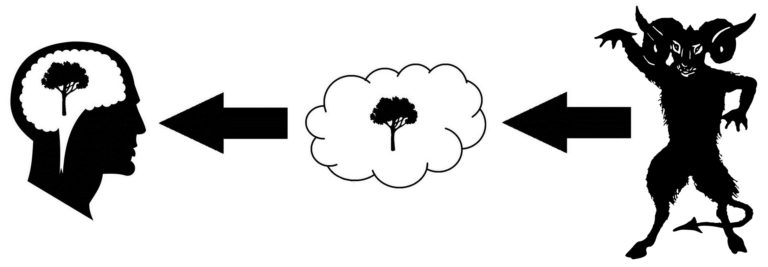
This supremely powerful deceiver could make Descartes believe that even if it is false. This hypothesis casts doubt on the validity of reason itself, plunging Descartes into a state of universal doubt where nothing seems certain.
3. The Cogito: The Indubitable Foundation
At the beginning of the Second Meditation, having demolished everything, Descartes searches for one thing that can resist even the evil genius doubt. He finds it in the very act of doubting.
René Descartes - Meditation #2 - I think, therefore, I am
Having reached the depths of doubt, Descartes makes his foundational discovery. This segment from Jeffrey Kaplan's video on the Second Meditation explains the emergence of the famous cogito.
Watch the clip from Descartes' discovery of "I am, I exist". Pay close attention to why this proposition is immune to doubt, even from an evil genius.
The argument, famously expressed as Cogito, ergo sum ("I think, therefore I am"), works as follows:
- I have convinced myself that nothing in the world exists.
- But if I convinced myself of something, then I must have existed.
- Suppose there is an evil genius who is constantly deceiving me.
- In that case, I too must undoubtedly exist in order to be deceived.
- Let him deceive me as much as he can, he can never cause me to be nothing so long as I think that I am something.
The proposition "I am, I exist" is necessarily true whenever it is put forward by him or conceived in his mind. The very act of thinking it, or doubting it, confirms its truth. The evil genius cannot deceive him about his own existence, because deception requires a subject to be deceived.
Reconstructing the Argument
Is the cogito an inference or a self-evident intuition? Philosophers debate this point. In some texts, Descartes presents it as an inference ("therefore I am"), while in others, he describes it as a "simple intuition of the mind." For a learner with your background, it's illuminating to see how it can be reconstructed formally as a logical argument.
Redalyc.Thought Experiment Analyses of René Descartes' ...
This article by C. P. Hertogh provides a formal logical analysis of the cogito, treating it as a valid argument form known as modus ponens.
Please read the section titled "Logical Analysis of Deep Structure". This section shows how the famous phrase "I think, therefore I am" is actually an enthymeme—an incomplete syllogism—that can be made valid by supplying an implicit major premise.
As the article demonstrates, the cogito can be formalized as follows:
- Implicit Major Premise: For all , if thinks, then exists.
- Minor Premise (The act of introspection): I think. ()
- Conclusion: Therefore, I exist. ()
This is a valid instance of universal instantiation and modus ponens. Whether Descartes discovered it through a formal deduction or a flash of intuition, its logical structure is sound. He has found his Archimedean point.
4. The Nature of the "I": A Thinking Thing
Having established that he exists, Descartes immediately asks what he is. He has doubted away his body, his senses, and the entire physical world. What is left?
René Descartes - Meditation #2 - I think, therefore, I am
This final selection from Kaplan's video explores Descartes' conclusion about his own nature and contrasts it with the preceding Aristotelian view, marking a pivotal shift in the history of philosophy.
Watch these final clips: "What sort of thing am I?" Here, Descartes concludes he is a "thinking thing" (res cogitans). The definition of thinking. This long and crucial segment explains Descartes' revolutionary concept of the mind as an entity whose activities (imagining, sensing, willing) are purely mental and separable from the body, a stark break from the Aristotelian soul we discussed in the context of Aquinas.
Descartes concludes he is, in essence, a thinking thing (res cogitans). For him, "thinking" (cogitatio) is an umbrella term for all conscious activities:
- Doubting
- Understanding
- Affirming
- Denying
- Willing
- Refusing
- Imagining
- Having sensory perceptions (e.g., seeming to see light or feel heat, even if it's a dream)
Crucially, at this stage of the argument, Descartes knows himself only as a mind. He still has no proof that he has a body or that a physical world exists. His essential nature is purely mental. This conclusion, that the mind is more immediately and certainly known than the body, is a cornerstone of his philosophy and directly leads to the famous mind-body problem, which we will explore in our next lesson.
Conclusion
Descartes' method of doubt and the resulting cogito argument represent a fundamental turning point in philosophy, shifting the starting point of inquiry from the external world (as in Aquinas) to the internal consciousness of the self.
Key Takeaways:
- Method of Doubt: A systematic, hyperbolic, and constructive process of suspending belief in anything doubtable to find an absolutely certain foundation for knowledge.
- Stages of Doubt: The method unfolds in three waves: doubting the reliability of the senses, the possibility of dreaming, and finally, the "evil genius" hypothesis that undermines even rational truths.
- The Cogito: The proposition "I think, therefore I am" emerges as the one indubitable truth that resists even the most extreme doubt, because the act of doubting itself presupposes the existence of a doubter.
- Res Cogitans: The cogito establishes the self's existence as a "thinking thing." For Descartes, this mental existence is the most certain thing of all—more certain, at this stage, than the existence of his own body or the physical world.
Preview of the Next Lesson:
Descartes has successfully secured his first piece of certain knowledge: "I exist as a thinking thing." But he is trapped within his own mind. How can he bridge the gap from this internal certainty to knowledge of an external world? The next logical step in his project is to determine if anything else exists with equal certainty. This will lead him to analyze the contents of his own mind, where he finds the idea of God. Before we analyze his argument for God's existence, however, we must first grapple with the immediate consequence of the cogito: the profound separation between the mind (res cogitans) and the body (res extensa). Our next lesson will address Cartesian substance dualism and the enduring philosophical puzzle it created: the mind-body problem.