Welcome back. In our previous lessons, we built a solid understanding of two monumental ethical frameworks. We first examined Kant's deontology, with its focus on universalizable maxims and the intrinsic worth of rational agents, and then contrasted it with utilitarianism, which judges morality solely by the yardstick of consequences.
Today, we will place these two theories in direct opposition. Your learning objective is to compare the deontological and consequentialist frameworks by applying them to a specific ethical dilemma. This exercise will move beyond abstract definitions and reveal how their fundamentally different starting assumptions lead to divergent, and often conflicting, moral conclusions. We will use the famous "Trolley Problem" and its variations as a diagnostic tool to probe the very core of each system's logic.
1. The Stage of Conflict: The Trolley Problem
Ethical thought experiments are like stress tests for moral theories. They are designed to push a framework to its logical limits and expose its underlying commitments. The Trolley Problem, first formulated by Philippa Foot, is perhaps the most famous of these.
Professor Michael Sandel of Harvard University provides an excellent interactive exploration of this problem. We will use his lecture as a starting point to frame our analysis.
Justice: What's The Right Thing To Do? Episode 01 "THE MORAL SIDE OF MURDER"
This segment from Professor Sandel's famous "Justice" lecture introduces the classic Trolley Problem and gauges the immediate moral intuitions of the audience.
Please watch the opening of the lecture, which details the first scenario. As you watch, consider two things: your own immediate answer, and the primary reason given by the students for their choice.
As you saw, the overwhelming majority opts to turn the trolley. The reasoning is explicitly consequentialist: "better to kill one so that five can live." For an act utilitarian, the analysis is straightforward. Faced with two possible actions, one resulting in five deaths and the other in one, the choice is clear. The act that maximizes utility (or, in this case, minimizes disutility) is to turn the trolley. It is not just permissible; it is morally required.
A deontological analysis is immediately more complex. A Kantian must ask: does turning the trolley violate a perfect duty? One could formulate a maxim such as, "I will sacrifice one person's life to save a greater number of lives." Could this be universalized without contradiction? It's not immediately obvious that it couldn't. However, the action is still causing a death. This initial ambiguity sets the stage for variations of the problem that bring the deontological constraints into much sharper focus.
2. Sharpening the Contrast: Using a Person as a Means
The power of the Trolley Problem lies in its variations, which are designed to isolate specific moral intuitions. Let's consider two famous variants: the "Fat Man" and the "Transplant" case.
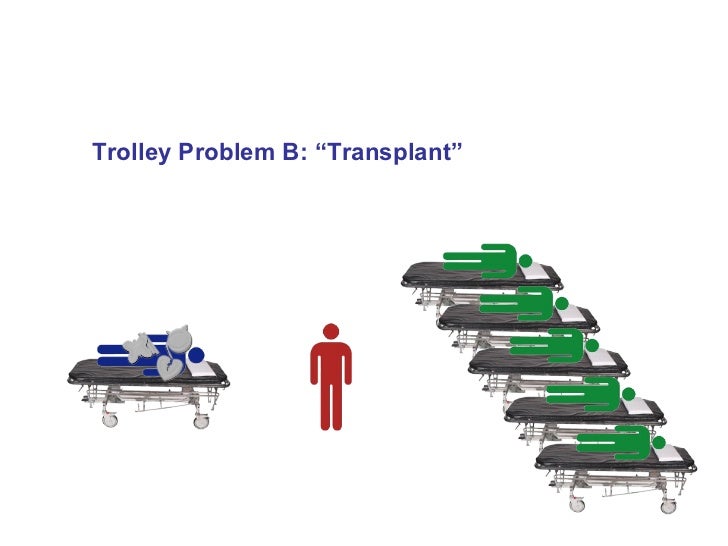
Professor Sandel introduces the "Fat Man" case to test the principle established in the first scenario. You have also previously encountered the "Transplant" case in our lesson on utilitarianism.
Justice: What's The Right Thing To Do? Episode 01 "THE MORAL SIDE OF MURDER"
These segments introduce two critical variations of the dilemma, pushing the simple consequentialist logic to its breaking point and revealing a new moral dimension.
First, watch the "Fat Man" variation from pushing the fat man. Note how the audience's moral judgment shifts dramatically. Next, watch the introduction of the medical dilemmas, specifically the transplant surgeon case.
In both the "Fat Man" and "Transplant" scenarios, the numbers are identical to the first case: one life is sacrificed to save five. A pure act utilitarian, committed only to aggregating consequences, might be forced to conclude that pushing the man or harvesting the organs is the morally correct action. This is the source of the "wrong answers" objection we discussed previously. While a rule utilitarian might argue that a general rule permitting such actions would lead to terrible social consequences (e.g., people fearing doctors), the deontologist offers a more direct and fundamental objection.
The reason most people recoil from these actions is captured perfectly by the second formulation of Kant's Categorical Imperative: Act in such a way that you treat humanity, whether in your own person or in the person of any other, always at the same time as an end and never merely as a means.
This "Means Principle" is the key to differentiating the cases:
- Original Trolley Case: You divert a pre-existing threat. The death of the one worker is a foreseen, tragic side-effect of saving the five. The five would be saved even if the lone worker miraculously escaped from the track at the last second. The lone worker's body is not the instrument of their salvation.
- Fat Man / Transplant Case: You introduce a new threat to a person who was not previously in danger. The victim is being used merely as a means. Their body is the tool that stops the trolley or provides the organs. If the fat man were to be pushed and somehow survive, the five on the track would still die. His death (or at least his body being used as a stop) is causally necessary for the plan to succeed.
This distinction between an action's intended effect and its foreseen side-effects is crucial for deontology. For a deeper, more formal understanding of this point, we turn to the Stanford Encyclopedia of Philosophy and an article applying these concepts in medical ethics.
Medical ethics and the trolley Problem - PMC
This article by David Rodríguez-Arias provides a clear analysis of how the Means Principle differentiates the trolley scenarios.
Please read section 2. The Second Trolley Case. Focus on the explanation of how Judith Jarvis Thomson's bystander scenario is analyzed using Kant's philosophy. The author clearly articulates why the organ donor is used as a means, while the person on the side track is not.
3. Deontology's Architecture: Agent-Relativity vs. Agent-Neutrality
This brings us to a more abstract and powerful distinction between the two frameworks. Utilitarianism is an agent-neutral theory. It posits a universal good (happiness, welfare) and asserts that all agents have the same reason to maximize it. From a "God's-eye view," the best state of affairs is the one with the most net utility, and it doesn't matter who brings it about.
Deontology, particularly in its most common forms, is an agent-centered theory. It gives each agent permissions and obligations that are relative to them. My primary duty is not to bring about the best state of affairs, but to ensure that my own actions do not violate moral law. I have a special, personal duty not to murder, which is more stringent than my general duty to prevent murders by others.
This leads to what is sometimes called the "paradox of deontology." Why shouldn't a deontologist kill one person if it would prevent five other people from being killed by someone else? The agent-centered answer is that the focus of my categorical obligations is on keeping my own agency free of moral taint. Violating a duty now to prevent more of the same violations by others is, in essence, to treat my own moral integrity as something that can be traded for better overall consequences—a consequentialist move.
The Stanford Encyclopedia of Philosophy provides a rigorous explanation of these concepts.
Deontological Ethics - Stanford Encyclopedia of Philosophy
These sections detail the formal structure of agent-centered and patient-centered deontological theories, which formalize the intuitions we've been discussing.
First, read the introduction to Agent-Centered Deontological Theories in section 2.1. Pay attention to the definition of an agent-relative reason and the core idea that "morality is intensely personal, in the sense that we are each enjoined to keep our own moral house in order." Next, read the introduction to Patient-Centered Deontological Theories in section 2.2. This section explains the rights-based approach, focusing on the core right against being used as a means. Notice how it provides a different, but complementary, explanation for the Trolley and Transplant cases.
4. Real-World Complexity: The Queen v. Dudley and Stephens
Hypotheticals are clean, but reality is messy. To see how these frameworks grapple with the pressures of a real-life moral catastrophe, we can examine a famous 19th-century English law case involving shipwreck and cannibalism.
Justice: What's The Right Thing To Do? Episode 01 "THE MORAL SIDE OF MURDER"
Professor Sandel recounts the harrowing true story of the Mignonette and analyzes the moral arguments for and against the sailors' actions.
Please watch the segment detailing the case of The Queen v. Dudley and Stephens. Then, continue watching the subsequent debate among the students regarding the role of consent and fair procedure.
Let's analyze this case through our two competing lenses:
- Consequentialist Analysis: A defense of Dudley and Stephens is possible. The cabin boy, Richard Parker, was an orphan and was already sick and near death. By killing him, three men survived, who could then return to their families and productive lives. From a purely utilitarian perspective that sums up outcomes, an argument can be made that sacrificing the one who was least likely to survive anyway to save three others resulted in a better state of affairs. This is the argument from "necessity."
- Deontological Analysis: The prosecution's argument was simple: "murder is murder." This is a purely deontological stance. Parker was killed to serve as food; he was used merely as a means for the others' survival. This is a direct and profound violation of a categorical duty not to kill an innocent person. The consequences, no matter how beneficial to the survivors, cannot justify an intrinsically wrongful act.
The discussion of consent and a lottery adds further layers. For a deontologist, consent is paramount because it respects a person's rational agency and autonomy. An action that would be "using" someone without their consent might become permissible with their consent, because they are then choosing to participate in the act as an end in themselves. Similarly, a fair lottery respects each person as an equal, rather than arbitrarily deciding one person's life is less valuable.
Conclusion
By stress-testing deontology and consequentialism with these dilemmas, we have illuminated their fundamental structural differences.
- Key Takeaways:
- Consequentialism (specifically act utilitarianism) judges the morality of an act based solely on its outcome, using an agent-neutral calculation to achieve the greatest good for the greatest number.
- Deontology judges an act based on its conformity with moral duties or rules, which are often understood in agent-relative terms. The focus is on the rightness of the action itself, not the goodness of the consequences.
- The Trolley Problem and its variations demonstrate that a key point of divergence is Kant's Means Principle: deontology categorically forbids using a person merely as a means to an end, even a good end. Consequentialism, in its purest form, has no such absolute prohibition.
- This distinction helps explain why our intuitions often differentiate between causing harm as an intended means (pushing the fat man) and causing harm as a foreseen side-effect (diverting the trolley).
These frameworks are not just abstract theories; they are different ways of reasoning about our most profound obligations to one another. Understanding their core logic is the first step toward building a sophisticated and consistent ethical worldview.
Preview of the Next Lesson:
The distinction we uncovered today—between intended harm and merely foreseen harm—is so critical in ethical analysis that it has been formalized into its own principle: the Doctrine of Double Effect. In our next lesson, we will dissect this doctrine, exploring its precise conditions and its application to complex moral cases in fields like medicine and warfare.