In our last lesson, we delved into the rigorous architecture of Kant's deontological ethics, where the morality of an action is determined by its conformity to universal rational principles, irrespective of its outcomes. We saw how the Categorical Imperative functions as a formal procedure for deriving moral duties. Today, we turn to a starkly contrasting ethical framework: utilitarianism. Where Kant saw consequences as irrelevant, utilitarians argue they are the only thing that matters.
Your learning objective for this lesson is to distinguish between the two primary forms of this theory—act utilitarianism and rule utilitarianism—and to analyze the classic objections that challenge each. This exploration will lay the groundwork for a direct confrontation between deontology and consequentialism in our next lesson.
At its core, all utilitarianism is built upon the principle of utility: the morally right choice is the one that produces the greatest good for the greatest number of people. While the principle sounds simple, its application has generated one of the most significant divisions within the consequentialist camp.
1. Act Utilitarianism: The Direct Calculation
The most straightforward interpretation of the principle of utility leads to act utilitarianism. It holds that in any given situation, the right action is the one that, on that specific occasion, maximizes overall utility (typically defined as happiness or well-being).
- Act Utilitarianism (AU): An act is right if and only if it produces at least as much net utility as any other act the agent could have performed.
This is a direct, case-by-case approach. Before acting, one should ideally calculate the foreseeable consequences of all available options and choose the one with the best outcome. The classical formulation of this view is most associated with Jeremy Bentham, who even proposed a "hedonic calculus" to quantify pleasure and pain.
To grasp the core idea of act utilitarianism and its demanding nature, the following short video provides a clear and concise introduction.
Act vs. Rule Utilitarianism: Why Mill Thought Bentham Was WRONG
This video from Untangle Philosophy introduces Jeremy Bentham's act utilitarianism and the ideal of the hedonic calculus.
Please watch the section explaining act utilitarianism. Focus on how it applies the principle of utility to each individual act and the practical challenges this entails.
2. Classic Objections to Act Utilitarianism
While intuitively appealing, the demand to maximize utility in every single action leads to conclusions that many find deeply counterintuitive or morally unacceptable. These challenges are often illustrated with powerful thought experiments.
a) The "Wrong Answers" and Rights-Violation Objection
Act utilitarianism seems to permit, and even require, actions that conflict with our firmest moral intuitions about justice and individual rights. Because it is aggregative—summing up total happiness—it can seemingly justify sacrificing an individual for the greater good of the many.
The Stanford Encyclopedia of Philosophy presents the canonical thought experiment illustrating this problem.
Consequentialism - Stanford Encyclopedia of Philosophy
This excerpt details the famous "Transplant" case, a formidable objection to direct consequentialist theories like act utilitarianism.
Please read the first three paragraphs of section 5, titled "Consequences of What? Rights, Relativity, and Rules," focusing on the Transplant thought experiment. Note how a direct application of the utility principle appears to justify a horrifying act.
Similar cases abound: a judge framing an innocent person to prevent a deadly riot, a person breaking a deathbed promise to create slightly more good elsewhere. In all these scenarios, act utilitarianism seems to give the "wrong" answer because it doesn't recognize any intrinsic moral status for concepts like rights, justice, or keeping promises beyond their immediate impact on utility.
b) The "Undermining Trust" Objection
If everyone followed act utilitarianism, the very foundations of social trust could erode. If a friend will break a promise or reveal a secret whenever they calculate it will produce a "whisker" more pleasure overall, the institution of friendship and promise-keeping becomes unstable.
The video you watched earlier presents a simple but effective version of this objection.
Act vs. Rule Utilitarianism: Why Mill Thought Bentham Was WRONG
This segment of the "Untangle Philosophy" video uses a relatable example to show how act utilitarianism can conflict with the value of friendship and trust.
Watch the section on the friendship and secrecy problem. This illustrates the broader "undermining trust" objection detailed in the Internet Encyclopedia of Philosophy article.
c) The "Too Demanding" Objection
Act utilitarianism's requirement for strict impartiality—where the happiness of a stranger counts just as much as your own or your family's—can seem excessively demanding. It suggests you should donate your resources to the point of marginal utility, where giving more would cause you more harm than it would cause good for the recipient. It leaves little room for personal projects or the special duties we feel we have to those we love.
3. Rule Utilitarianism: The Indirect Strategy
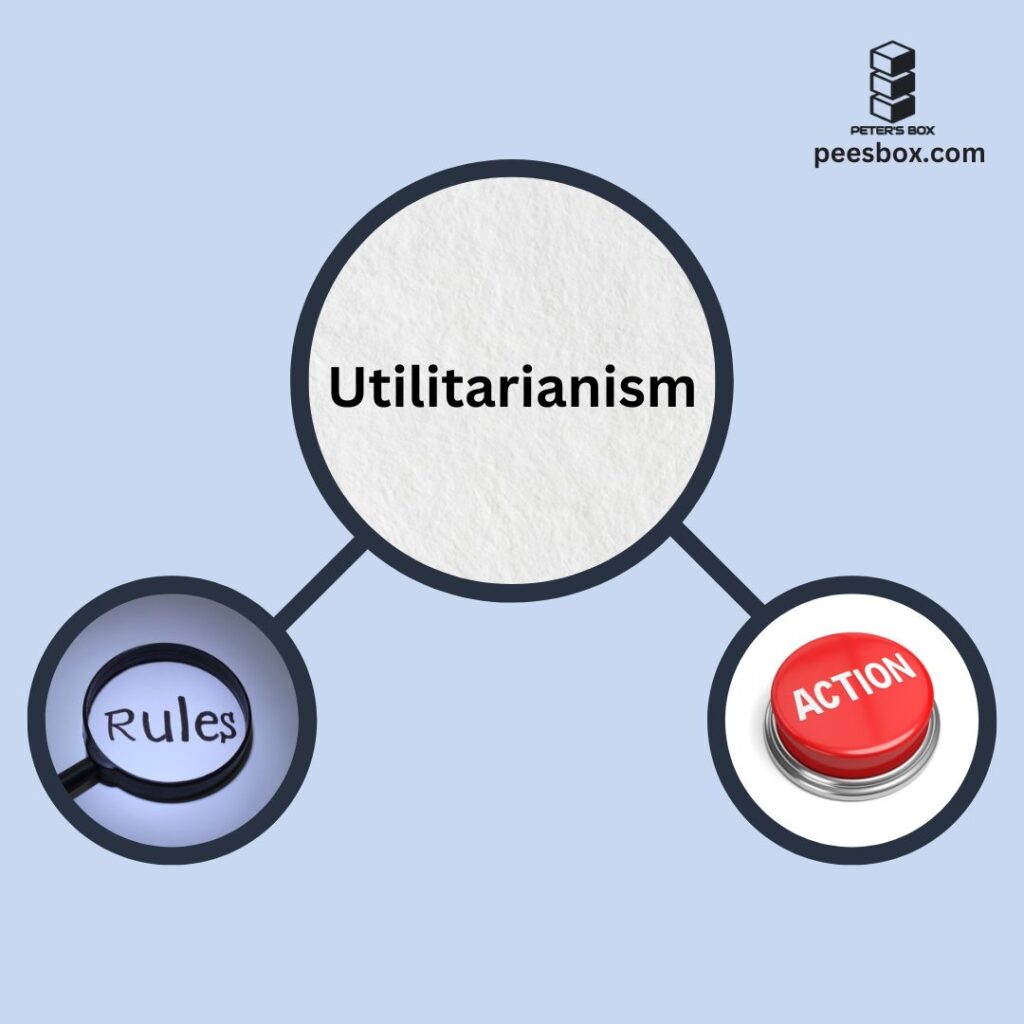
In response to these powerful objections, many consequentialists developed an indirect approach: rule utilitarianism. This view suggests that we can achieve better consequences overall by following a set of moral rules, even if breaking a rule in a particular instance might seem to maximize utility.
- Rule Utilitarianism (RU): An act is right if and only if it conforms to a rule whose general acceptance would produce the most utility.
The principle of utility is not applied to individual acts, but to the evaluation of potential moral rules. This creates a two-step procedure:
- Identify the set of rules that would produce the greatest overall utility if they were widely accepted and followed.
- Judge the rightness of an individual act by its conformity to those rules.
The Internet Encyclopedia of Philosophy provides an excellent formal definition and a compelling analogy to explain the logic of this indirect strategy.
These sections define rule utilitarianism and explain how it is designed to solve the problems of its act-based counterpart.
First, read the three paragraphs in Section 2, "How Act Utilitarianism and Rule Utilitarianism Differ," to get a precise definition of the core distinction. Next, read sub-sections 4.a.i ("Why Rule Utilitarianism Maximizes Utility") and 4.a.ii ("Rule Utilitarianism Avoids the Criticisms of Act Utilitarianism"). Pay close attention to the rules of the road analogy, particularly the comparison between stop signs (rule-based) and yield signs (act-based). Then, see how this logic is applied to resolve the classic problem cases of the judge, the doctor, and the promise-maker.
As you read, notice how rule utilitarianism secures social trust and avoids the "wrong answers" by establishing rules against killing, theft, and promise-breaking, because the general acceptance of these rules has high utility. It can even justify partiality (e.g., caring for your own children) by arguing that a system with such rules (a division of moral labor) produces the best overall consequences for everyone.
4. Objections to Rule Utilitarianism
While rule utilitarianism seems to solve many of act utilitarianism's problems, it faces its own set of sophisticated objections.
a) The "Rule Worship" Objection
Act utilitarians argue that RU leads to irrational "rule worship." If you know for certain that breaking a rule in one particular case will produce better consequences—and not harm the general respect for the rule—why should you stick to the rule? To do so seems to abandon the core utilitarian goal of maximizing good results. It seems you are prioritizing a rule over well-being itself.
b) The "Collapses into Act Utilitarianism" Objection
This is a more formal challenge. To avoid the charge of rule worship, the rule utilitarian might start adding exceptions to the rules.
- Initial rule: "Don't lie."
- Problem case: What if you must lie to save a life?
- Revised rule: "Don't lie, unless it saves a life."
- Another problem case: What if lying prevents a slightly smaller harm but creates a much greater good?
- Eventually, you might end up with a rule like: "Don't lie, unless lying produces greater utility."
But a set of rules like this is extensionally equivalent to act utilitarianism. You are simply back to calculating utility on a case-by-case basis. Rule utilitarianism seems to be stuck in a dilemma: either it is a distinct theory that irrationally worships rules, or it modifies itself with so many exceptions that it collapses back into act utilitarianism.
The "Untangle Philosophy" video provides a succinct explanation of this problem through the lens of "strong" vs. "weak" rule utilitarianism.
Act vs. Rule Utilitarianism: Why Mill Thought Bentham Was WRONG
This final segment explains the dilemma faced by rule utilitarianism.
Please watch the section covering strong vs. weak rule utilitarianism. Notice how the "weak" version, which allows for exceptions, risks collapsing into act utilitarianism.
5. A Synthesis: Mill's Two-Tiered Approach
This debate might suggest you must choose between two flawed theories. However, John Stuart Mill, a classical utilitarian, offers a more nuanced synthesis. This view distinguishes between a criterion of rightness (what fundamentally makes an action right) and a decision procedure (what we should use in practice to decide how to act).
This is analogous to a distinction in science. The theoretical definition of an acid involves hydrogen ions and proton donation. That is the "criterion" of acidity. However, the practical "decision procedure" for a chemist in a lab is often to use litmus paper. You don't analyze the ionic concentration every time; you use a reliable heuristic.
For Mill, act utilitarianism provides the theoretical criterion of rightness, while rule utilitarianism describes the correct practical decision procedure.
In his video on "Act and Rule Utilitarianism," Daniel Bonevac explains this sophisticated interpretation of Mill's position.
First, watch from the introduction of Mill's view to understand the crucial distinction between a theoretical explanation and a practical test, using the chemistry analogy. Next, see how Mill applies this to the "no time to calculate" objection from the impracticality objection. Here he introduces "secondary principles" (i.e., rules) as our practical guides. Finally, jump to the conclusion from Mill's final position to see the complete synthesis: we should think like act utilitarians in theory, but act like rule utilitarians in practice.
In this view, we follow common-sense moral rules (don't lie, keep promises) because they are the distilled wisdom of humanity about what tends to promote happiness. These "secondary principles" are our litmus test. We only appeal directly to the principle of utility (the "first principle") when these secondary rules conflict. This elegant solution attempts to get the best of both worlds: the theoretical consistency of act utilitarianism and the practical stability of rule utilitarianism.
Conclusion
In this lesson, we have navigated the primary division within utilitarian ethics, moving from its direct to its indirect application.
- Key Takeaways:
- Act Utilitarianism (AU) applies the principle of utility directly to individual acts on a case-by-case basis.
- AU faces serious objections regarding its potential to violate rights ("wrong answers"), undermine social trust, and be overly demanding.
- Rule Utilitarianism (RU) applies the principle of utility to the selection of a set of moral rules, which then guide actions. It was developed to solve AU's problems.
- RU faces its own objections, primarily that it either devolves into irrational "rule worship" or "collapses" back into AU when it tries to accommodate exceptions.
- Mill's two-tiered view offers a synthesis, treating AU as the theoretical criterion of rightness and RU as the practical decision procedure.
You have now analyzed two of the three major normative ethical theories: deontology and consequentialism. You are equipped with the conceptual tools to understand their fundamental structures, strengths, and weaknesses.
Preview of the Next Lesson:
We are now perfectly positioned to stage a direct comparison between these competing frameworks. In the next lesson, we will apply the formal procedures of Kant's Categorical Imperative and the principle of utility to a specific ethical dilemma, allowing us to see precisely where their reasoning converges and, more importantly, where it sharply diverges.