Welcome to the next lesson in our exploration of ethics. In our last session, we drew the primary dividing line in metaethics: the distinction between cognitivism and non-cognitivism, which hinges on whether moral statements are truth-apt. We saw that cognitivists believe they are, opening the door for positions like error theory and moral realism.
Today, we delve into what is perhaps the most intuitive of these metaethical positions: moral realism. This is the view that, like scientific or historical facts, moral facts exist objectively and mind-independently. Our goal is to first clearly define moral realism and its core commitments. Then, we will spend the bulk of our lesson reconstructing and analyzing one of the most formidable and enduring challenges to it: the argument from moral disagreement. This will require us to engage in the kind of rigorous philosophical analysis you're keen to master, evaluating an argument's structure and the strength of its premises.
1. What is Moral Realism?
In our previous lesson, we used a flowchart to map the metaethical landscape. Moral realism occupies a specific, and arguably common-sense, branch of that map.
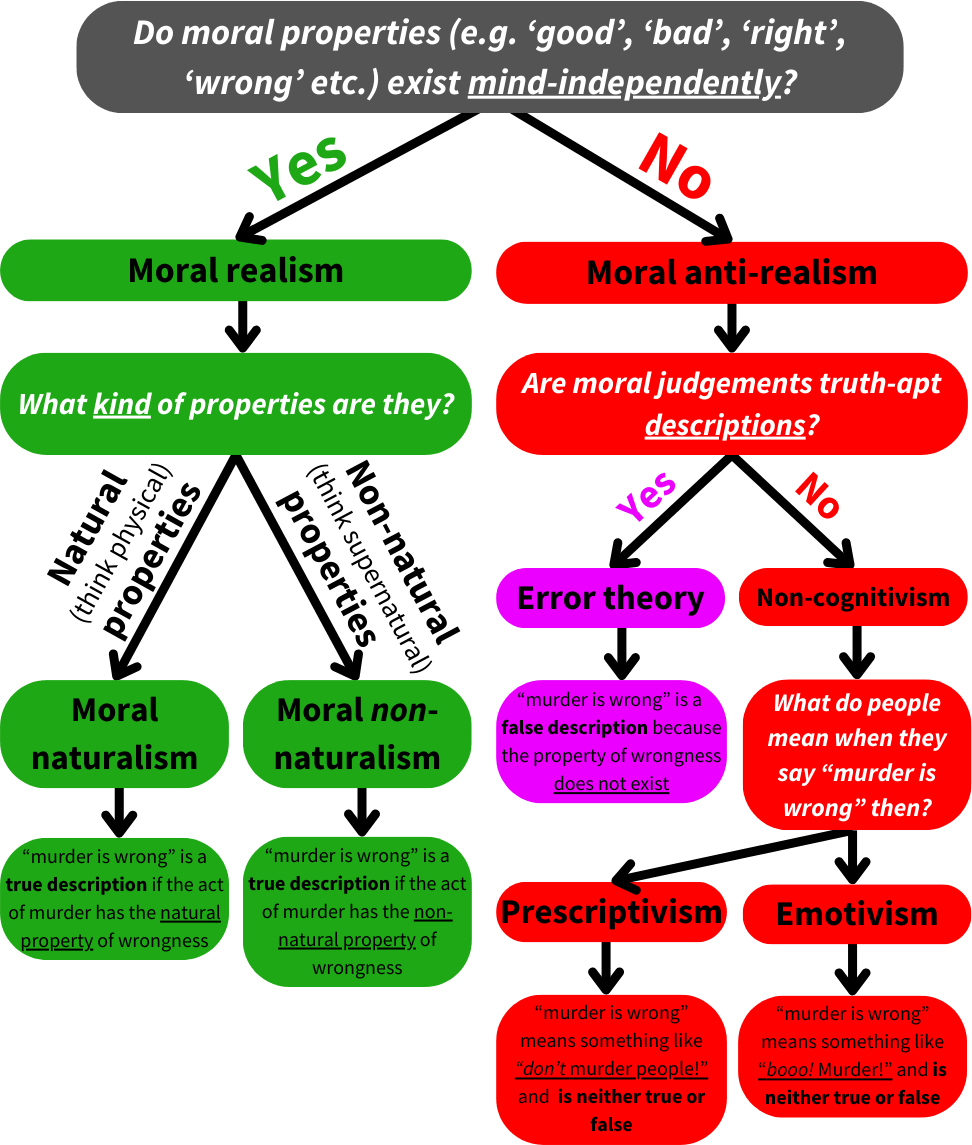
Moral realism is defined by three core tenets. To get a precise formulation of these, let's turn to a clear introductory explanation.
Moral Disagreement and Moral Realism
The video "Moral Disagreement and Moral Realism" from the Majesty of Reason channel provides a concise and accurate definition of moral realism right at the beginning.
Please watch the section from the definition of moral realism. The presenter breaks down the position into three essential claims.
As you just saw, the three pillars of moral realism are:
- Cognitivism (The Semantic Claim): Moral judgments express propositions. When we say "torturing babies for fun is wrong," we are making a statement that is capable of being true or false, not merely expressing an emotion like "ick!". This is the shared foundation of all cognitivist theories, which we covered last time.
- Success Theory (The Alethic Claim): Some of these moral propositions are true. This distinguishes moral realism from its cognitivist cousin, error theory, which claims all positive moral propositions are false.
- Objectivity (The Metaphysical Claim): These propositions are true in virtue of objective, mind-independent facts. Their truth doesn't depend on what any individual or society believes, desires, or approves of. If realism is true, "slavery is wrong" would be true even if every society on Earth practiced and endorsed it.
This combination of claims makes moral realism a robust position. It aims to secure the status of morality as a domain of objective inquiry, much like science or history. However, this very robustness invites a powerful objection. If there are objective moral facts, why can't we seem to agree on what they are?
2. The Argument from Disagreement
The "argument from disagreement," also known as J.L. Mackie's "argument from relativity," is perhaps the most famous and intuitively powerful argument against moral realism. At its core, it is an inference to the best explanation (IBE). Given your background in the sciences, you'll recognize this argumentative structure: we observe a phenomenon and argue that one hypothesis explains it better than any competing hypothesis.
The phenomenon in question is the sheer breadth and depth of moral disagreement across cultures and historical periods.
Mackie's Arguments for the Moral Error Theory
This supplement from the Stanford Encyclopedia of Philosophy gives a crisp summary of Mackie's argument.
Please read the section titled Argument from Relativity. Focus on how Mackie frames the argument as a choice between two competing explanations for moral diversity.
As the text explains, Mackie contrasts two hypotheses:
- The Realist Hypothesis: Moral disagreements arise because some people or cultures have a faulty or inadequate "perception" of objective moral values.
- The Anti-Realist Hypothesis (Mackie's preferred one): Moral disagreements arise because moral codes simply "reflect adherence to and participation in different ways of life."
Mackie argues that the anti-realist hypothesis is a better, more plausible explanation. It seems more likely that our moral views grow out of our social practices than that entire cultures are simply failing to "see" the moral truth.
Let's watch a short, clear presentation of Mackie's reasoning.
The video "Metaethics 3 - Error Theory" by Kane B offers an excellent walkthrough of Mackie's arguments.
Please watch the segment from the argument from relativity. Notice how the presenter articulates the challenge for the objectivist (realist): they have to explain how and why so many people's perceptions of moral facts go wrong. The video also raises an important counter-point: disagreement exists in science too, but we don't conclude there are no scientific facts.
The point about scientific disagreement is crucial. It forces the anti-realist to explain what makes moral disagreement different. Mackie's response, as noted in the video, is that scientific disagreements can typically be resolved by gathering more evidence and using established methods. Moral disagreements, he suggests, often seem intractable—persisting even when all parties agree on the non-moral facts.
3. Analyzing the Argument and Its Rebuttals
We've seen the basic form of the argument from disagreement. Now, we will subject it to the kind of rigorous analysis that is the hallmark of formal philosophy. We will explore it not as a settled proof, but as the opening move in a complex dialectic.
For this, we'll turn to a more advanced resource that unpacks the argument as a formal inference to the best explanation and then systematically explores numerous realist counter-arguments. This will be a deep dive, mirroring the process of philosophical debate.
Moral Disagreement and Moral Realism
This section of "Moral Disagreement and Moral Realism" is dedicated to a thorough analysis of Mackie's Inference to the Best Explanation argument and the powerful responses available to the moral realist.
Please watch the segment from Mackie's IBE argument. The presenter first lays out the argument's structure and then introduces a series of realist-friendly alternative explanations for moral disagreement. Pay close attention to these, as they form the core of the realist's defense.
Let's break down the key lines of response you just encountered. These strategies challenge the central premise of Mackie's argument: that anti-realism is the best explanation for disagreement.
Response 1: Realist-Friendly Explanations
The realist can argue that disagreement is perfectly compatible with realism. The existence of objective facts in a domain does not guarantee that humans will have easy or uniform access to them. The video highlights several factors that can explain moral disagreement within a realist framework:
- Complexity: Many moral issues are incredibly complex, involving intricate factual details and the balancing of multiple values.
- Cognitive Biases and Shortcomings: People are not perfect reasoners. We are prone to biases, emotional interference, and simple errors in logic.
- Self-Interest: This is a powerful distorting factor in morality that is less prevalent in, say, theoretical physics. As the video notes, it was in the profound self-interest of slaveholders to believe slavery was morally acceptable. The correlation between moral views and self-interest provides a powerful realist explanation for many disagreements.
- Limited Empathy and Imagination: It can be difficult to fully appreciate the perspective of others, leading to flawed moral judgments.
The realist can argue that a combination of these factors provides a very rich and plausible explanation for moral disagreement, without needing to deny the existence of objective moral facts.
Response 2: The Fallacy of Understated Evidence
Mackie's argument focuses on the fact of disagreement. But is that the whole story? The realist can argue that this commits the fallacy of understated evidence—that is, conveniently ignoring other, more specific facts that point in the opposite direction.
The video points to two crucial phenomena:
- Moral Convergence: Over time, there has been significant convergence on many moral issues (e.g., the abolition of slavery, the expansion of rights). It's arguable that realism provides a better explanation for this convergence (societies are slowly discovering objective moral truths as they overcome biases) than anti-realism does (societies' "ways of life" just happen to be changing in similar ways).
- Moral Progress: We have a strong sense of moral progress. We believe that moving from a society that condones slavery to one that condemns it is an improvement, not just a change in taste. The concept of "progress" seems to presuppose an objective standard to measure against, which fits perfectly with realism but is difficult for an anti-realist to explain.
Response 3: The Overgeneralization and Self-Defeat Worry
This is a classic and powerful objection in philosophy. The argument from disagreement seems to prove too much.
- Widespread Disagreement in Other Fields: There is deep and persistent disagreement in science, metaphysics, epistemology, and even mathematics. If disagreement implies a lack of objective facts, we are pushed towards a radical global skepticism.
- Disagreement in Metaethics Itself: Philosophers disagree vehemently about the status of moral realism. If the argument from disagreement is a good argument, then we should apply it to itself. The disagreement about the argument's validity would seem to suggest that there is no objective fact of the matter about whether it's a good argument, thereby undermining it. This is a form of epistemic self-defeat.
This is a sophisticated point, and it forces the proponent of the argument from disagreement to find a principled way to distinguish moral disagreement from disagreement in other domains.
Moral Disagreement - Stanford Encyclopedia of Philosophy
The Stanford Encyclopedia of Philosophy article on "Moral Disagreement" provides a scholarly summary of these arguments.
To reinforce these points, please read section 3.1, The Argument from Relativity, which recaps Mackie's argument. Then, read section 6, Over-Generalization and Self-Defeat Worries, which expertly details the self-defeat problem we've just discussed.
Conclusion
Today we have explored moral realism, the view that objective moral facts exist, and have rigorously analyzed its most prominent challenge. This process of presenting an argument and then systematically probing it with counter-arguments is the very heart of philosophical practice.
- Key Takeaways:
- Moral Realism is the cognitivist view that some moral statements are true in virtue of objective, mind-independent facts.
- The Argument from Disagreement is an inference to the best explanation (IBE) which claims that the best explanation for widespread and intractable moral disagreement is that there are no objective moral facts.
- Moral realists have several powerful lines of response:
- They can offer realist-friendly explanations for disagreement, such as complexity, cognitive bias, and self-interest.
- They can argue that focusing only on disagreement commits the fallacy of understated evidence, ignoring phenomena like moral convergence and progress which realism explains well.
- They can raise the overgeneralization and self-defeat worry, arguing that if the argument works for morality, it also works for science, philosophy, and itself, leading to absurd or self-refuting conclusions.
The argument from disagreement is not a simple proof against realism. Rather, it is a profound challenge that forces the realist to develop a sophisticated epistemology. It reveals that believing in objective moral facts is one thing; explaining how we come to know them in the face of such pervasive human disagreement is another, much harder, task.
Preview of the Next Lesson:
We have now examined the two major cognitivist positions: error theory (all moral claims are false) and moral realism (some are objectively true). In our next lesson, we will cross back over the great divide on our metaethical map to explore the other main branch: non-cognitivism. We will look in detail at two of its most influential forms, emotivism and prescriptivism, and analyze how they attempt to make sense of moral language without any appeal to truth or facts.