Welcome back. In our previous lessons, we've navigated the landscape of normative ethics, tackling questions like "What makes an action right or wrong?" We examined the frameworks of deontology and consequentialism and wrestled with complex cases using the Doctrine of Double Effect. All these discussions shared a common, unspoken assumption: that when we say "murder is wrong," we are making a statement that can be, in some sense, true or false.
Today, we take a step back to question that very assumption. We move from normative ethics to metaethics. Our focus will no longer be on what is moral, but on what morality itself is. Your learning outcome for this lesson is to distinguish between cognitivism and non-cognitivism in metaethics. This is the most fundamental dividing line in the field, a choice-point that determines the very nature of ethical language and thought. We'll explore whether moral claims are expressions of belief about the world, or something else entirely—perhaps more akin to a cheer or a command.
1. Mapping the Metaethical Terrain: Truth-Aptness
The central question that separates cognitivism from non-cognitivism is this: Are moral statements truth-apt? That is, are they the kind of statements that can be true or false?
-
Cognitivism answers YES. It holds that moral sentences like "Stealing is wrong" express beliefs and state propositions. These propositions have truth-values; they are either true or false. Just as "The Earth is round" expresses a belief that is true, a cognitivist holds that "Stealing is wrong" expresses a belief that is either true or false.
-
Non-cognitivism answers NO. It holds that moral sentences do not express beliefs or state propositions in the traditional sense. Instead, their primary function is to express non-cognitive states of mind, such as emotions, attitudes, or prescriptions. On this view, saying "Stealing is wrong" is not like stating a fact; it's more like saying "Boo to stealing!" or "Don't steal!". Cheers and commands are not the sorts of things that can be true or false.
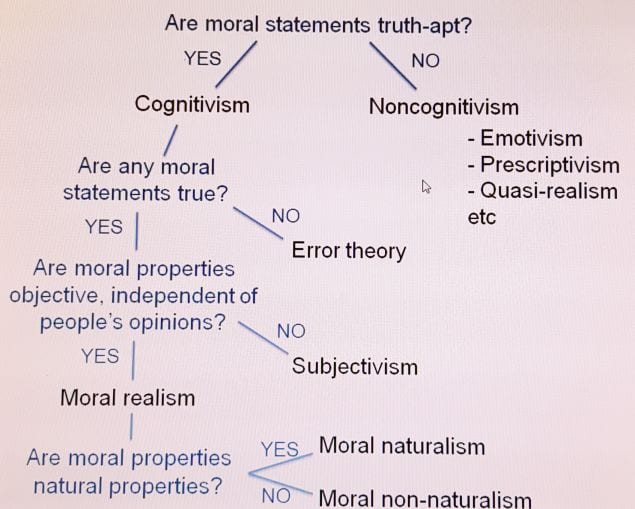
The following flowchart provides an excellent map of the main metaethical theories, all branching from this initial question. We will be referring back to this structure throughout the lesson.
To get a firm grasp of these definitions, please start by reading the introduction to the Stanford Encyclopedia of Philosophy's entry on the topic.
Moral Cognitivism vs. Non-Cognitivism
This article from the Stanford Encyclopedia of Philosophy (SEP) provides the authoritative definitions that underpin this entire topic.
Please read the introductory section, beginning with the initial overview, and the more detailed descriptions in section 1.1, Two Negative Constitutive Non-cognitivist Claims. Focus on the two core tenets of non-cognitivism: semantic nonfactualism (moral sentences don't have substantial truth conditions) and psychological non-cognitivism (moral utterances express non-cognitive attitudes like desires or approval, not beliefs).
The Nuance: Cognitivism Is Not the Same as Realism
It's tempting to equate cognitivism with the view that moral truths exist. However, this is a mistake. The flowchart above shows a crucial branch on the "YES" side of the first question. A cognitivist agrees that moral statements are truth-apt, but they can still deny that any of them are true.
This position is called Error Theory. An error theorist is a cognitivist because they believe moral language aims to state objective facts. However, they are also an anti-realist because they believe that no such moral facts exist. Consequently, all positive moral claims (like "benevolence is good" or "cruelty is bad") are false.
The following video provides a clear explanation of this landscape, paying special attention to the role of error theory.
An Explanation of Terminology used in Metaethics
This video by Jeffrey Kaplan offers a very structured walkthrough of the key terms in metaethics.
Please watch the segment from the explanation of error theory. Note the helpful analogy to Flat Earth theory: Flat-earthers make claims that are truth-apt (e.g., "The Earth is a disc"), but these claims are all false because the world isn't like that. The error theorist says the same about morality. The video then clearly defines non-cognitivism in contrast.
With this, we have our basic map:
- Cognitivism: Moral statements are truth-apt.
- Moral Realism: ...and some are true. (We'll explore this next lesson).
- Error Theory: ...but they are all systematically false.
- Non-cognitivism: Moral statements are not truth-apt. They express feelings, commands, etc.
- Emotivism: They express emotions ("Boo!/Hurrah!").
- Prescriptivism: They express commands ("Do this!/Don't do that!").
2. The Case for Non-Cognitivism
Why would anyone deny that "murder is wrong" can be true? Non-cognitivism arose from powerful philosophical motivations, especially from a desire to square our moral language with a scientific, naturalistic worldview.
Expressing vs. Reporting
First, let's clarify what non-cognitivists mean by "express." It is crucial to distinguish non-cognitivism from a simple form of cognitivist subjectivism.
- Cognitivist Subjectivist: "Murder is wrong" means "I disapprove of murder." This is a truth-apt statement about the speaker's psychological state. It can be true or false.
- Non-cognitivist (Emotivist): "Murder is wrong" expresses the feeling of disapproval itself, like saying "Boo to murder!" This is not a statement about one's feelings; it is a direct venting of them.
The SEP article makes this distinction very clearly.
Moral Cognitivism vs. Non-Cognitivism
This section of the SEP article uses a classic analogy to explain the difference between expressing an attitude and stating that one has it.
Please read the subsection 1.3 Contrast with Cognitivist Subjectivism. The key distinction is between saying that one has an attitude (cognitivist subjectivism) and expressing the attitude without saying that one has it, like booing or hissing (non-cognitivism).
Motivation and the Is-Ought Gap
A primary argument for non-cognitivism stems from the observation that moral judgments seem inherently motivating. When someone sincerely says "Helping the poor is right," we expect them to be motivated, at least to some degree, to help the poor.
This connects to a famous idea from David Hume: you cannot derive an "ought" from an "is." Hume argued that beliefs about facts (the "is") are, by themselves, motivationally inert. To be moved to action, you need a desire, a passion, or some non-cognitive state. The argument, which you'll recognize has a structure similar to formal proofs, proceeds as follows:
- Moral judgments necessarily motivate action (at least to some degree). This is the principle of motivational internalism.
- Beliefs about facts are not, by themselves, capable of motivating action. (The Humean Theory of Motivation).
- Therefore, moral judgments cannot be ordinary beliefs about facts. They must be, or at least contain, a non-cognitive, desire-like element.
This line of reasoning provides a powerful push towards non-cognitivism. It explains the action-guiding character of morality by building it directly into the meaning of moral terms.
A key figure in developing this line of thought was C.L. Stevenson, whose theory of emotivism was deeply influential. He drew a line between the "descriptive" use of language to state facts (the domain of science) and the "dynamic" use to influence behavior and express feelings (the domain of ethics).
Metaethics and Values in Science // Preprint Franco 1
This paper by Paul Franco explores the historical connection between non-cognitivism and the philosophy of science. It offers a fantastic account of Stevenson's emotivism.
Please read Section 2, "C.L. Stevenson’s noncognitivist emotivism." Pay close attention to the distinction between the descriptive use of language (to communicate beliefs, as in science) and the dynamic use (to vent feelings and incite action, as in ethics). This connects the metaethical debate directly to the nature of scientific inquiry.
3. The Great Challenge: Logic and the Frege-Geach Problem
The most significant challenge to non-cognitivism is a logical one. While "Boo to murder!" might seem like a plausible stand-in for "Murder is wrong" in simple assertions, our moral language is far more complex. We embed moral claims in logical constructions, like conditionals and arguments.
This is known as the Frege-Geach Problem, or the embedding problem. Consider this valid syllogism:
- P1: If lying is wrong, then getting your little brother to lie is wrong.
- P2: Lying is wrong.
- C: Therefore, getting your little brother to lie is wrong.
This argument is logically sound. But if "lying is wrong" just means "Boo to lying!", the argument becomes nonsensical:
- P1: If (Boo to lying!), then (Boo to getting your little brother to lie!).
- P2: Boo to lying!
- C: Therefore, Boo to getting your little brother to lie!
The problem is that the meaning of "lying is wrong" in P1 (the antecedent of a conditional) cannot be "Boo to lying!", because the person asserting the conditional isn't actually booing lying; they are just talking about what would be the case if it were wrong. The meaning seems to change between P1 and P2, which would make the argument invalid due to equivocation. How can non-cognitivism account for moral reasoning?
Simon Blackburn, a leading modern non-cognitivist, developed a sophisticated response called Quasi-Realism. The goal of quasi-realism is to show how a non-cognitivist can "earn the right" to use all the realist-sounding features of moral language, including truth, facts, and logical inference.
Are Ethics Just Emotions? - Simon Blackburn
In this video, Simon Blackburn explains the Frege-Geach problem and outlines his quasi-realist solution. This is a masterful display of philosophical problem-solving.
Please watch the detailed discussion of the Frege-Geach problem and its solution, from the introduction of the problem. The core of Blackburn's solution is that a conditional statement like "If lying is wrong, then getting your little brother to lie is wrong" expresses a higher-order attitude. It expresses disapproval of a combination of attitudes: specifically, disapproving of lying while not disapproving of getting your brother to lie. This allows non-cognitivists to build a consistent logic of attitudes that mirrors the logic of beliefs.
Blackburn's approach is to show that we can construct a consistent system of ethics based on attitudes, where logical entailment between beliefs is mirrored by rational constraints on combinations of attitudes. This allows the non-cognitivist to explain moral reasoning without positing mysterious moral facts.
Another tool the quasi-realist uses is a deflationary theory of truth. This theory holds that saying "...is true" adds nothing of substance to a statement. "It is true that the cat is on the mat" just means "The cat is on the mat." This allows the non-cognitivist to say, "It's true that murder is wrong," because all they are doing is repeating their condemnation of murder. They can use the word "true" without committing to a correspondence theory of truth where their statement must match a moral fact in the world.
Conclusion
We have now sketched the fundamental division in metaethics. The line is drawn on the question of truth-aptness.
- Key Takeaways:
- Cognitivism holds that moral statements express beliefs and are truth-apt (can be true or false). This includes both moral realism (some are true) and error theory (all are false).
- Non-cognitivism holds that moral statements are not truth-apt. Their primary function is to express non-cognitive states like emotions (emotivism) or commands (prescriptivism).
- Non-cognitivism is motivated by its ability to explain the action-guiding nature of morality and its fit with a scientific, naturalistic worldview (the "is-ought gap").
- The primary challenge for non-cognitivism is the Frege-Geach problem: how to account for the role of moral claims in logical arguments.
- Sophisticated non-cognitivists, like the quasi-realist Simon Blackburn, address this by constructing a logic of attitudes and employing a deflationary theory of truth to explain the realist-seeming features of our moral discourse.
The distinction between cognitivism and non-cognitivism is not merely an abstract philosophical game. As the paper on science and values showed, one's stance on this issue can have profound implications for other fields, influencing, for example, arguments about whether science can or should be value-neutral. Your position on what moral language is shapes your view on what it can do.
Preview of the Next Lesson:
Having mapped the great divide, our next step is to explore the most intuitive and historically prominent position on the map: moral realism. This is the cognitivist view that moral statements are indeed truth-apt, and that some of them are objectively true. We will examine the core tenets of realism and confront one of the most powerful arguments against it: the argument from disagreement.