Hello! Welcome back.
In our last lesson, we concluded our module on China's rise by assessing its Civil-Military Fusion strategy. We saw how this whole-of-nation effort to integrate the civilian tech sector with the military is a core component of China's bid for technological and military superiority. This strategy is a clear manifestation of a nation rapidly accumulating power and ambition.
Today, we begin Module 6, "The New Cold War: US-China Strategic Competition," by zooming out to look at the structural dynamics of this rivalry. What happens when a rapidly rising power like China directly challenges the position of a long-established ruling power like the United States? This is one of the most critical questions in modern geopolitics.
Our learning outcome for this lesson is to: Apply the Thucydides' Trap framework to analyze the structural tensions between the US and China.
To achieve this, we will:
- Define the Thucydides' Trap and its historical origins.
- Examine the historical pattern of conflicts between rising and ruling powers.
- Apply this framework to understand the core drivers of the US-China rivalry.
- Briefly explore potential pathways to avoid the trap.
This framework will provide you with a powerful analytical lens for interpreting many of the events and conflicts we will discuss for the remainder of the course.
1. What is the Thucydides' Trap?
The term "Thucydides' Trap" was coined by Harvard professor Graham Allison, but its conceptual roots are over 2,400 years old. It stems from the work of the ancient Greek historian Thucydides, who analyzed the devastating Peloponnesian War between the city-states of Athens and Sparta.
Thucydides concluded: "It was the rise of Athens and the fear that this instilled in Sparta that made war inevitable."
This core insight—that a dangerous dynamic is created when a rising power threatens to displace a ruling power—is the essence of the trap. The tension is structural, meaning it's caused by the changing power balance itself, often irrespective of the specific leaders or their intentions.

To hear the originator of the modern concept explain it himself, let's watch a brief segment from a TEDx talk by Graham Allison.
Can history teach us how to avoid war between the US and China? | Graham Allison | TEDxMidAtlantic
In this video, Graham Allison introduces the concept he named the 'Thucydides' Trap,' explaining its origin and core premise.
Please watch from 02:14 to 03:34. Focus on Allison's clear definition of the trap and his summary of Thucydides' famous line about Athens and Sparta.
Now, let's read a short excerpt from an essay by Allison that further unpacks the original insight and its two key psychological drivers.
This essay, 'The Thucydides Trap' by Graham Allison, provides a foundational text for our lesson. This first reading will solidify your understanding of the core concept.
Please read the section that begins 'More than 2,400 years ago...' and ends '...left Greece vulnerable to the Persians.' (This is on the second page of the PDF). As you read, identify the two key drivers Thucydides highlights: one related to the rising power (Athens) and one related to the ruling power (Sparta).
As the reading makes clear, the trap is powered by a combustible mix of two emotions:
- The rising power's growing sense of entitlement, importance, and demand for a greater say (think Athens, or modern China).
- The ruling power's fear, insecurity, and determination to defend the existing order (think Sparta, or the modern United States).
2. A Dangerous Historical Pattern
Is the Athens-Sparta dynamic a one-off event, or is it a recurring pattern in history? Allison's team at Harvard analyzed the last 500 years to find out. Their conclusion is sobering: in 12 of 16 cases where a rising power challenged a ruling one, the result was war.
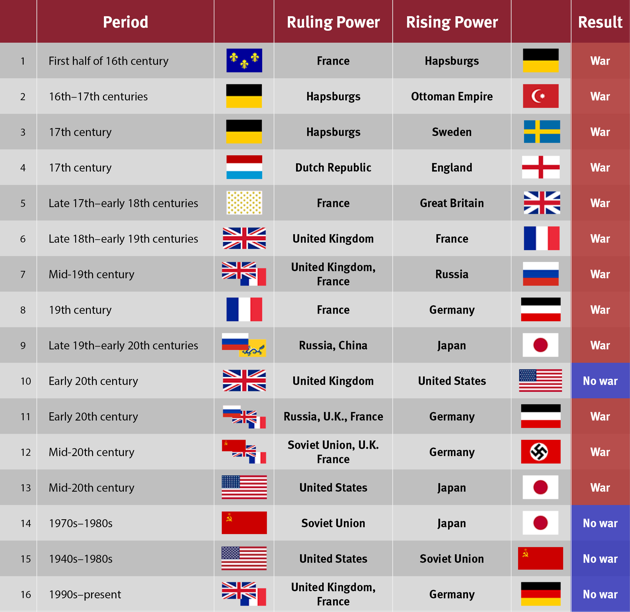
This statistic doesn't mean war is inevitable—four cases avoided it, and we'll touch on those later. However, it does suggest that the structural stress is immense and that "business as usual" often leads to conflict. Often, war isn't the desired outcome for either side but is triggered by a third-party action or an accident that spirals out of control. The classic example is World War I.
Let's return to Graham Allison's TEDx talk, where he discusses this historical pattern and uses the tragic case of WWI to illustrate how easily events can escalate.
Can history teach us how to avoid war between the US and China? | Graham Allison | TEDxMidAtlantic
Here, Allison explains the historical data behind the Thucydides' Trap and uses the rivalry between Britain and Germany leading up to WWI as a prime example of the trap in action.
Please watch from 03:53 to 08:20. Pay attention to his key takeaways from the WWI case: you don't have to want war to get war, and small crises can trigger catastrophes when structural tensions are high.
3. Applying the Trap to US-China Relations
Now we turn to the central question: Are the US and China in a Thucydidean rivalry today?
China: The Unprecedented Rise
As we've seen throughout this course, China's rise is historically unique in its speed and scale. Under Xi Jinping, the country has definitively moved away from Deng Xiaoping's "hide and bide" strategy to pursuing the "China Dream"—a vision of national rejuvenation that involves restoring China to what its leaders see as its rightful place at the center of global affairs.
This next reading details the staggering scale of China's rise and the assertive turn in its foreign policy under Xi.
This section of Allison's essay provides the hard data behind China's rise and explains the strategic shift under Xi Jinping, setting the stage for the Thucydidean dynamic.
Please read two sections from the article: Start with 'The preeminent geostrategic challenge...' and read to the end of the quiz tables ('...become #1?'). (Pages 4-5) Then, read the section starting 'With the arrival of China’s new paramount leader, Xi Jinping...' to '...enjoyed since World War II?' (Pages 6-7) Focus on the metrics of China's growth and how Xi's 'China Dream' translates into a more assertive foreign policy.
The Structural Drivers
China's rise is one side of the equation. The other is the US reaction. The tension isn't just about trade deficits or territorial disputes; it's about the fundamental structure of the international system. Allison describes this using a powerful "seesaw" analogy.
War Between China and the US is NOT Inevitable| Exclusive Interview with Professor Graham Allison.
In this interview, Graham Allison explains the psychological and emotional dimensions of the trap, using the 'seesaw' analogy to describe the fear and honor driving the US and China, respectively.
Please watch from 10:47 to 16:16. Listen for his core argument that the rivalry is structural ('inevitable Thucydidean Rivals') and his explanation of how the moving seesaw creates fear in the ruling power (US) and a sense of righteous confidence in the rising one (China).
To add more analytical precision, we can use concepts from Allison's book, Destined for War. The dynamic creates distinct psychological syndromes:
- Rising Power Syndrome: An enhanced sense of self-importance, entitlement to respect, and insistence on changing the rules to reflect new realities.
- Ruling Power Syndrome: A sense of fear and insecurity as the status quo is challenged. The rising power's assertiveness is seen as disrespectful, provocative, and dangerous.
These syndromes are exacerbated by what Samuel Huntington called a "Clash of Civilizations"—deep, underlying differences in culture and values that make mutual understanding even more difficult.
Destined for War: Can America and China Escape Thucydides's Trap?
This book review of 'Destined for War' provides a highly structured summary of Allison's arguments, including useful definitions and a table contrasting the cultural values of the US and China.
Please read the following three short parts of this review: The section 'What is 'Destined for War's' main argument?' to understand the syndromes. The section describing Part Three of the book, which introduces the 'Clash of Civilizations' thesis and includes Table 02: America and China clash of cultures. Finally, read the footnotes at the end (definitions 1, 2, and 4) which give clear definitions of the syndromes and Huntington's thesis. Focus on how these concepts add depth to your understanding of the US-China rivalry beyond simple power politics.
4. Why War is Not Inevitable
The Thucydides' Trap describes a powerful historical tendency, not an iron law of destiny. As we saw, 4 of the 16 cases avoided war. How? Through immense effort, painful adjustments, and creative statecraft from both sides.
Leaders in both the US and China are acutely aware of this framework. They know the risks. Acknowledging the trap is the first step to avoiding it. Allison and others have proposed several "escape routes," often involving a new type of relationship that combines fierce competition in some areas with essential cooperation in others.
Let's watch one final clip where Allison introduces the concept of a "rivalry partnership."
Can history teach us how to avoid war between the US and China? | Graham Allison | TEDxMidAtlantic
To conclude, let's look at one potential, if difficult, path to avoiding the trap. Here, Allison discusses a model where competition and cooperation can coexist.
Please watch from 13:17 to 16:20. Note the historical and business parallels he draws for a 'rivalry partnership'—a relationship that might seem contradictory but could be necessary to manage this dangerous dynamic.
Conclusion
The Thucydides' Trap provides a compelling framework for understanding the structural stress at the heart of the US-China relationship. It is not a prediction of inevitable war but a warning about the powerful historical forces at play when a rising power challenges a ruling one.
Key Takeaways:
- The Core Idea: The Thucydides' Trap is the dangerous dynamic that occurs when a rising power threatens to displace a ruling one, driven by the rising power's ambition and the ruling power's fear.
- Historical Precedent: This dynamic has resulted in war in 12 of 16 past cases, often triggered by accidents or third-party crises that escalate due to the underlying structural tension.
- Application to US-China: China's unprecedented rise and Xi Jinping's assertive "China Dream" represent the classic rising power, while the US, as the architect and leader of the current global order, exhibits the fear and insecurity of the ruling power.
- Deeper Drivers: The rivalry is intensified by psychological "syndromes" on both sides and a fundamental "clash of civilizations" regarding values, governance, and world order.
- War is Not Inevitable: Avoiding the trap is possible but requires extraordinary effort, mutual understanding, and creative strategies like a "rivalry partnership" to manage both competition and cooperation.
Preview of the Next Lesson:
Having established the overarching structural tension, our next lesson will dive into the first major battlefield of this competition: the economic front. We will analyze the causes and consequences of the US-China trade war, focusing on tariffs, supply chain decoupling, and the strategic logic behind these economic confrontations.