Hello! Welcome to our next lesson.
In our last session, we used the Thucydides' Trap framework to understand the deep, structural tension that arises when a rising power like China challenges a ruling power like the United States. We saw how this dynamic is fueled by the rising power's ambition and the ruling power's fear, creating a dangerous historical pattern.
Today, we shift from the structural to the functional, examining one of the primary arenas where this rivalry has played out: the global economy. Building on the context of China's economic rise, we will dissect the US-China trade war that began in earnest in 2018.
Our learning outcome for this lesson is to: Analyze the economic dimensions of the US-China trade war, focusing on tariffs and supply chain decoupling.
To do this, we will explore:
- The long-standing US grievances that led to the conflict.
- How tariffs were used as a primary tool of economic statecraft.
- The concepts of "decoupling" and "de-risking" and their basis in reality.
- How global supply chains have been reconfigured in response, leading to the "China + 1" strategy.
This analysis is crucial for understanding how great power competition translates into tangible economic policy with global consequences.
1. The Shifting Economic Landscape
Before we dive into the specifics of the trade war, it's helpful to visualize the broader economic shift that created the underlying tension. For decades after WWII, the US was the undisputed center of the global trade system. That has changed dramatically.

This map illustrates the foundation of the conflict: China's economic integration and expansion created a level of interdependence—and competition—with the US that is unprecedented in modern history.
2. The Grievances: Why a Trade War?
The trade war, formally launched by the Trump administration in 2018, was not a sudden event. It was the culmination of years of mounting American frustration over Chinese trade practices that the US viewed as unfair.
To understand these core issues, please watch the following video segment.
China’s Economic Rise vs America’s Dominance | U.S.–China Trade War Explained | The English Globe
This video from The English Globe clearly outlines the primary US grievances that were cited as the justification for initiating the trade war.
Please watch from 04:46 to 05:43 and then from 28:02 to 30:20. As you watch, identify and make a note of the four main complaints the US had against China's economic practices.
As the video explained, the main US grievances were:
- The Trade Deficit: The US consistently bought far more from China than it sold, leading to a massive and persistent trade deficit, which was seen as a transfer of wealth and jobs to China.
- Intellectual Property (IP) Theft: American companies alleged widespread theft of their designs, patents, and trade secrets by Chinese firms.
- Forced Technology Transfer: US firms wanting to operate in China were often compelled to enter joint ventures and share their proprietary technology with their Chinese partners.
- State Subsidies & Currency Manipulation: The US argued that the Chinese government unfairly supported its domestic companies with subsidies to help them outcompete foreign firms, and historically kept its currency artificially low to make its exports cheaper.
From the US perspective, these practices tilted the playing field and directly challenged its economic and technological leadership.
3. Tariffs as a Weapon
The primary weapon chosen by the US to combat these perceived injustices was the tariff—a tax on imported goods. The strategy was straightforward: make Chinese products more expensive for American importers, thereby encouraging consumers and companies to buy American-made goods instead.
This led to a "tit-for-tat" escalation, where China immediately retaliated with its own tariffs on American goods.
China’s Economic Rise vs America’s Dominance | U.S.–China Trade War Explained | The English Globe
Let's return to the same video to understand how this tariff war played out and who ultimately bore the costs.
Please watch from 30:20 to 36:07. Focus on how the 'tit-for-tat' strategy worked and the specific impacts on US consumers and farmers.
As the video highlighted, the effects of the tariffs were complex and often counterproductive to the stated goals:
- Consumer Costs: Instead of absorbing the tariff costs, importers largely passed them on to American consumers in the form of higher prices.
- Retaliation: China’s retaliatory tariffs targeted key US exports, inflicting significant financial pain on sectors like agriculture (e.g., soybean farmers).
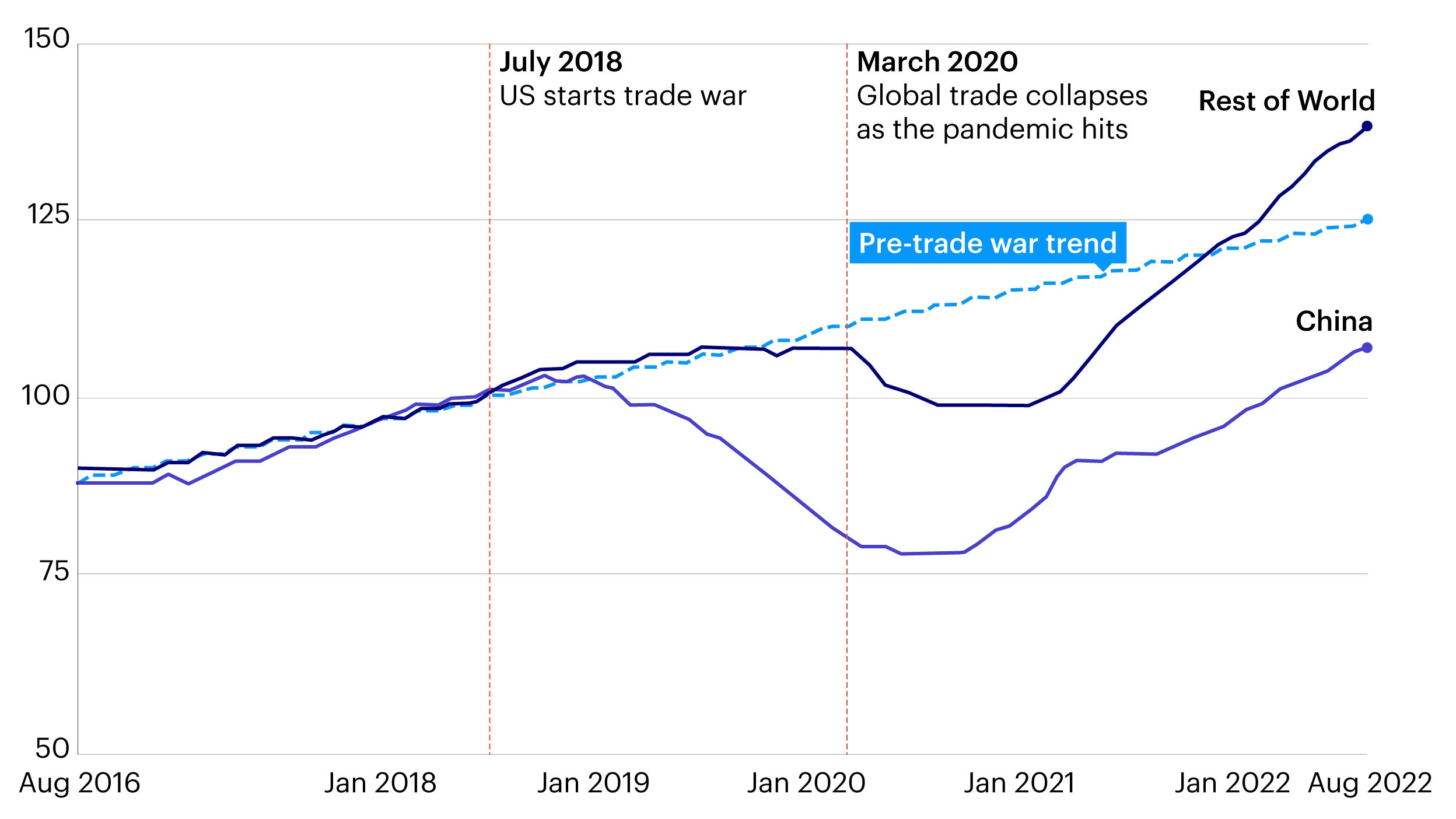
- Trade Diversion: The most significant effect was not a return of manufacturing to the US, but rather a diversion of trade. US importers began sourcing goods from other countries to avoid the tariffs.
This last point is clearly visible in the trade data.
4. Decoupling: Rhetoric vs. Reality
The trade war fueled talk of "decoupling"—a complete separation of the intertwined US and Chinese economies. While politically potent, the reality of decoupling is far more nuanced.
For a detailed analysis, let's look at an article from the Peterson Institute for International Economics (PIIE), a leading think tank on the global economy.
Four years into the trade war, are the US and China decoupling?
This article by Chad Bown provides a data-driven look at whether the US and China are truly decoupling, finding a mixed picture.
Please read the first three sections (up to 'Trump’s trade war tariffs affected imports in expected ways') and the section titled 'Chinese products hit with 25 percent tariffs have struggled.' Focus on the 'yes and no' answer to the decoupling question: in which product areas is decoupling evident, and where is it not?
The PIIE article shows that decoupling is happening, but it's selective.
- Yes, decoupling is visible in products hit with high tariffs (25%), such as industrial components, semiconductors, and some electronics. Imports of these goods from China fell, while imports from the rest of the world rose.
- No, decoupling is not visible in products that were strategically exempted from tariffs, often due to fears of direct consumer backlash. Imports of goods like laptops, mobile phones, and video game consoles from China actually increased, driven by pandemic-era demand.
Some analysts go further, arguing that the entire concept of decoupling is a political mirage that ignores the fundamental logic of global capitalism. Let's hear this critical perspective.
Economic Update: U.S. China Decoupling Myth
In this clip, Professor Richard Wolff argues that deep economic decoupling is largely a myth, driven more by political posturing than by business reality.
Watch from 01:27 to 04:30 and from 14:50 to 18:20. Focus on Wolff's core argument: why do politicians talk about decoupling, and why, in his view, is the underlying economic interdependence too strong to break?
The key takeaway from these contrasting views is that while bilateral trade flows between the US and China have changed, the deep integration built over decades has not been erased. This leads us to the final, and most important, dimension of this economic conflict: the reconfiguration of supply chains.
5. Supply Chain Reconfiguration: The "China + 1" Strategy
If companies are moving out of China to avoid tariffs, but not returning to the US ("reshoring"), where are they going? And does this move truly reduce dependence on China?
The dominant corporate strategy that has emerged is known as "China + 1." This involves firms keeping a significant portion of their manufacturing base in China while adding a second production site in another country, such as Vietnam, Mexico, or India, to diversify and mitigate risk.
However, there's a crucial catch. A World Bank study examined this shift and came to a striking conclusion.
[PDF] Is US Trade Policy Reshaping Global Supply Chains?
This World Bank policy paper provides a rigorous analysis of how supply chains are being reshaped. Its findings are central to understanding the true nature of 'decoupling.'
Please read the following sections: The abstract on the first page (section 0). It provides a concise summary of the entire paper's findings. The first two paragraphs of Section 4, 'US tariffs and the reconfiguration of supply chains,' (section 4) to understand the characteristics of the countries gaining from this shift. The first paragraph of Section 5, 'Conclusion,' (section 5) which summarizes the key tension between efficiency and diversification. Focus on the relationship between the 'new' manufacturing countries and China itself.
The World Bank paper reveals the illusion at the heart of simple decoupling. The countries that are 'replacing' China as final assemblers for the US market are often those most deeply integrated into China's supply chains.
In essence, the supply chain has simply added a stop. Chinese components are now shipped to Vietnam or Mexico for final assembly before being exported to the US. This strategy allows US importers to avoid tariffs, but it does not sever the underlying dependence on Chinese manufacturing. As the paper states, "to displace China on the export side, countries must embrace China’s supply chains."
Conclusion
The US-China trade war is a textbook example of geoeconomic competition. It demonstrates how economic tools like tariffs can be weaponized to achieve strategic goals. However, in a deeply interconnected global system, the results are often complex and unintended.
Key Takeaways:
- Grievances and Escalation: The trade war was sparked by long-standing US complaints about China's trade practices, leading to a tit-for-tat tariff war.
- The Tariff Effect: Tariffs successfully reduced direct imports from China in targeted sectors but also raised costs for US consumers and prompted retaliatory measures that hurt US exporters.
- Selective Decoupling: The idea of a full economic separation is more rhetoric than reality. Decoupling is occurring in specific, politically sensitive, or tariff-heavy sectors, while interdependence remains high in others.
- The "China + 1" Reality: The primary corporate response has been to diversify by adding a second production base outside of China. However, these new hubs (e.g., Vietnam, Mexico) are themselves heavily reliant on Chinese components, meaning the reconfiguration has lengthened supply chains rather than truly decoupled them from China.
Preview of the Next Lesson:
From the broad economic conflict of the trade war, we will narrow our focus to the most critical battleground in the US-China strategic competition: technology. In our next lesson, we will analyze the "chip war," explaining the strategic importance of semiconductors and why control over their design and production has become a central pillar of national power.