Hello! Welcome back to our course on geopolitics.
In our last lesson, we established a clear definition of geopolitics as an analytical lens that uses geography, history, and culture to understand state strategy. We distinguished it from related fields like political geography and international relations, setting the stage for a more rigorous analysis.
Today, we will explore the foundational "grand theories" of classical geopolitics. You'll learn the core ideas of three thinkers whose work, though a century old, continues to shape the strategic calculations of major powers. The learning outcome for this lesson is to explain the core ideas of classical geopolitical thinkers: Mackinder's Heartland Theory, Spykman's Rimland Theory, and Mahan's sea power doctrine.
Think of these theories as the foundational algorithms of strategic thought. They provide the source code for understanding the large-scale, structural competition between states. For anyone interested in how great powers compete and how smaller states like Nepal navigate that competition, these theories are indispensable.
1. Alfred Thayer Mahan: The Doctrine of Sea Power
We begin at sea. In the late 19th century, as global trade exploded, a US naval officer named Alfred Thayer Mahan argued that national power was fundamentally linked to control of the oceans. His work, The Influence of Sea Power Upon History, became required reading for naval strategists worldwide, from Britain to Imperial Japan.
A short video will introduce Mahan's core concepts.
History of Geopolitics: theories and types of geopolitics [Updated]
Let's watch a brief overview of Mahan's theory from the 'Geopoliticus' channel. It concisely explains the key components of what constitutes sea power.
Watch the segment from 10:10 to 11:33. Focus on the necessary ingredients Mahan identified for a nation to build its power at sea, including technology and human factors.
As the video explained, Mahan's theory wasn't just about having warships. It was a complete system. To go into more detail, please read the following section from an article on E-IR, a student-run international relations website.
Heartland vs. Sea Power: Why the Rimland Will Shape the Future of ...
This article, 'Heartland vs. Sea Power', provides an excellent summary of Mahan's doctrine and its historical impact. It will deepen your understanding of why controlling the waves was seen as the key to global dominance.
Please read the section titled 'Sea Power: The Engine of Modern Domination'. Pay attention to how the British Empire exemplified his theory and how the US adopted it.
To synthesize Mahan's doctrine, true sea power requires:
- A powerful navy: A fleet strong enough to defeat enemies and protect commerce.
- A vibrant merchant marine: A large fleet of commercial ships to carry out trade.
- A network of overseas bases: For refueling, repairs, and resupply, extending the navy's global reach.
- Control of strategic maritime "chokepoints": Narrow passages like the Suez Canal, the Strait of Malacca, or the Strait of Hormuz, through which global trade must flow.
Mahan's ideas directly influenced the naval arms race before World War I and justified America's own expansion into a global power. Today, the US Navy's global network of bases and its focus on protecting Sea Lanes of Communication (SLOCs) are a direct inheritance of Mahan's thinking.
2. Halford Mackinder: The Heartland Theory
As sea power seemed supreme, a British geographer named Halford Mackinder offered a powerful counter-argument. He believed a new technological force—the railway—was about to upend the global balance of power, shifting the advantage from the seas back to the great landmass of Eurasia.
The following video provides a detailed and systematic breakdown of his theory.
Examining Mackinder's Heartland Thesis
This video from 'Strategy Stuff' is one of the clearest explanations of Mackinder's Heartland Thesis available. It methodically walks through the logic of his argument.
Please watch from 04:07 to 10:45. This covers three key parts: The World-Island and the Heartland (04:07 - 07:57): Understand how Mackinder divides the world and the unique characteristics of the Heartland. The Role of Technology (07:57 - 09:13): Focus on why he believed rail power would surpass sea power. The Strategic Imperative (09:13 - 10:45): This explains the logic behind his famous triad.
Mackinder's theory is famously summarized in this dictum from his 1919 book:
"Who rules East Europe commands the Heartland;
Who rules the Heartland commands the World-Island;
Who rules the World-Island commands the World."
Let's visualize this.
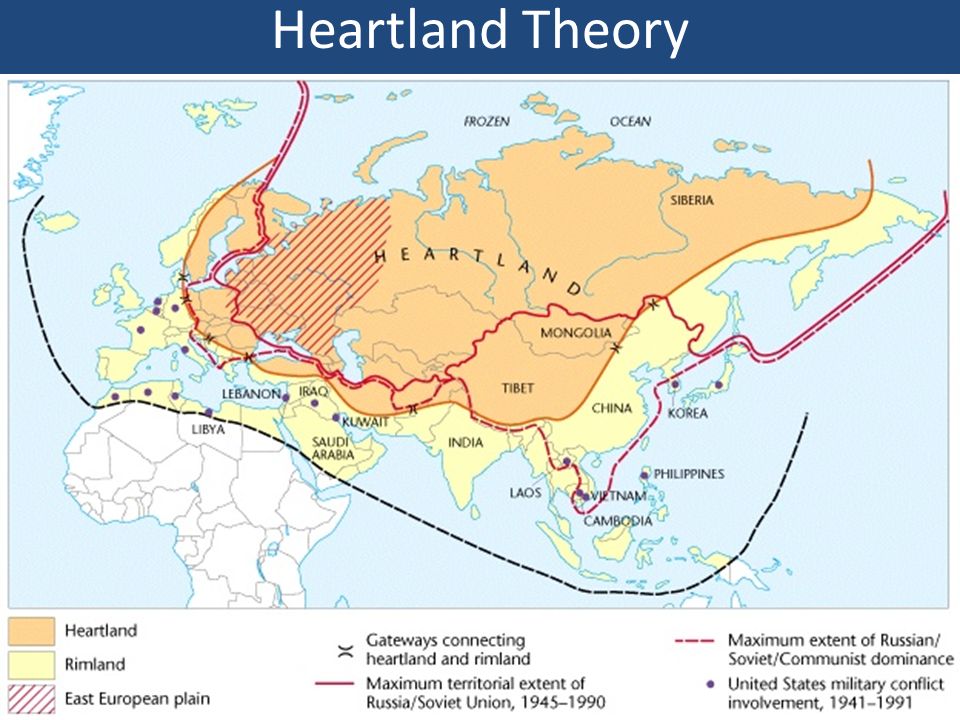
Here is a breakdown of Mackinder's logic:
- The World-Island: The combined continents of Europe, Asia, and Africa contain the vast majority of the world's land, population, and resources.
- The Heartland: This "pivot area" at the center of the World-Island is a natural fortress, protected by mountains, deserts, and the frozen Arctic, making it impregnable to attack by sea power.
- Land Power vs. Sea Power: Mackinder argued that while sea powers had dominated for 400 years, the development of trans-continental railways would allow a single power to consolidate control over the Heartland's immense resources. This land-based mobility would eventually become superior to sea-based mobility.
- The Path to World Domination: A power that controlled the Heartland could expand outwards to conquer the coastal regions, thereby dominating the entire World-Island. With these resources, it could build an unbeatable navy and achieve global hegemony. Eastern Europe was the "gateway" to this Heartland.
Mackinder's theory was a warning to the maritime powers of Britain and the US. It profoundly influenced Western strategic thinking, framing Russia (and later the Soviet Union) as the natural Heartland power that had to be "contained."
3. Nicholas Spykman: The Rimland Theory
Nicholas Spykman, an American political scientist at Yale, engaged directly with Mackinder's work during World War II. While he accepted the basic geographical framework, he came to a radically different conclusion about where the true power lay. He argued that Mackinder had overvalued the Heartland.
Spykman famously inverted Mackinder's formula:
"Who controls the Rimland rules Eurasia;
Who controls Eurasia controls the destinies of the world."
The Rimland is the same geographical area as Mackinder's "Inner Crescent"—the coastal periphery of Eurasia, including Western Europe, the Middle East, and South and East Asia.

To understand why Spykman believed the Rimland was decisive, please read the following sections.
Geopolitical Theories Mackinder, Spykman, and Their ...
The 'Cosmos' journal article provides a detailed exploration of Spykman's theory and directly contrasts it with Mackinder's.
Please read the section 'Spykman’s Rimland Theory: A Comprehensive Exploration' (starts on page 15). Focus on why Spykman considered the Rimland more important than the Heartland and its dual function as a buffer and access point.
Spykman's logic was as follows:
- Strategic Location: The Rimland functions as a vast buffer zone between the Heartland (land power) and the outlying islands (sea power).
- Demographics and Resources: Unlike the sparsely populated Heartland, the Rimland contains most of the world's people and a great deal of its economic productivity.
- Amphibious Character: The Rimland has access to both land and sea, making it the critical arena where the struggle between land power and sea power is fought.
Spykman's key insight was that a Heartland power like Russia could not dominate the world without first controlling the Rimland, and a sea power like the US could not ensure its security without preventing any single hostile power from controlling the Rimland. This thinking became the intellectual foundation for the US policy of Containment during the Cold War—creating a ring of alliances (NATO in Europe, CENTO in the Middle East, SEATO in Southeast Asia) around the Soviet-controlled Heartland to keep its influence from spreading into the crucial Rimland.
Conclusion: Applying the Theories
These classical theories provide a powerful, if simplified, model for understanding global power struggles.
Key Takeaways:
- Mahan's Sea Power Doctrine emphasizes that control over maritime trade, chokepoints, and a global network of naval bases is the key to national greatness.
- Mackinder's Heartland Theory posits that a technologically advanced land power controlling the Eurasian Heartland could become an unchallengeable world power.
- Spykman's Rimland Theory counters that the coastal periphery of Eurasia—the Rimland—is the most critical strategic region, and the key to global power is to control it or prevent a rival from doing so.
These ideas form a conceptual triangle: Mahan focused on the sea, Mackinder on the land, and Spykman on the crucial coastal zone where they meet.
Your interest in South Asian dynamics provides a perfect case study. Nepal is located squarely on the edge of the Rimland, bordering a major Rimland power (India) and the most significant aspiring Heartland power (China). The strategic pressures you see from both neighbors are a modern-day manifestation of the land power vs. sea/rim power dynamic that Spykman described. The competition to fund and build infrastructure in Nepal, for instance, can be seen as part of a larger struggle for influence in this critical buffer region.
In our next lesson, we will move from these grand theories to a more granular level. We will analyze how specific physical geography features—chokepoints, resource distribution, and terrain—constrain and enable state behavior, using contemporary examples to bring these concepts to life.