Welcome to the final lesson of your geopolitics course.
In our previous lesson, we conducted a comprehensive analysis of Nepal's geopolitical situation. We identified its core challenges, assessed its sources of power, and examined its primary strategic options: hedging, energy diplomacy, and niche diplomacy. You successfully outlined how these different concepts apply to Nepal's context, setting the stage for today's final task.
This lesson is the culmination of everything you've learned. We will move from analysis to synthesis and recommendation. Your task is to step into the role of a strategic advisor and formulate a coherent, evidence-based strategy for Nepal.
Your learning outcome is to: Formulate a coherent strategic recommendation for the selected state, justified with evidence and theoretical concepts.
By the end of this lesson, you will have constructed a professional-level strategic recommendation for Nepal, demonstrating your ability to apply the full range of geopolitical theories and frameworks from this course to a real-world challenge.
1. From a Plan to a Strategy
Before we start building the recommendation, we need to be precise about what we are creating. In policy and business, the words "plan" and "strategy" are often used interchangeably, but they are fundamentally different. A plan is often a list of activities—things to do. A strategy is a coherent, integrative set of choices that positions you to win in a competitive environment.
Formulating a strategy is a bit like designing a complex optimization algorithm. You have a clear objective function (e.g., maximize national prosperity and autonomy), a set of constraints (geography, resources, power dynamics), and a dynamic environment (the actions of other states). A good strategy isn't just a list of tasks; it's a robust logic for navigating the environment to achieve the objective.
This short video from Harvard Business Review explains this distinction brilliantly.
Watch this video, 'A Plan Is Not a Strategy,' to understand the crucial difference between a simple plan and a true strategy. It will provide the core conceptual foundation for our task today.
Watch the entire video. Pay close attention to: The definition of strategy as an 'integrative set of choices' designed to win. The discussion of why planning feels more comfortable but is less effective. The Southwest Airlines case study, which is a powerful analogy for how a smaller actor can succeed by adopting a different, coherent strategy rather than just competing on the same terms as larger rivals. The final advice on how to build and refine a strategy under uncertainty.
As you watched, consider how this applies to Nepal. A "plan" for Nepal might be a list: "build more hydropower plants," "increase tourism," "join more international forums." A "strategy," however, would be an integrated framework that explains how these activities work together to achieve a specific competitive outcome, such as becoming an indispensable energy and connectivity hub in South Asia, thereby enhancing its strategic autonomy.
2. The Architecture of a National Strategy
A strategic recommendation doesn't exist in a vacuum. It fits into a broader national framework. The following diagram illustrates how high-level national interests and values are translated into a concrete national strategy.
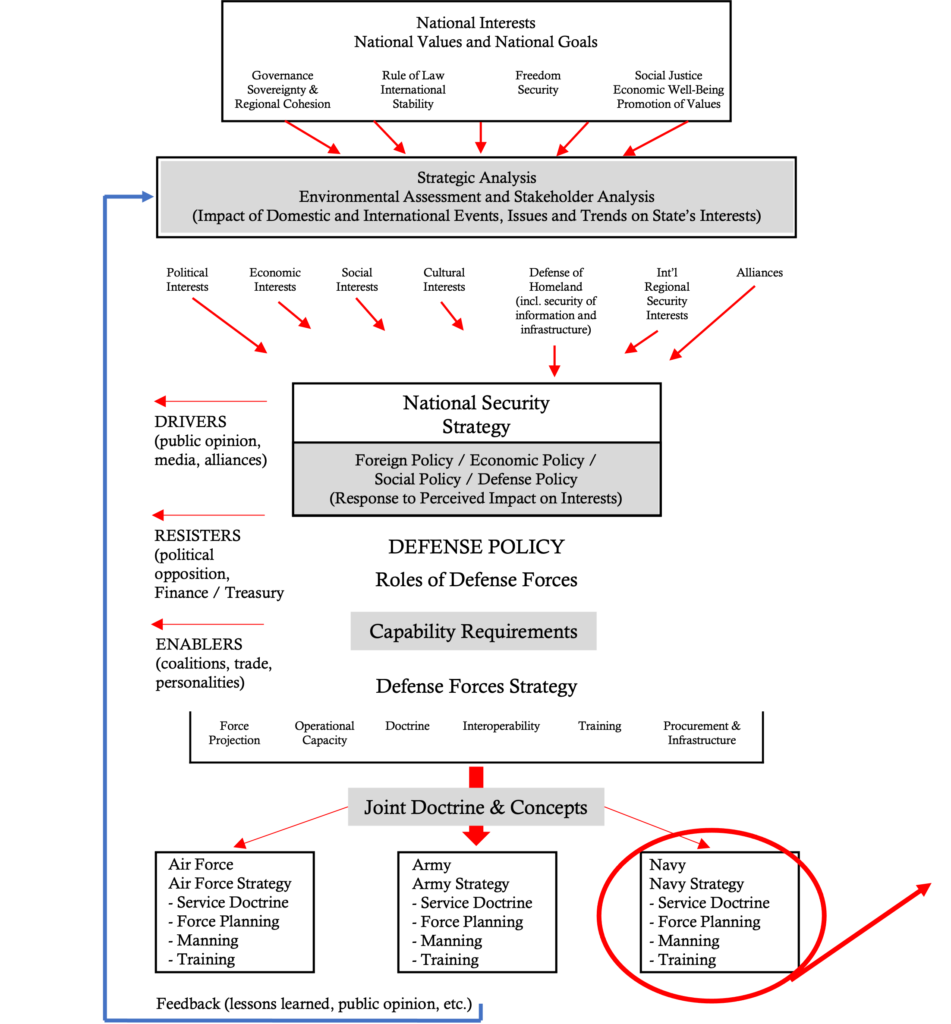
This model provides a top-down structure for your thinking. Your task is to formulate the core logic of the National Security Strategy box, informed by your analysis of the strategic environment and designed to achieve Nepal's high-level National Interests.
3. Crafting the Recommendation for Nepal
In the last lesson, we identified three key strategic options for Nepal:
- Strategic Hedging: Navigating the rivalry between India, China, and the US by maintaining balanced relationships with all, avoiding over-dependence.
- Energy Diplomacy: Leveraging hydropower resources to create economic interdependence, particularly with India and Bangladesh, turning a resource into geopolitical capital.
- Niche Diplomacy / Norm Entrepreneurship: Carving out a unique role as a champion of multilateralism, climate action, and peace, thereby building soft power.
A true strategy, as we've learned, integrates these elements. They are not a menu of options to choose from; they are mutually reinforcing components of a single, coherent approach.
For instance:
- Energy diplomacy is the economic engine that powers a hedging strategy. By becoming a vital energy supplier to India, Nepal increases its leverage and makes its balancing act more credible. It's no longer just a small buffer state but a strategic partner.
- Niche diplomacy provides the normative justification for the hedging strategy. By consistently promoting peace and international law, Nepal frames its refusal to take sides not as opportunism, but as a principled stance consistent with its national identity.
The academic paper we reviewed previously provides a set of concrete policy ideas that can serve as the building blocks for your recommendation.
[PDF] Small State, Big Influence – Nepal's Role in South Asian Diplomacy
Let's revisit the paper 'Small State, Big Influence – Nepal's Role in South Asian Diplomacy.' This time, focus on the concrete policy advice offered at the end, which synthesizes the paper's findings.
Please read only the section titled 'VII. CONCLUSION AND POLICY IMPLICATIONS'. This section provides five specific, actionable recommendations that you can use as evidence and inspiration for your own strategic memo.
This section provides a strong foundation. Your task now is to synthesize these points into a singular strategic vision and present it in a professional, persuasive format.
4. Capstone Exercise: Your Policy Memo to the Prime Minister
To formalize your strategic recommendation, you will draft it as a policy memo. This is a standard format used in government to provide concise, actionable advice to senior decision-makers. The key is to be clear, direct, and evidence-based.
This guide from the Harvard Kennedy School provides an excellent template.
[PDF] How to write policy memos: Communications Program Workshop
This brief guide, 'How to write policy memos,' outlines the professional standard for this type of document. We will use its structure for your final exercise.
Quickly review this guide, focusing on these key principles: Problem Statement: The importance of defining a clear, solvable problem. Audience: Tailoring your message to the decision-maker. Structure: Using the 'Bottom Line Up Front' (BLUF) format. Options & Trade-offs: The need to present a well-reasoned recommendation, not just a pitch. Formatting: Using clear, concise language and formatting for 'skimmability.'
Now, it's time to put it all together.
Your Final Task
Imagine you are a Senior Advisor for National Strategy to the Prime Minister of Nepal. Your task is to write a one-page policy memo outlining a coherent national strategy for the next decade.
Please draft a policy memo that includes the following five sections:
- TO/FROM/DATE/SUBJECT:
- TO: The Prime Minister of Nepal
- FROM: Your Name, Senior Advisor for National Strategy
- SUBJECT: A Strategy of 'Strategic Interdependence' to Secure Nepal's Prosperity and Autonomy
- Bottom Line Up Front (BLUF): Start with a direct, one-paragraph summary of the problem and your core recommendation. (e.g., "Nepal faces increasing pressure from great power competition. To secure our long-term interests, we must pursue a national strategy of 'Strategic Interdependence,' leveraging our hydropower resources and diplomatic identity to integrate with our neighbors on our own terms, thereby strengthening our autonomy.")
- Background: A Narrowing Path: Briefly summarize Nepal's geopolitical context—the "yam between two boulders" dilemma, now intensified by US-China rivalry—and the risks of inaction (loss of autonomy, becoming a proxy battleground).
- Recommended Strategy: Strategic Interdependence: This is the core of your memo. Articulate your integrated strategy. Explain how Nepal will weave together energy diplomacy, multi-aligned foreign policy (hedging), and niche diplomacy into a single, coherent approach. Use the concepts and evidence from the resources. Show how these elements are mutually reinforcing. For example, explain how becoming a regional energy hub gives Nepal the leverage to successfully hedge between great powers.
- Key Implementation Steps & Risks:
- Implementation: List 3-4 high-level, concrete actions needed to execute this strategy. (e.g., "Establish a cabinet-level 'Energy Diplomacy Task Force' to fast-track cross-border projects," "Launch a diplomatic initiative at the UN focused on 'Mountain Ecology and Climate Security' to institutionalize our niche identity.")
- Risks & Mitigation: Acknowledge one major risk or counterargument (e.g., "Risk: Over-dependence on India for electricity exports could undermine our autonomy."). Briefly propose a mitigation measure (e.g., "Mitigation: Diversify by finalizing energy export agreements with Bangladesh and pursuing trilateral grid connectivity projects involving China.").
Conclusion
Congratulations on reaching the end of this comprehensive journey into the world of geopolitics. Today, you moved beyond theory and analysis to the difficult but essential task of strategy formulation. By crafting this policy memo, you have applied the course's diverse intellectual tools—from classical geopolitical thought to modern theories of interdependence—to a complex, real-world problem.
Key Takeaways from this Lesson:
- A strategy is not a list of plans; it is a coherent, integrated set of choices designed to achieve a specific outcome in a competitive environment.
- Effective national strategy connects high-level national interests to specific, actionable policies across diplomatic, information, military, and economic (DIME) domains.
- For a small state like Nepal, a winning strategy involves integrating its unique assets—hydropower (economic), a non-threatening identity (normative), and a pivotal location (diplomatic)—into a unified approach that creates leverage and enhances autonomy.
You have built a powerful analytical framework that will serve you well, whether you are analyzing developments in South Asia, assessing the impact of a new technology on statecraft, or simply making sense of the daily headlines. You have demonstrated the ability to think critically, synthetically, and strategically about the forces that shape our world. Well done.