Hello! Welcome to the sixth lesson in our final module, "Capstone: Applied Geopolitical Analysis."
In our last session, we delved into the cognitive traps that can undermine analysis, exploring Richards Heuer's frameworks for identifying and mitigating biases. You learned that disciplined, structured thinking is the most effective antidote to these mental shortcuts.
Today, we move from deconstructing our thought processes to constructing a robust analytical product. This lesson is a capstone in the truest sense, designed to help you synthesize the diverse theories and frameworks you've learned throughout this entire course. We will build a systematic process for producing a sophisticated written analysis of a geopolitical crisis.
Your learning outcome for this lesson is to: Synthesize multiple IR theories and geopolitical frameworks to produce a written analysis of a current geopolitical crisis.
This is where the rubber meets the road. We'll combine classical geopolitics, the grand theories of International Relations, concepts of national power, and the critical modern dimensions of technology and information warfare into a single, coherent analytical method.
1. The Blueprint: Structuring a Geopolitical Analysis
A strong analysis is built on a logical and comprehensive structure. Without a clear blueprint, even the most brilliant insights can get lost. Fortunately, there is a well-established format for professional geopolitical reports.
The following resource provides an excellent, detailed outline that we will use as our foundational structure. It breaks down a complex topic into manageable, logical components.
IR 101: Comprehensive Guide to Writing Geopolitical Reports and ...
This guide, 'IR 101: Comprehensive Guide to Writing Geopolitical Reports and Articles,' offers a professional template for structuring your analysis. We will adopt its core components.
Please read the section titled '3. Detailed Structural Outline & Content Guidelines.' Pay close attention to the components from 'Start with a Strong Opening Quote' down to 'Geopolitical & Strategic Analysis.' This provides the essential scaffolding for your written work.
As you can see, a thorough report moves from the general to the specific, and from historical context to future implications. The key sections are:
- Introduction: Hooks the reader and states the thesis.
- Historical Context: Establishes the socio-political landscape and underlying tensions.
- Chronology of Events: Details the specific developments of the crisis.
- Theoretical Perspectives: Applies IR theories to explain the dynamics (our focus today).
- Humanitarian Impact: Grounds the analysis in real-world consequences.
- Geopolitical & Strategic Analysis: Dissects actor motivations and strategic objectives.
- Diplomatic Efforts & Future Scenarios: Evaluates responses and projects potential outcomes.
This structure not only organizes your argument but also acts as a built-in Structured Analytic Technique (SAT), forcing you to consider multiple facets of the crisis and thus mitigating biases like satisficing or premature closure.
2. The Art of Synthesis: From Listing to Layering
The "Theoretical Perspectives" section is where true synthesis happens. It's not enough to simply state, "A realist would say X, and a liberal would say Y." The goal is to weave these theories together to create a multi-layered, nuanced explanation that is more powerful than any single theory on its own.
Given your background, you can think of this as creating a "full-stack" analysis. Each theory provides a different layer of explanation, from the "hardware" of geography to the "application layer" of ideas and narratives.
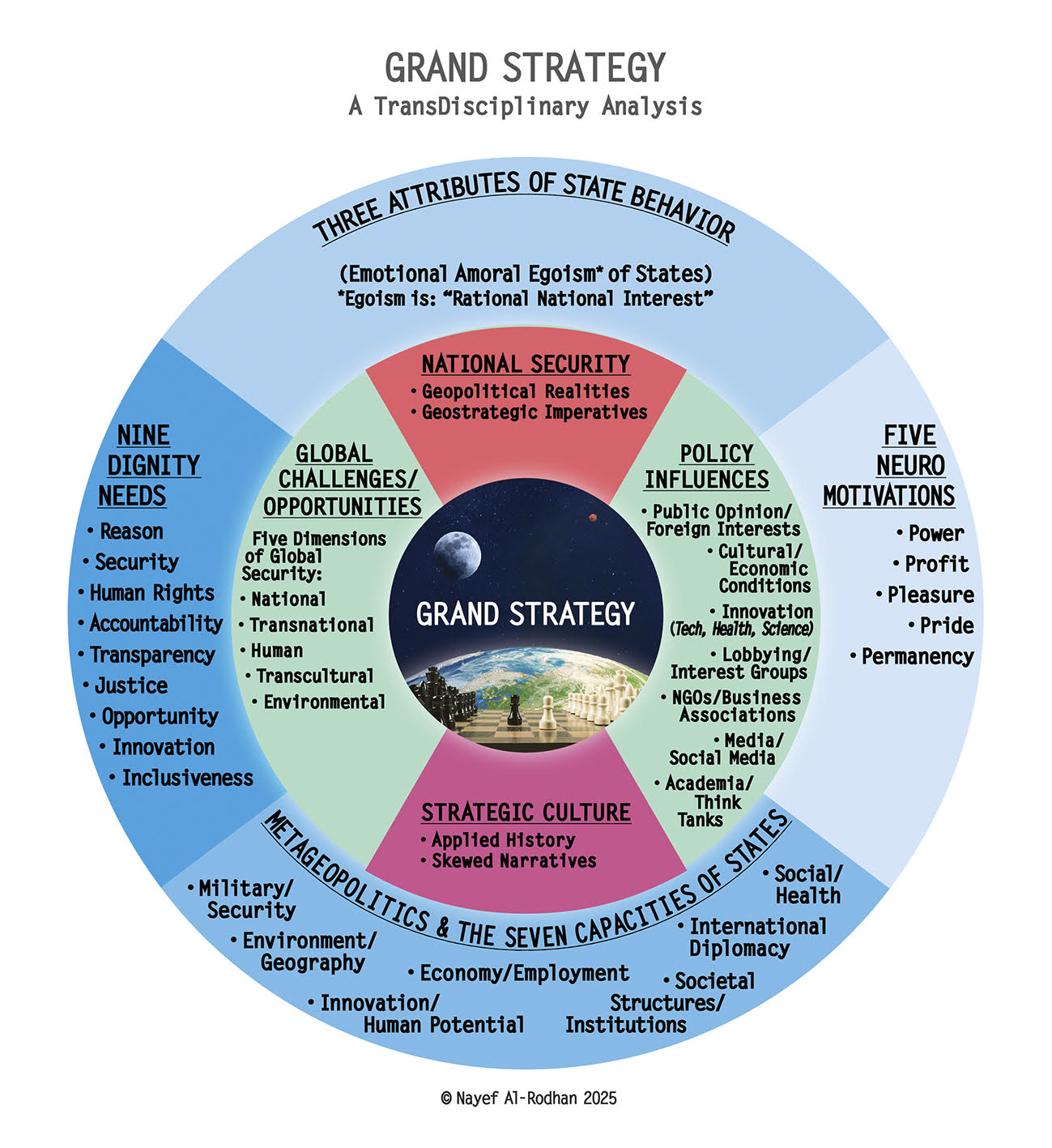
To do this effectively, we must integrate both established theories and the emerging frameworks that address the complexities of the 21st century.
[PDF] A Comparative Analysis of Established and Emerging Geopolitical ...
The following paper, 'A Comparative Analysis of Established and Emerging Geopolitical Theories,' provides a superb conclusion on how to synthesize different theoretical schools of thought.
Please read the final section, 'Synthesis: The Confrontation Between Established and Emerging' (typically on the last page). Focus on the four key takeaways about how our understanding of power, geopolitics, and the state is evolving.
The key takeaways from that reading give us our synthesis method:
- Power is Structural and Infrastructural: Don't just count tanks and ships (Realism). Analyze control over networks—financial (SWIFT), technological (semiconductors, data cables), and informational. This is where you bring in concepts like Weaponized Interdependence.
- Geopolitics is Not Human-Only: Don't forget the foundational role of geography and the environment (Classical Geopolitics). In the modern era, this includes the Anthropocene—climate change, resource scarcity, and ecological stability are now core national security issues.
- Knowledge Production is Power: Analyze the narrative battle. How are actors framing the crisis? Who is shaping the "truth"? This is where you apply Constructivism and concepts from information warfare.
- The State is Transformed: The nation-state is still the main actor, but its power is now defined by its position within these global networks.

3. Synthesis in Action: Analyzing a Leader's Strategy
Let's look at a practical example of how analysts apply multiple theoretical lenses to make sense of a complex geopolitical actor. The foreign policy of Donald Trump, for instance, has been interpreted in various ways, and using a single theory often falls short.
Three theories of Trump’s strategy for American power | DW Analysis
This DW News analysis, 'Three theories of Trump’s strategy for American power,' is an excellent demonstration of applying multiple frameworks to explain a single phenomenon. It shows how different theories provide complementary, not just competing, insights.
Please watch from the introduction at 00:44 to the end of the section on Realism at 14:28. Notice how the analysis doesn't just define Realism but applies it to specific policies regarding Ukraine, NATO, and the 'rules-based order.' It also highlights the limits of a purely realist explanation, which is a key part of good synthesis.
The video explores three distinct frameworks:
- Realism: Trump's "America First" policy is viewed as a focus on national interest, power, and transactional deals, rejecting idealistic, values-based foreign policy.
- The "Reverse Kissinger": A strategic framework suggesting an attempt to pull Russia away from China, a modern mirror image of Nixon's opening to China in the 1970s.
- Spheres of Influence: A classical geopolitical concept where great powers dominate their respective regions, and tacitly agree not to interfere in others'.
An analysis that combines these lenses—a realist focus on power, a strategic gambit to reorder alliances, and a classical geopolitical view of world order—provides a far richer explanation than any single theory could alone.
4. Integrating the Information and Narrative Layer
A crucial layer in any modern analysis, and one that aligns with your interest in technology, is the information domain. Crises today are fought with narratives, disinformation, and strategic communication as much as with economic or military tools. This is the domain of Constructivism and Information Warfare.
Dr. Andreas Krieg's work provides sharp insights into how states weaponize narratives to achieve strategic goals.
Gold, AI Surveillance & Gulf Power in the Shadows | Dr. Andreas Krieg UNFILTERED
In this interview, Dr. Andreas Krieg explains the mechanics of narrative weaponization, using Russia and the UAE as compelling case studies.
Please watch the segment from 22:11 to 39:16. Focus on two key concepts: Reflexive Control: How Russia identifies and amplifies existing social grievances (like Islamophobia or anti-Semitism) to disrupt social cohesion in the West. The 'Bogeyman' Narrative: How the UAE has systematically framed the 'Muslim Brotherhood' as a terrorist organization to delegitimize any political opposition, both domestically and abroad. Think about how you would integrate this 'narrative analysis' into the report structure we discussed earlier.
This brings us back to the "full-stack" model. An analysis of a crisis in the Middle East would be incomplete if it only focused on military balances (Realism) and oil markets (Geoeconomics). A complete picture must also analyze how actors like the UAE and Qatar use state-funded media, social media campaigns, and political lobbying to shape perceptions and delegitimize rivals. This is a core part of their statecraft.
5. A Practical Walkthrough
Let's outline how you would apply this synthesis framework to a hypothetical crisis.
Crisis Scenario: A coordinated cyberattack, attributed to a state actor, causes a 48-hour shutdown of the Society for Worldwide Interbank Financial Telecommunication (SWIFT) system, halting most international financial transactions.
Here is how you would structure your analysis, weaving in multiple theories:
-
Introduction: State the crisis and your thesis: "The SWIFT shutdown is not merely a cyberattack but a watershed moment in the weaponization of global financial infrastructure, accelerating a fragmentation of the international order."
-
Historical Context: Briefly explain the post-WWII Bretton Woods system, the rise of the US dollar as the reserve currency, and SWIFT's central role. Mention previous uses of financial sanctions against states like Iran and Russia.
-
Chronology: Detail the attack, its immediate effects, and the initial attribution.
-
Theoretical Synthesis & Strategic Analysis:
- Realist Lens: Who benefits from the disruption? The attack is a direct challenge to the hegemon's (US) power. It creates an opportunity for a rising challenger (e.g., China) to promote its alternative system (CIPS). This is a classic move in a power transition.
- Liberal Lens: The attack represents a catastrophic failure of international cooperation and norms governing cyberspace and finance. It undermines the institutions that foster global interdependence and will likely lead to calls for new international treaties on cyber warfare and financial security.
- Weaponized Interdependence Lens (Emerging Theory): This is the core of your analysis. The attack exposes the ultimate vulnerability of a centralized global network. It's the "Chokepoint Effect" in action. You would analyze how this incentivizes states to "de-risk" by developing "sanctions-proof" alternative financial plumbing, leading to what Farrell and Newman call "governance decoupling."
- Constructivist/Narrative Lens: How is the event framed? The attacking state denies involvement and frames it as a response to "Western financial aggression." The US frames it as an assault on the "rules-based international order." A narrative battle ensues to win the support of non-aligned nations, who must now choose which financial ecosystem to trust.
By layering these perspectives, you move beyond a simple description of the event to a deep, multi-faceted explanation of its strategic significance.
Conclusion
Today we've assembled a comprehensive toolkit and a repeatable methodology for analyzing geopolitical crises. You have learned how to structure a professional report and, most importantly, how to synthesize multiple theoretical frameworks to create a rich, layered analysis.
Key Takeaways:
- A structured report (Context -> Chronology -> Theory -> Analysis -> Future) is essential for clarity and rigor.
- True synthesis involves layering theories to create a "full-stack" explanation, not just listing them.
- Integrate established theories (Realism, Liberalism) with emerging frameworks that address modern realities like Weaponized Interdependence, Cyber-Realism, and the Anthropocene.
- Always include the narrative and information domain. Analyze how actors use strategic communication to frame events and pursue their objectives.
Preview of the Next Lesson:
You now have the complete analytical framework. In our final lesson, you will apply it to a topic of direct interest to you. The learning outcome will be: Select a small state (e.g., Nepal) and analyze its geopolitical context, position, and strategic options using concepts from the course. You will then be asked to formulate a strategic recommendation for that state, bringing your journey from theoretical understanding to practical application to a close.