Introduction
Welcome to your fourth lesson in our "Foundations: Image and Sensation" module. In our last session, we focused on the crucial principle of "showing, not telling," learning how to use concrete sensory details to evoke an abstract emotion. You practiced describing an object in a way that made a reader feel an emotion without you ever having to name it.
Today, we're going to add two of the most powerful and fundamental tools of descriptive writing to your toolkit: simile and metaphor. These are specific techniques for comparison that allow you to create surprising connections, deepen meaning, and make your imagery more vivid and memorable. By the end of this lesson, your goal is to be able to clearly distinguish between simile and metaphor and write examples of each. This skill is essential for crafting the kind of "magical" and philosophically resonant work you aspire to write.
Defining the Tools: Simile vs. Metaphor
At their core, both similes and metaphors are forms of comparison. The difference lies in how they make that comparison.
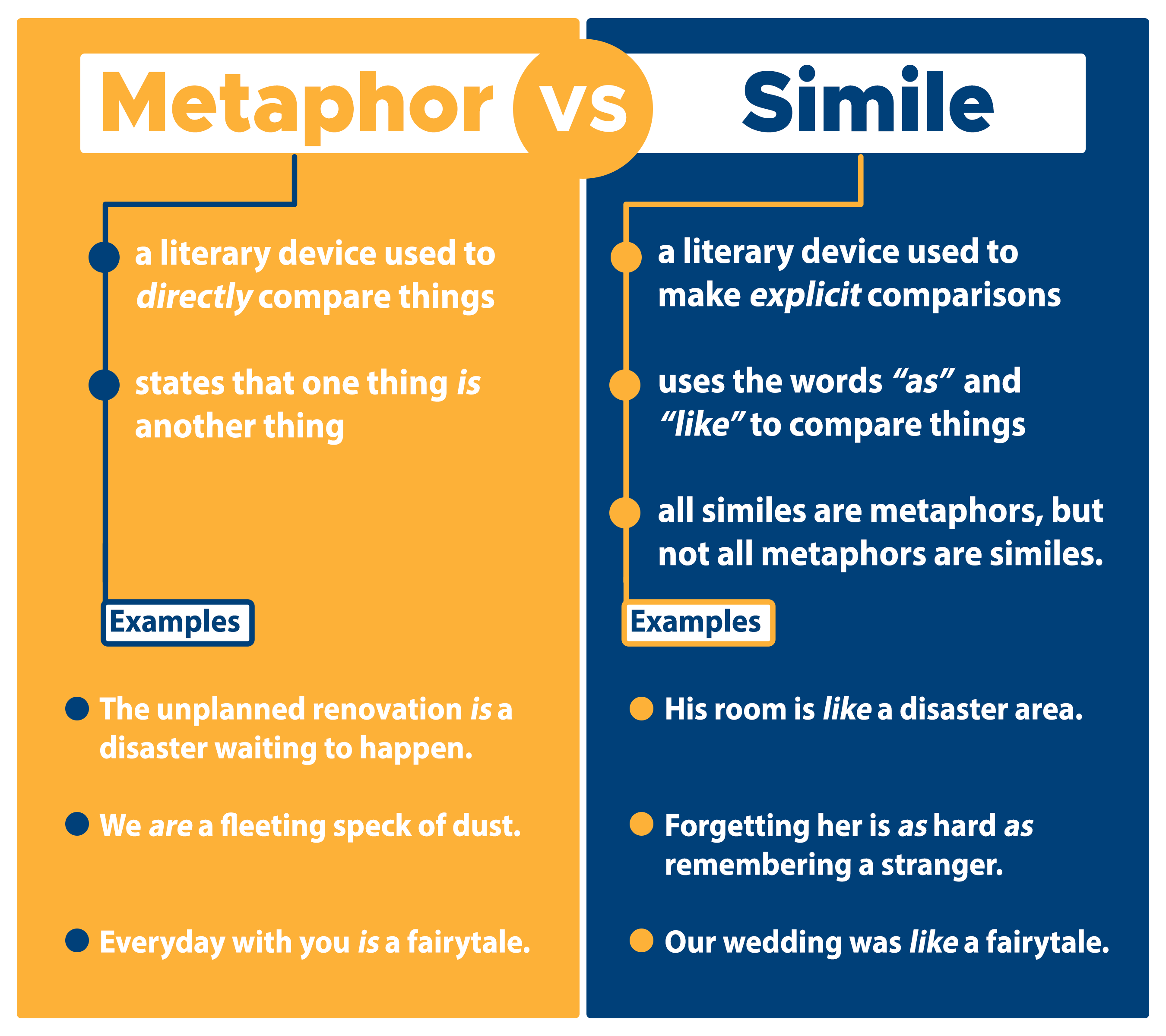
A simile is an explicit comparison, using words like "like" or "as."
A metaphor is a direct comparison, stating that one thing is another.
Let's start with a short video segment from a familiar face.
Everything you need to write a poem (and how it can save a life) | Daniel Tysdal | TEDxUTSC
In our previous lesson, we watched a part of Daniel Tysdal's TEDx talk. Let's revisit it for his clear, concise definitions of these two key terms.
Please watch from 09:22 to 10:12. Pay close attention to the definition he provides for each term and the literary examples from Langston Hughes (simile) and Thylias Moss (metaphor).
As Tysdal points out, a simile uses a connecting word ("like a raisin in the sun"), while a metaphor makes a direct equation ("eyes are birds with clipped wings").
Now, let's explore the different effects these two devices can have on a reader with a beautifully animated video.
The art of the metaphor - Jane Hirshfield
This TED-Ed video by poet Jane Hirshfield, 'The art of the metaphor,' delves into why these comparisons are so powerful. It treats simile as a specific type of metaphor and explores how they work on our imagination.
Watch from 00:30 to 02:30. Notice the distinction made: a simile 'admits it's making a comparison' and tends to make you think, whereas a metaphor lets you feel things more directly. This idea that metaphors can 'ghost right past the logical mind' is key to their power.
To summarize this core distinction, here is a helpful visual. A common way to think about it is that all similes are a type of metaphor, but not all metaphors are similes. The simile is just more open about the comparison it's making.
The Anatomy of a Good Comparison
Now that we can identify similes and metaphors, let's break down what makes them work. A good comparison should feel both surprising and fitting.
To analyze this, writers often use two terms:
- The Tenor: The original subject you are trying to describe.
- The Vehicle: The object you are comparing it to, whose qualities you are borrowing.
In Robert Burns's famous line, "O my Luve is like a red, red rose," the Luve is the tenor, and the rose is the vehicle. We borrow the qualities of the rose (beauty, fragrance, perhaps thorns) to describe the love.
The following reading explains this concept and discusses what separates a weak comparison from a powerful one.
Learning about Figurative Language
This article from the Poetry Foundation, 'Learning about Figurative Language,' offers practical advice on crafting effective comparisons.
Please read the three short sections starting with 'When we think of figurative language...', 'Metaphors and similes have two parts.', and 'Let’s say you were to write...'. Focus on these key ideas: The definitions of tenor and vehicle. The goal of balancing aptness and surprise. The example comparing 'The coffin was a dark shroud' to 'The coffin was a black boat,' and why the second one is more effective.
The "coffin as a boat" example is excellent because it illustrates how a surprising comparison can introduce new layers of meaning—in this case, the idea of a journey or transition into the afterlife. This is how you can begin to weave the philosophical themes that interest you into your descriptions.
A major obstacle in writing fresh comparisons is the cliché—the overused phrase that has lost its power. For example, "as busy as a bee" or "life is a journey." Your technical background in software engineering involves finding novel solutions to problems; you can apply a similar mindset here to find original, specific comparisons that avoid cliché.
Notice the difference:
- Cliché: Her tears fell like rain.
- Original: A single tear skittered down her cheek like a droplet of rain on a car window.
The second example is far more vivid because of its specificity. It creates a much clearer image and feeling.
Writing Exercise: Crafting Your Own Comparisons
It's time to put theory into practice. These exercises are designed to be playful and generative, helping you make new connections without pressure.
Exercise 1: Metaphor Mad-Libs (10 minutes)
This first exercise is about letting your imagination run wild. Don't worry about making perfect sense; the goal is to generate surprising juxtapositions. Complete the following prompts, which are adapted from the Poetry Foundation article you just read.
- The world is a ____________________ (noun) trying to _______________________ (verb phrase).
- My memory of that day is like a __________________ (adjective) __________________ (noun).
- Anxiety is the ____________________ (noun) of the _______________________ (noun).
After you've filled them in, look back at your creations. Does one of them strike you as particularly strange, funny, or true? A single surprising line generated this way can often become the seed for an entire poem or story.
Exercise 2: From Object to Comparison (10 minutes)
In the last lesson, you wrote a paragraph describing an object through the lens of a specific emotion. Now, let's return to that object and that emotion.
Your Task:
- Think of the object and emotion you worked with in the previous lesson's exercise.
- Write one simile that describes the object, informed by that emotion.
- Write one metaphor that describes the object, informed by that emotion.
Example (using the 'lonely teacup' from the last lesson):
- Simile: The teacup sat on the vast table like a single, unvisited island.
- Metaphor: The teacup was a porcelain cage holding the memory of warmth.
This exercise directly integrates today's tools with the skill you developed previously, showing how similes and metaphors can be used to achieve the goal of "showing, not telling."
Conclusion
In this lesson, you've dissected two of the most fundamental devices in a writer's toolkit. You now have a framework for not only identifying similes and metaphors but for understanding how they function and how to begin crafting your own.
Key Takeaways:
- A simile is a comparison using "like" or "as," which makes the comparison explicit.
- A metaphor is a direct comparison stating one thing is another, creating a more immediate and often more powerful effect.
- Effective comparisons hinge on a balance of aptness (the comparison makes sense) and surprise (it offers a fresh perspective).
- Using the concepts of tenor (subject) and vehicle (object of comparison) can help you analyze and construct your own figurative language.
Preview of the Next Lesson:
Now that you've learned about sensory details, showing emotion, and crafting comparisons, our next lesson will be about reflection and application. We will focus on explaining the principle of 'showing, not telling' using examples from your own writing. You'll have the chance to look back at the short pieces you've generated and analyze how these techniques are working, which is a crucial first step in the process of revision.