Welcome to the third lesson in our exploration of AI-assisted social media strategy. In our previous session, we focused on transforming performance data into strategic content ideas. You learned how to prime an AI with your brand context and use frameworks like Content Pillars and GAP to generate targeted concepts.
Now that you have a backlog of strong ideas, we'll move to the next critical step in your workflow: drafting the actual social media copy. This lesson will teach you how to use an AI assistant to write compelling posts, captions, and threads, while precisely controlling their tone and format. We will go beyond simple instructions and develop a systematic approach to prompt engineering that turns your creative ideas into polished, platform-ready drafts.
The Anatomy of an Effective Drafting Prompt
Just as in computer science where a well-defined function requires specific parameters to produce a predictable output, a good AI prompt needs structure. Vague requests like "write a post about our new product" lead to generic, ineffective copy. To get consistently high-quality results, you need to provide the AI with a clear set of instructions.
A powerful and easy-to-remember framework breaks a prompt down into six key components. The following video provides an excellent overview of this formula.
Master the Perfect ChatGPT Prompt Formula (in just 8 minutes)!
Watch this video, "Master the Perfect ChatGPT Prompt Formula (in just 8 minutes)!" by Jeff Su. It introduces a foundational structure for all effective prompts.
Watch the entire video. As you watch, pay close attention to the six components he introduces: Task and Context Exemplars (Examples) Persona Format Tone Notice the hierarchy he presents: Task is mandatory, Context and Exemplars are important, and Persona, Format, and Tone are "nice-to-haves" that significantly elevate the quality of the output. For your work in social media, these last three are often what separate great copy from mediocre content.
While Jeff Su's framework is universal, we can refine it for the specific task of copywriting. The next video translates this structure into a focused, seven-part recipe for generating persuasive copy.
The BEST ChatGPT Copywriting Prompt (I Tested 100's)
Now, watch "The BEST ChatGPT Copywriting Prompt (I Tested 100's)" by Jesse Forrest. He presents a template specifically designed for copywriting tasks.
First, watch the section explaining the seven essential ingredients of a copywriting prompt. These are: Length: Word or character count. Type of copy: Facebook ad, Instagram caption, etc. Product/Service: What you're promoting. Target Audience: Who you're talking to. Tone of Voice: How the copy should feel. Call to Action (CTA): What you want the reader to do. Key Points: Must-include information. Then, watch the practical demonstrations for a Facebook ad and a sales page. Notice how he fills in the template for each specific need.
These two frameworks provide a robust mental model. Think of Jeff Su's six components as the "what" and Jesse Forrest's seven ingredients as the "how" for your daily work.
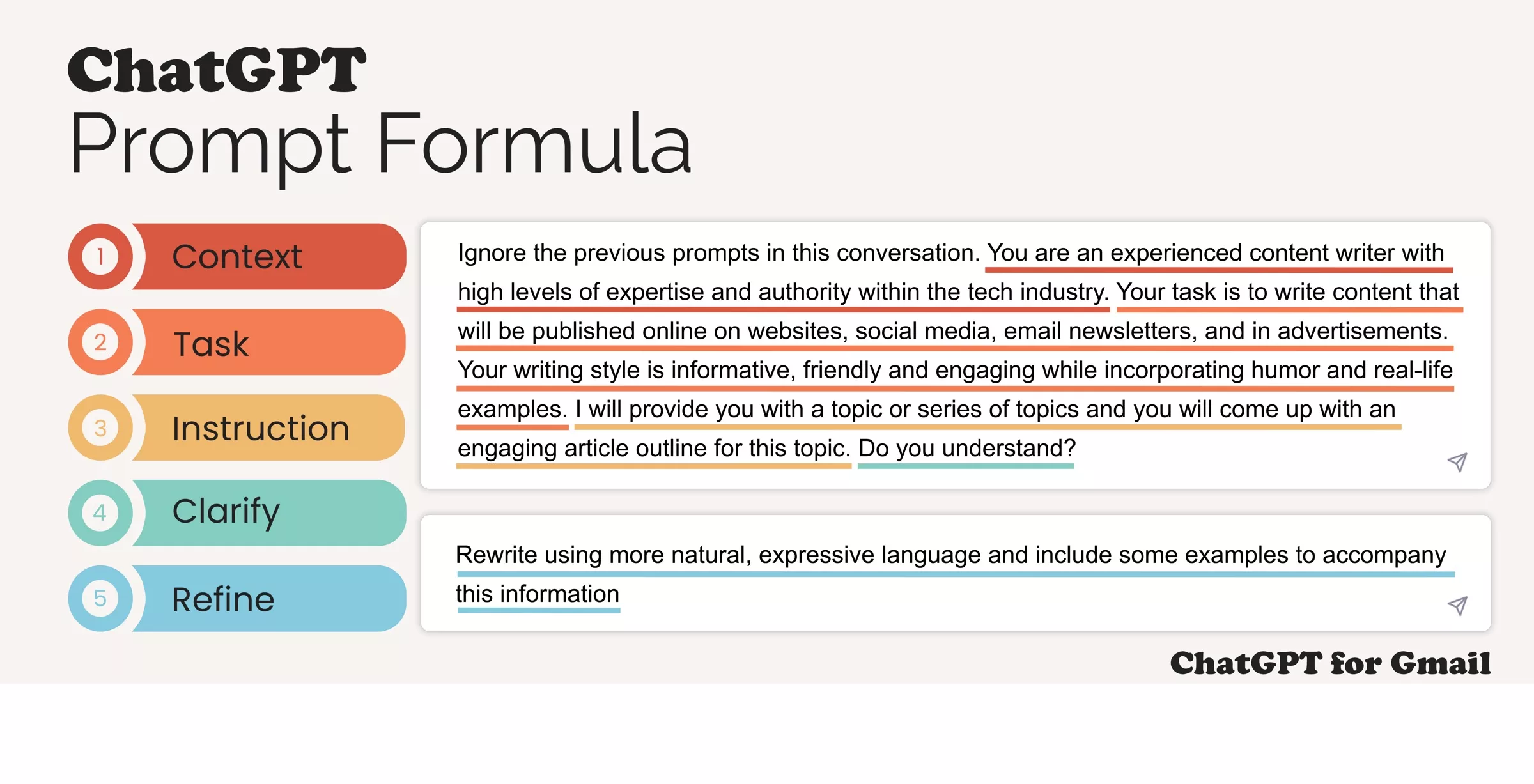
Mastering Tone: From Casual to Authoritative
Tone is arguably the most crucial element in social media copy. It's what makes your brand feel human and connect with your audience. Simply telling an AI to "be friendly" isn't enough. Precision is key.
The following resource provides an excellent breakdown of how to think about and instruct an AI on tone.
10 Examples of Tone-Adjusted Prompts for LLMs - Latitude.so
This article from Latitude.so is a practical guide to controlling tone in your AI prompts. It explains the mechanics and provides specific examples.
First, read the introduction and the section on how tone adjustment works. The principles of strategic vocabulary, contextual framing, and explicit instructions are fundamental. Next, focus on the section titled Casual Tone: Social Media Content Prompt. This is directly applicable to your work. Pay attention to the prompt structure and the "What to Watch Out For" tips. Finally, review the sections on Humorous Tone and the FAQ at the end, particularly the answer to "What tone to tell ChatGPT?". This reinforces the need for clear, specific instructions.
A More Powerful Technique: The Role Assignment Pattern
To take your control over tone to the next level, you can use a technique called the Role Assignment Pattern. Instead of just describing a tone (e.g., "professional"), you instruct the AI to adopt a specific persona (e.g., "You are a direct-response copywriter specializing in B2B tech"). This primes the AI to access a much richer set of stylistic and structural conventions associated with that role.
10x your AI with these 9 Foundational Prompt Patterns
This article from AI Made Simple introduces several advanced prompting techniques. We'll focus on the one most relevant for controlling voice.
Read the section on the Role Assignment Pattern. The practical example comparing a generic prompt to a role-assigned prompt for email subject lines is particularly insightful. Notice how the "direct response copywriter" persona not only changes the copy but also adds strategic annotations explaining the psychology behind the choices.
By assigning a role, you leverage the model's vast training data on how different professionals write, giving you a more authentic and expert-level output with less effort.
Controlling Format and Adapting for Different Platforms
Your job as a social media executive requires you to post content across multiple platforms, each with its own formatting rules and audience expectations. A great LinkedIn post is not a great Tweet. The Style Transfer Pattern is a powerful technique for efficiently adapting a core piece of content for various channels.

The Style Transfer Pattern involves giving the AI a piece of completed content and asking it to rewrite it in a different style, tone, or format while preserving the core message.
10x your AI with these 9 Foundational Prompt Patterns
Let's return to the AI Made Simple article to explore how to transform content for different contexts.
Read the section on the Style Transfer Pattern. The key idea is to "transform existing content into a different style, tone, or voice, while preserving the core information." The example of adapting a technical explanation for a non-technical audience is a perfect analogy for what you do when you adapt a detailed blog post into a short, snappy Instagram caption.
Bringing It All Together: From Idea to Multi-Platform Drafts
Let's synthesize these concepts with a practical example, continuing with the plant shop scenario from our last lesson.
Recap:
- Insight: Instagram Reels about plant care mistakes get high engagement.
- Idea: A Reel titled "Overwatering: The #1 Plant Killer."
Now, let's use our structured prompt formula to draft the Instagram caption.
Your Prompt:
Persona: You are a witty and knowledgeable social media copywriter for "The Leafy Corner," a plant shop with a friendly and slightly quirky brand voice.
Context: We are posting an Instagram Reel about the dangers of overwatering plants. Our target audience is millennial and Gen Z plant enthusiasts who appreciate aesthetics and clear, helpful advice.
Task: Write a caption for this Instagram Reel.
Tone: The tone should be helpful, empathetic, and slightly humorous. We want to show we understand the struggle without being preachy.
e> Format & Key Points:
- The caption must be under 150 words.
- Start with a strong, relatable hook.
- Include 3 quick, actionable tips to avoid overwatering.
- Include 3-5 relevant hashtags for discoverability (e.g., #plantcare, #overwatering, #planttips).
Call to Action: End with a question that encourages comments, asking followers to share their own "overwatering horror stories."
This detailed prompt will produce a much better result than "write a caption about overwatering."
Now, let's use the Style Transfer Pattern to adapt this for Twitter.
Follow-up Prompt:
"Excellent. Now, take the core message of that Instagram caption and adapt it into a 3-tweet thread for Twitter.
- Tweet 1: The hook. Make it punchy and intriguing.
- Tweet 2: The 3 tips, written as a numbered list. Use emojis to save space.
- Tweet 3: The call-to-action question. Link back to our Instagram profile at the end."
This two-step process—drafting a primary piece of content and then systematically adapting it—is far more efficient than writing unique copy from scratch for every platform.
Conclusion
In this lesson, you've learned how to move from ideation to execution by drafting high-quality social media copy with AI. You now have a structured methodology to replace guesswork with precision, ensuring your outputs are consistent, on-brand, and effective.
Here are your key takeaways:
- Structure is Everything: Use a comprehensive prompt formula (like Task, Context, Persona, Format, Tone) to guide the AI. Generic prompts yield generic results.
- Master Tone with Personas: Go beyond simple adjectives by assigning the AI a specific role (e.g., "direct response copywriter," "brand strategist"). This unlocks a more authentic and expert voice.
- Control Format with Exemplars and Instructions: Clearly define your desired output, whether it's a table, a bulleted list, or a specific post structure.
- Adapt, Don't Recreate: Use the Style Transfer Pattern to efficiently repurpose a core message for different social media platforms, saving time while maintaining consistency.
In our next lesson, we will address the critical final step before publishing: evaluating AI-generated social media content for brand consistency and factual accuracy. Now that you can generate drafts, it's time to learn how to refine and validate them.