Hello! In our last lesson, we focused on the "data-first" part of our strategy, using AI to analyze and interpret social media performance data. By applying the DIG framework, you learned how to transform raw numbers into actionable insights about what content resonates with your audience.
Now, we'll take the next logical step in your workflow. Having uncovered the why behind your content's performance, this lesson will equip you to determine the what. We'll focus on using an AI assistant to generate targeted content ideas for a specific audience and platform. You'll learn how to move beyond generic brainstorming and prompt AI to produce creative, relevant, and strategic ideas that are directly informed by the insights you've learned to extract.
The Foundation: Priming Your AI for Your Brand
Before you can ask an AI to generate brilliant ideas, you must teach it who you are. An AI without context is like a new team member on their first day—knowledgeable in general, but useless for specific tasks until they're briefed. Your background in computer science has shown you that the quality of an output is dictated by the quality of the input; the same principle is fundamental to prompt engineering.
This initial briefing process is often called "priming." It involves providing the AI with detailed information about your business, your products or services, your brand voice, your goals, and, most importantly, your target audience. This turns a generic tool into a personalized assistant tuned to your specific needs.
The following video provides an excellent, practical demonstration of how to prime an AI assistant from scratch.
You’re working too hard! Let’s use ChatGPT to build your content strategy, calendar + posts FAST.
Watch this segment from the video "You’re working too hard! Let’s use ChatGPT to build your content strategy..." by High Season Co. It walks through the critical initial step of briefing the AI.
Pay close attention to the section from the start of the process. The presenter explains why priming is crucial and demonstrates how to provide the AI with: Business background and offerings. A detailed description of the target audience. Specific social media goals. Notice how she feeds the information in stages to ensure the AI processes it correctly.
By priming the AI, every subsequent prompt you use in that conversation will be filtered through this contextual lens, leading to far more relevant and on-brand outputs.
Defining Your Audience and Finding Your Angle
A deep understanding of the audience is the cornerstone of any successful content strategy. The more specific you are about who you're talking to, the better the AI can generate ideas that will resonate with them.
One effective technique is to have the AI help you build out a detailed persona. This serves as a constant reference point for all future ideation. The article below provides a powerful prompt for this.
The AI-Driven Content Strategy: 6 Powerful Prompts for Content ...
This article from Orbit Media details several prompts for AI-driven content strategy. We'll start with the foundational step of understanding the audience.
Read the section titled 1. Quick audience insights. Focus on the prompt provided to generate a detailed persona. This structure is an excellent way to feed audience information to the AI.
Once your AI understands who you're talking to, the next step is to find compelling angles for your content. The most engaging social media content often stems from strong opinions or fresh perspectives, which differentiate your brand from generic, AI-generated noise. The same article offers a clever prompt for unearthing these topics.
The AI-Driven Content Strategy: 6 Powerful Prompts for Content ...
Now, let's look at how to generate topics that spark conversation.
Read section 3. Discover engaging topics for social media. The key here is the prompt that asks for mundane topics people have strong opinions about. This is a brilliant way to source ideas that are highly engaging yet low-risk.
This approach helps you generate ideas that are inherently social and designed to trigger conversation, a key driver of algorithmic visibility.
Frameworks for Strategic Ideation
To ensure your content is balanced and consistently supports your goals, it's helpful to use strategic frameworks for ideation. Instead of just asking for "post ideas," you can ask for ideas that fit into specific categories.
The Content Pillars Framework
As a social media executive, you are likely familiar with content pillars: the core themes or topics your brand focuses on. You can use your primed AI to help define these pillars and then generate ideas for each one. The video from High Season Co. demonstrates this beautifully.
You’re working too hard! Let’s use ChatGPT to build your content strategy, calendar + posts FAST.
Let's return to the High Season Co. video to see how to translate your brand context into strategic content pillars.
Watch the segment from where the presenter introduces content pillars. Notice how she prompts ChatGPT to suggest 3-5 pillars based on the previously provided business information and then provides post ideas for each pillar. This ensures a direct link between your goals and your content.
The GAP Framework
Another powerful model is the GAP framework, which categorizes content into three types, each serving a distinct purpose in your audience's journey:
- Growth (G): Content that gets people to know you. It often leverages trends or popular figures to drive reach.
- Authority (A): Content that gets people to trust you. This includes tutorials, case studies, and tips that showcase your expertise.
- Personal (P): Content that gets people to like you. This includes behind-the-scenes stories, personal opinions, and brand values.
The following video introduces this concept and explains how it builds a bridge from a stranger to a fan.
How To Use ChatGPT To Make 3 Months Of Content In 3 Hours
This video by Dakota Robertson explains his "GAP" framework for creating a well-rounded content strategy.
First, watch the explanation of the framework from the introduction of the GAP framework. Then, see how it's used in practice by watching the section on prompting the AI to ask questions for each category. This turns the framework into a powerful idea-generation engine.
Using frameworks like Content Pillars or GAP allows you to prompt the AI with more strategic intent, asking not just for ideas, but for ideas that fulfill a specific role in your marketing funnel.
Bringing It All Together: From Insight to Idea
Now, let's synthesize what we've learned. The most powerful prompts for content ideation combine your performance insights, your primed brand context, and a strategic framework.
This infographic provides a great overview of the best practices for structuring your prompts.
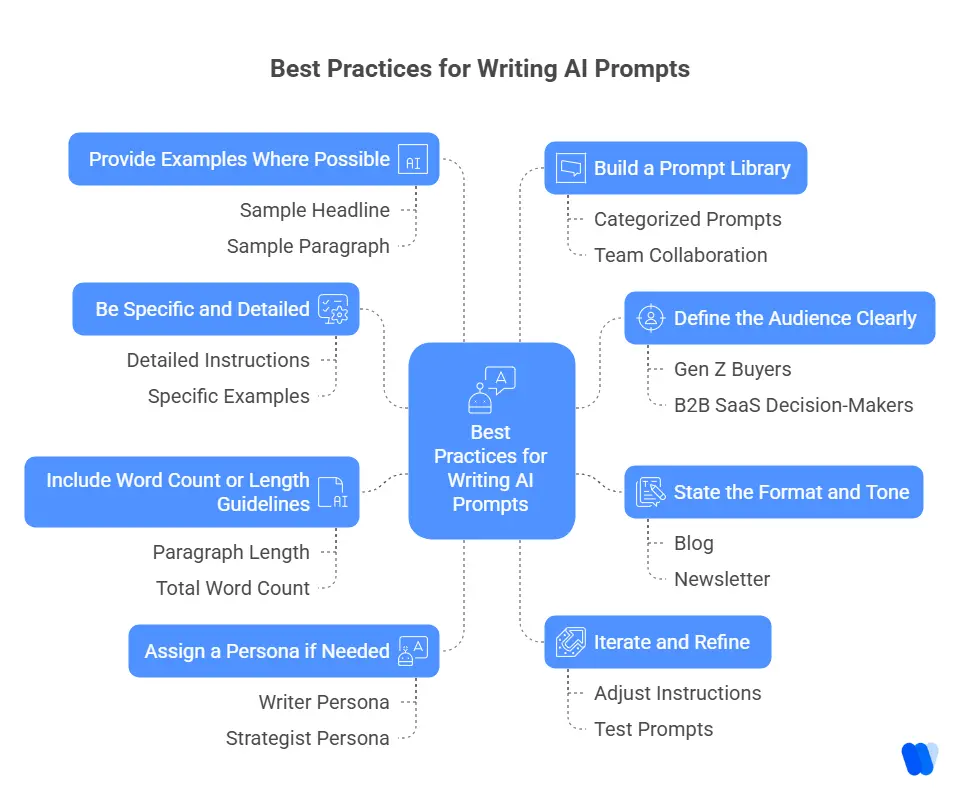
Imagine you're the social media manager for the plant shop from the videos. From your analysis in the last lesson, you discovered that Instagram Reels about plant care mistakes get the highest engagement.
Here’s how you could structure a prompt to generate targeted ideas:
Your Prompt:
"You are a creative social media strategist for a plant shop that sells to millennial plant enthusiasts who value aesthetics and expertise. Our brand voice is knowledgeable, friendly, and slightly quirky.
Based on our performance data, Instagram Reels that address common plant care mistakes perform best for driving engagement.
Using the 'Authority' pillar of the GAP framework, generate 5 creative ideas for short Instagram Reels (under 60 seconds) that address common but surprising mistakes new plant parents make. For each idea, provide:
- A catchy, scroll-stopping hook (3-7 words).
- A brief concept for the Reel.
- A suggestion for the call-to-action (e.g., 'Comment with your biggest plant fail!')."
This prompt is effective because it includes:
- Persona: Millennial plant enthusiasts.
- Platform: Instagram Reels.
- Insight: "Plant care mistakes" drive engagement.
- Framework: The "Authority" pillar.
- Format: Hook, concept, and CTA.
This entire process, from ideation to final scheduling, can be structured with the help of AI.

For further examples of prompts for specific social media tasks, the following article is an excellent resource to bookmark.
30 ways to master AI prompts for social media: A marketer's guide
This guide from Sprout Social is a comprehensive library of prompt examples for various social media marketing tasks.
Scan through the following sections for inspiration: Content creation prompts (examples 1-3) for high-level brainstorming. Audience targeting prompts (example 19) for tailoring content to specific segments. Strategy prompts (examples 20-21) for bigger-picture campaign planning.
Conclusion
In this lesson, you've moved from analyzing past performance to ideating future content. You've learned that generating high-quality, targeted ideas with AI is not about finding a single "magic prompt," but about a systematic process of providing context and clear instructions.
Here are your key takeaways:
- Prime Your AI: Always start by briefing your AI on your brand, audience, and goals to ensure outputs are personalized and relevant.
- Use Strategic Frameworks: Employ models like Content Pillars or the GAP framework (Growth, Authority, Personal) to guide your ideation and ensure a balanced content mix.
- Combine Insight with Intent: The best prompts integrate performance data (what works), audience personas (who it's for), and a clear objective (what it should achieve).
- Be Specific: Clearly define the platform, format, tone, and desired structure of the output to get precisely what you need from the AI.
In the next lesson, we will take the ideas you've just learned to generate and move to the next stage of the workflow: using an AI assistant to draft compelling social media copy in different tones and formats.