Introduction
In our last lesson, we examined the architecture of algorithmic echo chambers, concluding that they not only reflect user preferences but actively shape community norms by rewarding platform-friendly content and punishing what is deemed non-normative. This lesson delves into the direct psychological impact of living within these algorithmically managed realities.
Today's focus is on a phenomenon that arises from the chaotic nature of our content feeds. We will address the learning outcome: Define 'hypernormalization' of extreme emotions and identify its desensitizing effect in content feeds. You will learn what hypernormalization is, how the very structure of your social media feed causes it, and the neurobiological reasons why it leads to emotional numbing. Understanding this is vital for you, as it explains the emotional exhaustion you might feel as a creator and helps you anticipate how your audience, bombarded by contradictory stimuli, might perceive your content.
The Emotional Whiplash of the Digital Feed
Take a moment to consider the image below. It captures a common, yet profoundly strange, modern experience.
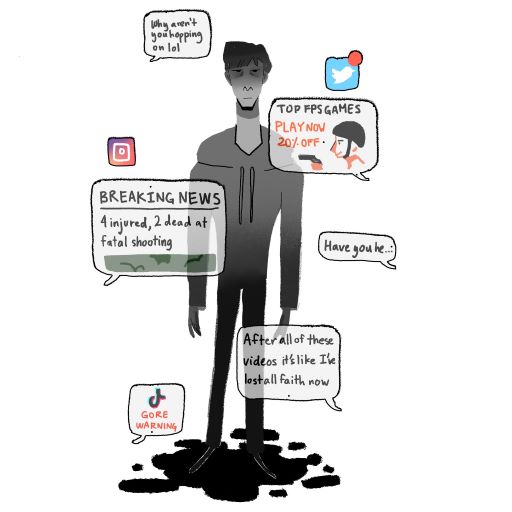
The person in the drawing is inundated with a mixture of the tragic, the trivial, the violent, and the commercial, all competing for attention simultaneously. This constant, jarring juxtaposition is the engine of a process called hypernormalization.
The term was originally coined by scholar Alexei Yurchak to describe late-era Soviet society, where everyone knew the system was failing but pretended everything was normal because they couldn't imagine an alternative. In our digital context, hypernormalization describes the process by which we are so frequently exposed to crises, tragedies, and extreme emotions that they cease to feel shocking and become part of the normal, everyday background noise of our lives.
The following article offers a clear definition of this concept and traces its origins.
Tragedy Turned Typical – FEEDBACK
This article from FEEDBACK introduces hypernormalization and explains its relevance to modern media consumption.
Please read the introduction and the section titled "Origins". Focus on how the author transposes the original meaning of the term to our current digital environment.
The core mechanism driving this phenomenon in social media is the structure of the feed itself, which demands rapid, inconsistent emotional responses. A short video from BBC Ideas explains this perfectly.
Is social media messing with our emotions? | BBC Ideas
This video, "Is social media messing with our emotions?", clearly explains the emotional whiplash caused by the structure of social media timelines.
Watch the segment from this section. The speaker describes the "quick gear changes in our emotional lives" required when a picture of a friend's child is immediately followed by news of a deadly earthquake.
This constant emotional "gear-shifting"—from amusement to horror, from arousal to outrage, from personal warmth to global crisis, all in the space of a few seconds—is neurologically taxing. To cope, our brains begin to blunt the impact of these emotional signals. The result is not that we stop understanding that a tragedy is tragic; it's that we stop feeling its full weight.
The Neurobiology of Numbness
This feeling of being emotionally blunted or detached is often called desensitization. It is more than just a vague feeling; it is a measurable neurobiological process. Constant exposure to high-arousal content, whether it's graphic news or emotionally charged debates, rewires our brain's threat and empathy circuits.
The powerful spoken-word performance in the following TEDx Talk gives a visceral voice to this experience of becoming a "desensitized drone."
#Trending: Social Media is a Killer of Emotions | Porsche Kelly | TEDxOakland
In "Social Media is a Killer of Emotions," poet Porsche Kelly articulates the experience of emotional desensitization from consuming real-world tragedy as digital content.
Watch the first three minutes of the performance, from the start to the end of the verse. Notice how she distinguishes the effect of watching real-world violence on a feed from watching fictional violence in a movie.
Kelly’s performance captures the feeling, but what is the underlying science? A clinical perspective reveals how algorithms, seeking to maximize engagement, create a feedback loop that pushes us toward increasingly intense content, accelerating this desensitization process.
The article "The Empathy Crisis" from the Psychiatric Times details the neurological and psychological shifts that occur. Given your background in statistics and analysis, you will likely find this mechanistic explanation particularly insightful.
The Empathy Crisis: How Social Media Algorithms Drive Emotional ...
This article explains the clinical and neurobiological basis for desensitization caused by algorithmically promoted content.
Please read these three key sections: "How Algorithms Work": This connects to our previous lesson, explaining how algorithms can escalate content intensity and disproportionately affect vulnerable communities. "Neurobiology of Desensitization and Compulsive Exposure": This is the core scientific explanation. Focus on the findings that repeated exposure leads to reduced reactivity in the brain's emotional centers (the amygdala) and a blunted stress response. "Moral Psychology and Shifts in Empathy and Judgment": This section details the consequences. Pay attention to how desensitization leads to harsher judgments and reduced empathy.
In essence, your brain adapts to the constant state of high alert by turning down the volume. The amygdala, which acts as a threat-detection center, becomes less responsive. This cognitive-emotional shortcut allows you to keep scrolling without being perpetually overwhelmed, but it comes at a cost: a diminished capacity for empathy and a tendency toward harsher, more simplistic moral judgments.
Contextualizing Desensitization: Your Brand and Your Community
This phenomenon has direct implications for your work as a content creator and as a participant in niche communities.
As a Lingerie and Bikini Designer:
Your content, which is designed to be artistic, provocative, and empowering, does not exist in a vacuum. The algorithm might place your latest boudoir photo right after a video of a political protest or a news story about a natural disaster.
- Flattened Impact: For a user experiencing hypernormalization, the emotional impact of your work can be "flattened." The intended feelings of desire, beauty, or confidence are dampened because their brain's emotional circuits are already fatigued and desensitized.
- Harsher Judgments: A desensitized mind favors quick, low-effort judgments. A follower scrolling in this state may be less likely to appreciate the nuance of your artistic expression and more likely to revert to a simplistic, reflexive label like "attention-seeking" or "inappropriate," regardless of your intent.
Within Alternative Lifestyle Communities:
The complex emotional landscape of polyandry and hotwife relationships is particularly vulnerable to the distortions of hypernormalization.
- Normalization of Extremes: The constant firehose of high-drama content online can make extreme relationship scenarios (e.g., chaotic breakups, public accusations) seem like the norm. This can desensitize community members to the real-life emotional weight of navigating jealousy, communication, and consent.
- Loss of Nuance: A desensitized audience has less patience for nuance. A thoughtful post about the subtle emotional negotiations in a cuckold dynamic might get ignored in favor of a more dramatic, high-conflict story that provides a stronger (if cruder) emotional signal. This reinforces the very algorithmic loop we discussed in the last lesson, where extreme content is amplified and nuanced conversation is suppressed.
Safeguarding Your Emotional Bandwidth
Recognizing hypernormalization is the first step toward mitigating its effects. The goal is not to become uninformed, but to regain control over your emotional responses.
The "Tragedy Turned Typical" article you read earlier concludes with actionable advice. The key strategies involve creating intentionality in your media consumption.
- Separate Your Spaces: Actively choose where you get different types of information. Use social media for connection and entertainment, but turn to dedicated, reputable sources (like news apps, podcasts, or long-form journalism) for serious global issues. This prevents tragedy from being just another piece of "content" to swipe past.
- Practice Mindful Disengagement: When you feel the emotional whiplash or notice yourself becoming numb, recognize it as a symptom of hypernormalization. Give yourself permission to put the phone down and step away. This is not apathy; it is essential self-preservation.
- Challenge Performative Responses: Be wary of the impulse to simply repost something tragic to feel like you've "done something." While it can raise awareness, it can also become a substitute for genuine feeling or meaningful action, contributing to the overall noise that fuels desensitization.
Conclusion
In this lesson, we explored the unsettling phenomenon of hypernormalization and its desensitizing effects. We have seen that this is not just a vague cultural malaise but a predictable psychological response to the chaotic, algorithmically-curated environments of our social media feeds.
Key Takeaways:
- Hypernormalization is the process where constant exposure to crisis and dysfunction makes them feel normal, driven by the jarring juxtaposition of trivial and tragic content in our feeds.
- This creates an emotional whiplash that, over time, leads to desensitization—a blunting of our emotional responses.
- This desensitizing effect has a neurobiological basis, primarily involving reduced reactivity in the brain's emotional centers like the amygdala.
- The consequences include reduced empathy, harsher moral judgments, and a "flattening" of the emotional impact of all content, including your own creative work.
- Safeguarding strategies focus on conscious, intentional media consumption, such as separating information sources and practicing mindful disengagement.
Now that we understand how this constant stream of high-arousal content can make us numb, a new question arises: why do we find it so hard to look away? Our next lesson will address this directly by defining 'doom scrolling' and explaining the underlying neurological reward-punishment cycle that keeps us compulsively engaged, even with content that makes us feel bad.