Introduction
In our recent lessons, we've explored the more detrimental aspects of algorithmic systems, from the reinforcement of echo chambers and hypernormalized emotions to the draining cycles of doomscrolling and brain rot. We've established a clear diagnosis of the problems. Now, we pivot from diagnosis to intervention. This lesson begins our focus on practical solutions, empowering you to move from being a passive recipient of algorithmically-chosen content to an active curator of your digital environment.
Today, we will directly address the learning outcome: Apply feed curation techniques (muting, blocking, strategic engagement) to actively train platform algorithms. We will break down the mechanics of how algorithms learn from your behavior and equip you with a toolkit of defensive and offensive techniques. Given your background in statistics and operations research, you can think of this as moving from simply observing a stochastic system to actively providing the weighted inputs needed to guide it toward a desired state.
The Algorithm: A Feedback System You Can Control
Social media algorithms are, at their core, massive, dynamic feedback systems. Their goal is to predict what will keep you engaged and serve you more of it. While they seem like opaque black boxes, their fundamental structure is quite straightforward.

As the diagram shows, the process is a cycle. The algorithm collects content, uses a model to predict what you'll engage with, ranks and distributes it to your feed, and then—critically—analyzes your signals (your behavior) to update its model. Every scroll, pause, like, comment, or block is a data point that feeds back into this loop. You are constantly training your personal algorithm, whether you do so intentionally or not. Our goal is to make this training process deliberate.
Deconstructing the Signals: Positive and Negative Reinforcement
To train the system effectively, you need to understand which signals it values most. The internal workings are proprietary, but a rare glimpse into Twitter's (now X) open-source algorithm provides a quantitative look at how different engagements are weighted. This model offers a powerful mental framework for all platforms.
The Ultimate Guide to Getting Recommended by Twitter's Algorithm ...
This article, based on Twitter's source code, breaks down the specific weights assigned to different user actions. It provides a rare, concrete look at the signals that drive algorithmic ranking.
First, read the section "The Ranking Signals That Matter". Pay close attention to the table of positive and negative signals and their relative impact. Notice the stark difference in weight between a reply and a like. Then, scroll to the end and review the summary tables under the heading "Key Takeaways". This will reinforce the most and least valuable signals.
As you can see, not all engagement is created equal. The system responds to both positive and negative reinforcement, with some actions carrying far more weight than others.
- Positive Signals (Reinforcement): These are your "votes for more." They include likes, comments, shares, saves, profile clicks, and video watch time. As the article shows, a reply can be weighted up to 9 times more than a simple like. This tells the algorithm you find the content valuable enough to invest time and thought.
- Negative Signals (Punishment): These are your "votes for less," and they are your most powerful curation tools. Actions like Block, Mute, Report, or clicking "Not Interested" send strong negative signals that the algorithm is designed to obey. An action like blocking a user is an extremely high-weight signal that tells the algorithm, "This content, and content like it, is unwelcome."
The Feed Curation Toolkit
Armed with this understanding of signals, we can build a practical toolkit for feed curation. This involves two distinct but complementary approaches: defensive pruning and offensive cultivation. For an overview of the tools available, refer to this chart.
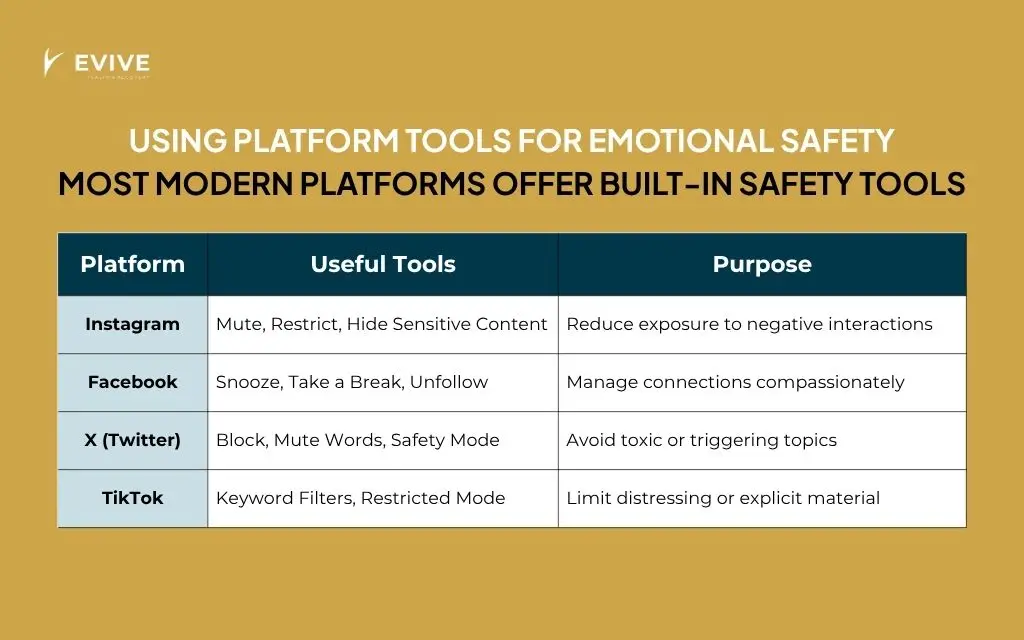
1. Defensive Pruning: Removing Unwanted Content
This is the first and most crucial step: aggressively removing content that is irrelevant, harmful, or simply low-quality. This is how you "starve" the parts of the algorithm that are serving you content you don't want.
Hack your social media algorithm with our step-by-step guide
This guide provides an excellent, actionable checklist for cleaning up your feed using the tools available on most platforms.
Start by reading the section "Practical ‘prune & reset’ steps". This covers the basics of unfollowing, muting, and using the "Not Interested" feature. Next, read "Use filters, keyword-blocks, and content settings" to learn about more proactive filtering. Finally, review the platform-specific instructions for Instagram, TikTok, and Facebook, as the exact steps differ slightly.
Let's apply this to your specific context:
-
Context: Your lingerie design account. You post an artistic photo of a new bikini top. It attracts comments that are purely objectifying and miss the focus on design.
- Ineffective Action: Deleting the comment. This removes the text but sends no signal to the algorithm.
- Effective Action: Block the user. This sends a powerful negative signal. The algorithm learns to deprioritize showing your content to users with similar profiles or engagement patterns, effectively helping you filter your future audience.
-
Context: Your involvement in polyamorous communities. Your feed starts showing content from "anti-monogamy" creators that frames all non-monogamy as toxic, because of keyword overlap.
- Ineffective Action: "Hate-watching" or leaving angry comments. This is engagement! The algorithm will interpret this as interest and show you more.
- Effective Action: On each post, click the menu and select "Not Interested" or "Show Less of This." For a more permanent solution, use the platform's keyword filtering/muting feature (available on Instagram and X) to hide posts containing terms like "red pill," "trad wife," or other phrases common to that discourse.
2. Strategic Engagement: Cultivating Your Desired Feed
Defensive pruning stops the bleeding. Strategic engagement is how you build a healthy, nourishing information diet. This means consciously using high-weight positive signals to amplify the content you want to see.
-
Context: Elevating your brand as a designer. You want your work to be associated with artistic boudoir photography and couture fashion, not generic fast-fashion lingerie accounts.
- Strategy: Dedicate 10 minutes each day to actively engaging with your "aspirational" niche. Find 3-5 accounts of high-end photographers or independent fashion designers. Don't just "like" their posts. Leave a thoughtful comment ("The way you've used lace to create that shadow play is brilliant") or Save the post to a collection (e.g., "Inspiration"). These are high-value signals that train the algorithm to place you within that more sophisticated "SimCluster," a term from the Twitter analysis for a community of like-minded users.
-
Context: Fostering a specific conversation in the hotwife community. You want your feed to reflect discussions on communication, trust, and ethical dynamics, rather than just sensational or drama-focused content.
- Strategy: When you see a post, video, or thread that thoughtfully discusses these topics, give it the strongest positive signals you can. Share it to your story with your own commentary, reply to the creator with a follow-up question, and save it. This tells the algorithm, "This is the conversation I value," which not only refines your feed but also increases the chances that the algorithm will show your content to others who engage with these nuanced topics.
Platform-Specific Strategies: Not All Feeds Are Alike
Finally, it's crucial to recognize that the type of content that gets rewarded differs by platform. Training the algorithm effectively means giving it signals that align with its native content style.
How To Grow on TikTok vs. Reels - Key Differences
This video from Flick provides a sharp contrast between the content styles that succeed on Instagram Reels versus TikTok, offering clear guidance on how to tailor your approach.
First, watch the segment on Instagram Reels from the start. Notice the emphasis on "pretty," "polished," and "punchy." Next, watch the contrasting section on TikTok from the discussion of raw content, which highlights "raw," "deep," and "organic" as key values. Finally, watch the advice on cross-posting, which explains how to adapt concepts for each platform.
As the video explains:
- Instagram (Reels) prioritizes high-quality, aesthetic, and fast-paced visual content. For your lingerie designs, this is the place for beautifully shot, quick-cut videos showing off the product with trending audio. When curating, you should preferentially engage with this type of polished content.
- TikTok prioritizes authenticity, storytelling, and a more "off-the-cuff" feel. This is where you could tell a story about a relationship dynamic, discuss the ethics of your community, or do a "get ready with me" while talking about your design process. Rawness and depth are rewarded.
Understanding this distinction is key to your curation strategy. Engaging with a raw, unedited video on Instagram sends a weaker signal than engaging with a polished one, because it doesn't fit the platform's optimal content profile. Tailoring your engagement to the platform's "language" makes your training efforts much more efficient.
Conclusion
Today we've transformed your role from a passive consumer into an active algorithmic trainer. You now have a framework and a toolkit to consciously shape your digital environment.
Key Takeaways:
- Social media algorithms are feedback systems that you are always training with your behavior, whether intentionally or not.
- Your most powerful curation tools are strong negative signals like "Block," "Mute," and "Not Interested," which carry more weight than simple likes.
- Effective feed curation is a two-part process: defensively pruning unwanted content and strategically engaging with desired content using high-value signals like comments and shares.
- Optimal strategy requires adapting your engagement to the native content style of each platform (e.g., "polished" on Instagram, "raw" on TikTok).
By consistently applying these techniques, you can systematically shift your feeds away from content that causes "brain rot" and toward content that is inspiring, educational, and genuinely connecting. In our next lesson, we will build on this foundation by designing a personal 'content diet'—a structured plan to manage your consumption habits and ensure a balanced and nutritious information intake, moving from training the machine to training ourselves.