Introduction
In our last lesson, we explored the persona of the "edgelord" and drew a critical line between authentic, purposeful provocation and empty shock-trolling. We focused on the qualitative intent behind a post. Today, we shift from the qualitative to the quantitative. We will examine the 'ratio', a powerful, data-driven signal of community sentiment that you can read directly from a post's engagement metrics.
Your background in statistics and efficiency analysis makes you uniquely equipped to appreciate this concept. The 'ratio' is, in essence, a quick, real-world heuristic for sentiment analysis. This lesson will teach you how to interpret this metric to instantly gauge community dissent or controversy. Understanding the ratio will give you a powerful tool for diagnosing the reception of your own content and identifying moments of contention within your communities.
Part 1: Defining the 'Ratio'
At its simplest, to be "ratioed" on a platform like X (formerly Twitter) means a post has received significantly more comments or replies than it has likes or retweets. It's a slang term that has evolved into a widely understood indicator of a post's unpopularity or controversy.
Let's begin with a clear, straightforward definition.
Ratio Twitter - BrandMentions Wiki
This BrandMentions Wiki entry provides a concise overview of what the 'ratio' means in social media slang.
Please read the introduction and the first section, "What does the term ratio mean?" to grasp the basic concept. Then, in the FAQ section, read the answers to "Does ratio always equal an insult?" and "Why is it not good to get more comments than retweets and likes?" to understand the qualitative difference between engagement types.
As the article explains, likes and retweets are generally signals of endorsement or agreement. They are low-effort, positive interactions. Replies, however, are higher-effort and can be positive, but a disproportionately high number of them often indicates disagreement, debate, mockery, or outright criticism. When the replies swamp the endorsements, the post has been "ratioed," signaling a strong negative community reaction.
A classic example of this is the initial apology from the CEO of United Airlines in 2017 after a passenger was forcibly removed from a flight.
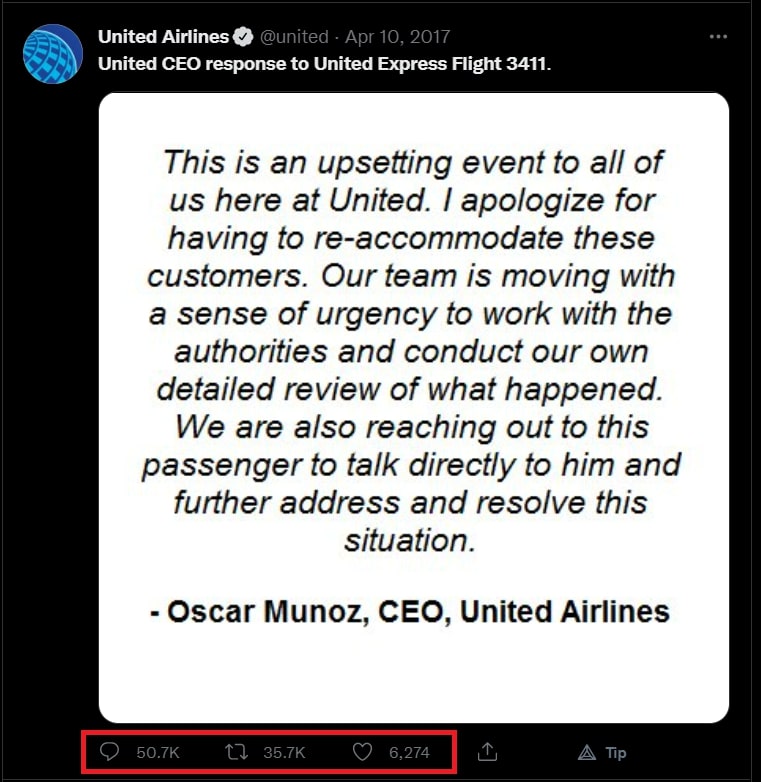
The numbers here tell a clear story: tens of thousands of people were motivated enough to write a reply, likely to express outrage, while far fewer were willing to endorse the message with a 'like'.
There's a second, more active form of this phenomenon: "winning the ratio." This occurs when a user replies to a post, and their reply gets more likes than the original post it's commenting on. This is often done deliberately. A user might even reply with the single word "ratio" as a challenge.

Part 2: The Ratio as a Formal Metric
While "getting ratioed" is internet slang, the underlying principle has been formalized in academic research as a legitimate way to measure public sentiment. Your background in stochastic processes and econometrics involves finding signals in noisy data, and that's precisely what this is. The ratio of different engagement types is a signal of "popular legitimacy."
A study on the World Health Organization's (WHO) public perception on X provides an excellent framework for this.
Social Media Metrics and Popular Legitimacy: Content Analysis of Pre
This academic paper from the Journal of Medical Internet Research uses the "retweet-to-reply ratio" to quantitatively measure public trust in the WHO. This formalizes the slang concept of the 'ratio' into a research tool.
Please read the following sections to understand the statistical underpinning of the 'ratio': In the Introduction, focus on the paragraph that defines the core concept: this explains why replies signal dissent while retweets signal endorsement. Jump to the Methods section, and under "Step 2: Retweet-to-Reply Ratio," read the paragraph defining the metric. This treats the ratio as a formal calculation. Finally, in the Discussion, read the first paragraph of the section: this validates the use of engagement metrics as practical proxies for public perception.
The paper codifies the intuitive understanding of the ratio. A high retweet-to-reply ratio suggests endorsement and legitimacy. A low ratio, where replies approach or exceed retweets, indicates controversy, skepticism, and a loss of legitimacy.
Think of it this way:
- Likes: Passive agreement. "I see this and approve."
- Retweets: Active endorsement. "I approve of this so much, I want my own followers to see it."
- Replies: Active engagement. "I have something to say about this."
When the impulse to "say something" (reply) dramatically outweighs the impulse to endorse (like/retweet), you have a quantitative signal of community dissent. The algorithm may push the post for having high "engagement," but the ratio tells you the nature of that engagement is contentious.
Part 3: Applying Ratio Analysis to Your Niche
Understanding the ratio is not just an academic exercise. It's a real-time diagnostic tool for managing your online presence.
Defensive Analysis: Interpreting a Ratio on Your Own Content
Imagine you post a photo of a new, particularly daring bikini design. The post starts getting a lot of traction, but you notice the number of comments is rapidly outpacing the likes. You are being ratioed.
- The Signal: The ratio is your first alert. It tells you that the post is controversial. It has struck a nerve.
- Your Action (as an Analyst): Your training in causal analysis is key here. The ratio establishes a strong correlation between your post and negative community sentiment. Now, you must investigate the cause. You must read the replies.
- Scenario A (Moral Policing): The replies are filled with comments like "This is indecent" or "You should cover up." This is a classic moral policing attack. The ratio tells you this sentiment is widespread among the commenters.
- Scenario B (Community Backlash): The replies are from your own followers, saying things like "This design doesn't seem practical" or "This feels like a step back from your usual empowering message." This is a more serious issue. The ratio is signaling genuine dissatisfaction from your core audience.
- Scenario C (Outrage Baiting): The post has been picked up by an external account that is using your content to farm outrage among their own followers. The ratio is a symptom of you being instrumentalized in someone else's attention-economy game.
In each case, the ratio is the quantitative smoke signal that tells you there's a fire. It allows you to react efficiently, directing your attention to a problem post before it spirals.
Offensive Analysis: Using the Ratio Strategically
The ratio can also be used proactively to assert your position and build your brand.
Imagine a prominent account within the alternative lifestyle space makes a post that you feel is exclusionary or promotes a harmful stereotype (an act of gatekeeping or moral policing).
- The Signal: You observe that their post is getting ratioed. The comments are full of people disagreeing, but no single voice has unified the dissent. The community is pushing back, but incoherently.
- Your Action (as a Strategist): This is an opportunity. The ratio indicates that the original poster has lost the support of the community on this issue. You can step in and "win the ratio."
- Craft a reply that eloquently and respectfully articulates the counter-argument that is already bubbling up in the other comments.
- Your goal is for your reply to get more likes than the original poster's gatekeeping message.
- If you succeed, you haven't just won an argument. You have quantitatively demonstrated that the community stands with your perspective. You become a leader, a voice for the dissenting majority, and you solidify your own influence and credibility within the niche.
This is a powerful, non-confrontational way to engage in community debates. You are leveraging an existing tide of public opinion, giving it a clear voice, and using the platform's own metrics to prove your point.
Conclusion
Today, we've dissected the 'ratio', transforming it from a piece of internet slang into a potent analytical tool. You now understand how to read this quantitative signal to measure community sentiment with surprising accuracy.
Key Takeaways:
- A 'ratio' occurs when a post's replies vastly outnumber its likes and retweets, serving as a strong indicator of controversy or unpopularity.
- This concept is formalized in research as the "retweet-to-reply ratio," a metric used to gauge public dissent and an organization's perceived legitimacy.
- Defensively, the ratio is an early warning system. It signals that one of your posts is contentious, prompting you to analyze the replies and diagnose the root cause of the backlash.
- Offensively, the ratio presents a strategic opportunity. By identifying when a bad take is being ratioed, you can articulate the community's dissent and "win the ratio," solidifying your own authority and influence.
The ratio is often the first sign of a larger event. A severe ratio can be a precursor to the kind of coordinated harassment campaigns we will discuss next.
In our upcoming lesson, we will explore what happens when this negative sentiment escalates. We will define and analyze dog-piling and digital mobbing, examining the mechanics of mass harassment and how to protect yourself when a ratioed post turns into a targeted attack.