Introduction
In our previous lesson, we dissected the deceptive practice of catfishing, where a single fake identity is crafted to manipulate an individual. You now have a robust workflow for auditing profiles and identifying the red flags of a one-on-one deception. Today, we advance from singular deception to plural illusion. We will explore a tactic that moves from a single fake person to a fake crowd.
This lesson addresses the learning outcome: Define sock puppetry and identify how single actors use multiple accounts to simulate consensus or harass. Sock puppetry is the art of one person speaking with many voices. For a public figure in niche communities, understanding this is critical. It's the difference between perceiving a genuine community debate and recognizing a manufactured attack by a single, determined adversary. We will define the concept, explore its two primary functions—manufacturing consent and coordinated harassment—and equip you with an analytical framework to detect it.
What is Sock Puppetry?
At its most basic, sock puppetry is the use of multiple online accounts by a single person to create a false impression of independent support, dissent, or activity. While a catfish creates one false persona to deceive you, a sock puppeteer creates a small army of them to deceive a group.

The term "sock puppet" evokes the image of a hand inside a puppet, controlling its every move. Online, the hand is the single user, and the puppets are the multiple accounts they operate. These accounts are designed to look and act like separate, unrelated individuals.
To get a formal definition and understand its core mechanics, the IFTAS (Institute for Trust & Safety) provides a clear and concise overview.
This resource from a trust and safety organization offers a precise definition of sock puppetry and explains its fundamental purpose.
Please read the first three short sections: Definition, Related Terms, and Background. Pay close attention to how it's used to create a "false appearance of widespread support."
It is crucial to distinguish sock puppets from the automated "bots" we often hear about. While bots are typically fully automated by code, sock puppets are controlled by a human. This human touch makes them more difficult to detect, as their posts can seem more natural and responsive. The Medium article "Spot a Bot" makes this distinction clearly.
Spot a Bot: Identifying Automation and Disinformation on Social Media
This article helps differentiate between the various types of inauthentic accounts you might encounter.
Read the section under the heading "Bots vs. sockpuppets vs. good old fashioned trolls." Focus on the key difference: a sock puppet is "at least partially controlled by a human."
The Dual Functions of Sock Puppetry
A sock puppet network is a tool, and it is typically used for one of two primary purposes: simulating consensus or orchestrating harassment.
1. Simulating Consensus and Social Proof
As you know from your work as a relationship analyzer, social proof is a powerful influencer of human behavior. We tend to trust and adopt opinions that appear to be held by many others. Sock puppetry exploits this by manufacturing that consensus.
A single actor can use their network of fake accounts to:
- Amplify a Message: Liking and sharing a post from multiple accounts to make it appear popular, thereby gaming the platform's algorithm to show it to more people.
- Create False Endorsements: Posting positive comments about a person, product, or idea from various accounts. For instance, someone launching a lingerie line could (unethically) use sock puppets to leave glowing reviews.
- Sway a Debate: In a community forum discussing polyandry, a single user could use three or four accounts to argue for their viewpoint, making it seem like a significant portion of the community agrees with them.
2. Coordinated Harassment
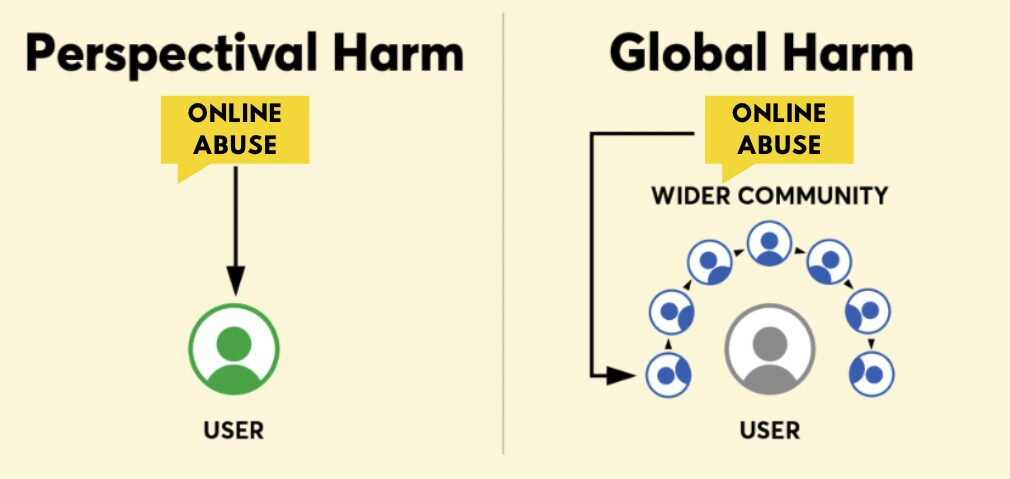
The second, more malicious use of sock puppetry is to harass a target. By using multiple accounts, a single attacker can create the illusion of a mob attack, which is psychologically far more distressing than criticism from one person. This is a shift from what the image below calls "Perspectival Harm" (one source) to the appearance of "Global Harm" (many sources), even if the origin is singular.
Imagine you post a provocative photo wearing one of your bikini designs. A single hostile individual might use a network of sock puppets to:
- Dog-pile your comments: One account posts a slut-shaming comment, another criticizes the design, a third questions your motives, and a fourth attacks other users who defend you.
- Isolate you: The puppets can create a hostile environment that drives away genuine followers and makes you feel alienated from your own community.
- Evade moderation: If one puppet account is blocked or banned, the attacker simply continues the harassment with another.
This tactic transforms a one-on-one conflict into what feels like a many-on-one assault, designed to overwhelm and silence the target.
An Analyst's Guide to Detecting Sock Puppets
Your background in statistics and design of experiments is perfectly suited for this task. Identifying sock puppets is not about finding a single "smoking gun" but about recognizing a pattern of correlated, inauthentic behavior. It's a signal detection problem in a noisy social environment.
The IFTAS guide provides an excellent checklist for moderators, which we can adapt for your personal use as an analyst of social dynamics.
This resource provides a systematic framework for identifying sock puppet accounts. It offers specific behavioral and content clues to look for.
Read the sections titled "Why We Care," then focus on the detailed checklist under "Spotting Sock Puppets." Finally, read "Before You Act," as it is crucial for avoiding false positives.
Let's synthesize the key indicators from that guide and the "Spot a Bot" article into a practical checklist. Think of these as variables in your analysis. No single one is definitive, but a high correlation across several is a strong indicator of a single puppeteer.
1. Behavioral and Temporal Coordination
This is often the strongest signal.
- Synchronized Activity: The accounts post or comment in quick succession on the same thread. For example, within minutes of a critical comment, three "different" users appear to support it.
- Clustered Interactions: The accounts almost exclusively like, share, and reply to each other's content or that of a single "main" account. They show little to no authentic interaction with the wider community. From a network analysis perspective, they form a tight, isolated cluster.
- Shared Uptime: The accounts are all active during the same hours and go silent at the same times, corresponding to the puppeteer's daily schedule.
2. Content and Linguistic Fingerprints
The puppeteer's personal style often leaks through.
- Identical Phrasing: Use of the same unusual words, jargon, or catchphrases across different personas.
- Shared Errors: Making the same specific spelling or grammatical mistakes (e.g., consistently misusing "your/you're" or a particular idiom).
- Superficial Arguments: The accounts echo one another's points without adding depth or original thought. They often parrot a simple, repetitive narrative.
3. Profile and Metadata Clues
The account creation process often leaves a trail. The "Spot a Bot" article offers excellent details here.
Spot a Bot: Identifying Automation and Disinformation on Social Media
This article adds further technical and behavioral clues to our detection toolkit.
Quickly read through these subsections: Stolen profile images Tell-tale account names Recent accounts Coordination and Metadata similarities
These resources give us the following clues:
- Creation Dates: Multiple accounts were created on the same day or within a very short timeframe.
- Naming Conventions: Usernames follow a pattern (e.g.,
CommonWord_123,CommonWord_124) or are gibberish alphanumeric strings. - Profile Consistency: The accounts use similarly generic bios, have no profile picture, or use stolen images (which you can check with a reverse image search).
Applying the Framework: A Scenario
You post a piece on your blog about navigating jealousy in polyamorous relationships, and you share it on Twitter.
- User A leaves a supportive comment.
- User B immediately replies to User A, agreeing and adding another point.
- User C then quote-tweets your original post with high praise.
- You notice Users A, B, and C all joined Twitter last month, have few followers, and their only other activity is retweeting each other and a fourth account, User D, who seems to be the main opinion leader. They all use the same obscure hashtag related to "ethical non-monogamy."
This pattern—temporal coordination, clustered interaction, and similar metadata—is a strong signal that Users A, B, and C are likely sock puppets operated by the person behind User D to amplify their own voice and appear more influential.
Conclusion
You are now equipped to distinguish between genuine online interaction and the manufactured illusion of sock puppetry. This is a crucial defensive skill, protecting you from both deceptive influence campaigns and coordinated harassment. It allows you to more accurately assess the social dynamics of your online spaces.
Key Takeaways:
- Sock Puppetry is One-to-Many Deception: A single actor operates multiple fake accounts to create a false impression of group consensus or to harass a target.
- It Has Two Main Functions: To simulate social proof (manufacturing consensus) and to orchestrate psychologically damaging harassment (simulating a mob).
- Detection is Pattern Recognition: You can identify sock puppets by analyzing correlated patterns in their behavior (timing, interaction clusters), content (language, errors), and metadata (creation dates, naming schemes).
- Be Cautious: Not all agreement is a conspiracy. Distinguish between genuine cliques and the coordinated, inauthentic activity that defines sock puppetry.
In our next lesson, we will scale up this concept to look at astroturfing. If sock puppetry is one person creating a fake crowd, astroturfing is an organization or campaign creating a fake grassroots movement. We will examine how this is used to manipulate public opinion on a much larger scale.