Introduction
In our last lesson, we examined sock puppetry, where a single individual operates multiple accounts to simulate a small crowd for harassment or false consensus. You learned to detect this one-to-many deception by identifying coordinated behaviors and linguistic fingerprints. Today, we elevate our analysis from a fake crowd to a fake grassroots movement.
This lesson addresses the learning outcome: Define astroturfing and identify signs of a coordinated, inauthentic campaign designed to manipulate community opinion. If sock puppetry is the act of a single person creating a few fake voices, astroturfing is a funded, organized campaign designed to create the illusion of widespread public support or opposition. Understanding this is crucial, as it allows you to distinguish between genuine community sentiment and a manufactured narrative intended to sway opinion, discredit you, or manipulate your entire niche. We will define the concept, explore the psychological heuristics it exploits, and build a framework for detecting its statistical and behavioral signatures.
From Fake Grass to Fake Grassroots
The term "astroturfing" is a clever play on words, contrasting a synthetic grass brand, AstroTurf, with a genuine "grassroots" movement. The name perfectly captures the essence of the tactic: an artificial campaign designed to mimic authentic, spontaneous public opinion.
While a sock puppet operator might be a single disgruntled individual, an astroturfing campaign is typically sponsored by a commercial or political entity with a specific agenda and the resources to execute it on a large scale. The core of the deception lies not necessarily in the message itself, but in hiding the true source and sponsor of that message.
Is Astroturfing Illegal Around The Globe? - Pagefreezer Blog
The Pagefreezer blog provides a clear and direct introduction to astroturfing, explaining what it is and the common tactics it employs.
Please read the first three sections of the article: the introduction, "What is Astroturfing?," and "The different forms of astroturfing." As you read, focus on the distinction between astroturfing and regular marketing: the deliberate lack of transparency about the source.
As the reading highlights, astroturfing is a strategy that often employs sock puppets, but it also uses a wider array of tools, including automated bots, paid influencers who don't disclose their sponsorship, and even AI-generated content.
Astroturfing vs. Fake News
A crucial distinction for an analyst like yourself is the difference between astroturfing and "fake news." While fake news involves disseminating factually incorrect information, astroturfing's primary deception is about the source and perceived support for a message. The message itself might be an opinion, a subjective claim, or even factually true in a narrow sense. The manipulation lies in making it seem like this message arises spontaneously from a large group of independent individuals.
[PDF] The Moral Judgment of Direct and Indirect Tactics - Hal Inrae
This academic paper provides a more nuanced, theoretical understanding of astroturfing, including its psychological underpinnings.
Read the section titled "Introduction." Pay close attention to the paragraph that begins "Interestingly, although there is some overlap between 'fake news' and astroturfing...". This passage clarifies that the root of the deception relates to the source and validation, not necessarily the content.
For instance, within the non-monogamy communities you frequent, an astroturfing campaign wouldn't necessarily need to spread outright lies. It could amplify a particular viewpoint—say, that a certain relationship style is "more ethical" than others—using hundreds of coordinated accounts to create the illusion that this is the dominant community consensus, thereby pressuring others to conform.
Why It Works: Exploiting Cognitive Heuristics
Your background in statistics involves understanding how to make valid inferences from data. Astroturfing is effective because it exploits well-known cognitive shortcuts, or heuristics, that cause people to make faulty inferences from social data. An astroturfer presents a set of highly correlated data points (posts from their network) and tricks the audience into treating them as independent observations.
The academic paper you just reviewed outlines several of these exploited heuristics. Let's focus on three that are most relevant.
-
The Multiple Source Effect (Bandwagon): People perceive an argument as more valid if it seems to come from multiple independent sources. Astroturfing manufactures this effect. A campaign might use 50 accounts to post similar comments on your latest bikini design photo. An observer sees 50 "different" people saying the same thing and may conclude the sentiment is widespread, even if it all originates from one paid PR agency.
-
The In-group Persuasion Effect: We are more easily persuaded by people we perceive as part of our own group. Astroturfers create accounts that mimic the language, interests, and profile aesthetics of the target community. An astroturf campaign against your lingerie designs might use accounts with bios like "body positivity advocate" or "fashion lover" to seem like authentic community members, making their criticisms feel more legitimate and damaging.
-
The Illusory Truth Effect: Repeated exposure to a statement increases its perceived truthfulness. By relentlessly pushing a simple, consistent message across many channels and accounts (e.g., "Her designs are exploitative," "This lifestyle is harmful"), a campaign can make a subjective or false claim feel like an established fact over time.
An Analyst's Toolkit for Detection
Identifying astroturfing is a signal detection exercise. You are searching for patterns of coordination that are statistically improbable in an environment of genuine, independent actors. Here are the key signals to monitor.
1. Coordinated Inauthentic Behavior (CIB)
This is the strongest evidence of astroturfing and is what platforms like Facebook and Twitter look for when they conduct mass takedowns of influence operations.
- Temporal Spikes: A sudden, massive surge of activity (likes, comments, shares) around a post or topic that is otherwise not exceptionally viral. For example, a minor comment thread suddenly getting hundreds of replies in a few hours, all echoing the same point.
- Linguistic Monoculture: Supposedly different users repeating the exact same phrases, slogans, or hashtags. Genuine online conversations are messy and diverse; astroturfing often exhibits strict "message discipline."
- Coordinated Timing: Posts or comments appearing in rapid, machine-like succession, or a cluster of accounts all becoming active during a specific time window and then going silent simultaneously.
2. The Mechanics of Manipulation
Astroturfing requires infrastructure. Sometimes you can see the plumbing.

This leads directly to statistical anomalies in an account's profile. An authentic presence tends to grow somewhat evenly across platforms as a creator's audience follows them. A massive imbalance can be a red flag for artificially inflated numbers.
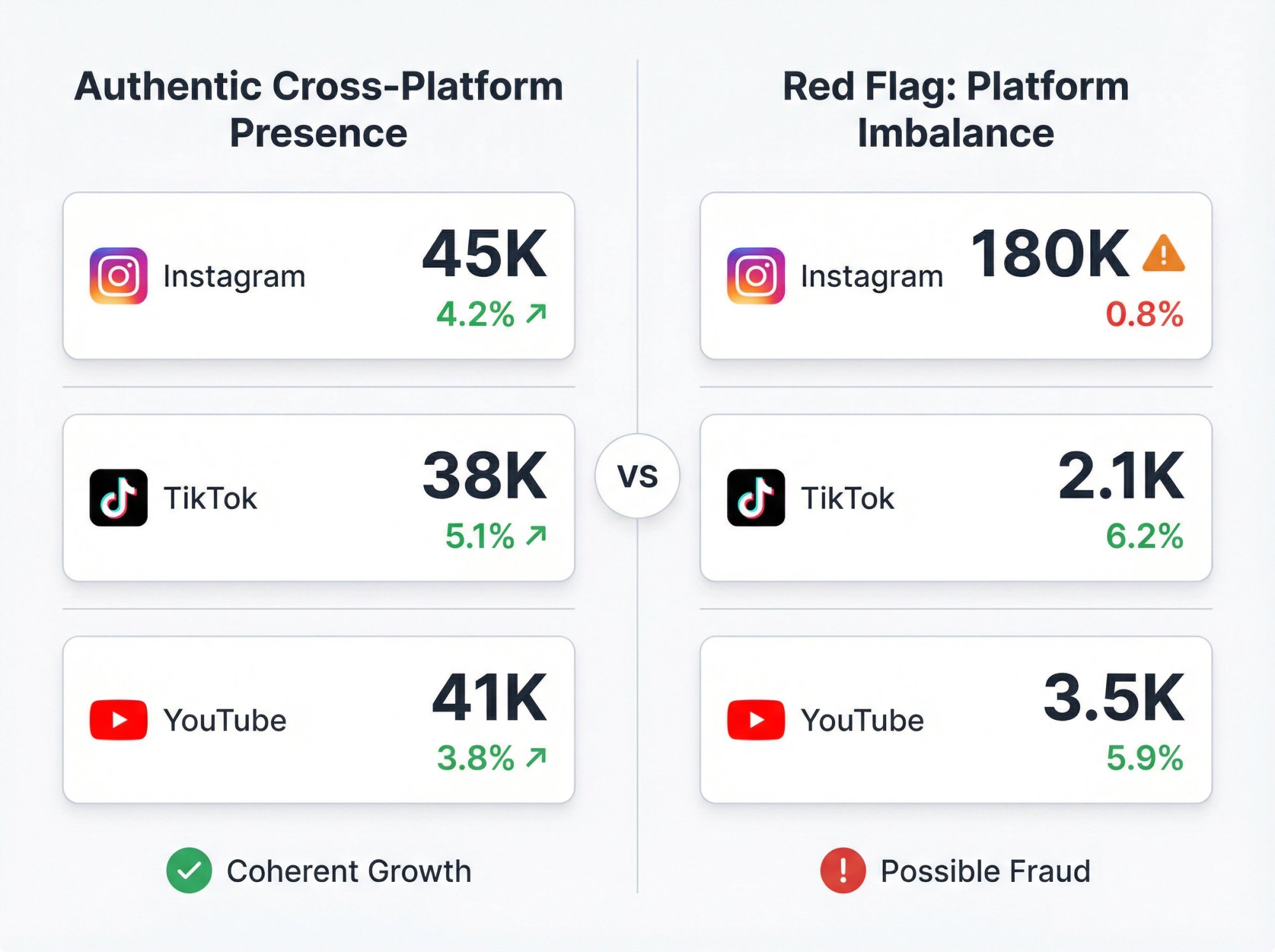
For your own brand, if you see a competitor suddenly gain 100,000 followers on one platform while their engagement and presence on others remain flat, it is a strong signal of inauthentic activity.
3. Modern and Sophisticated Tactics
Astroturfing is constantly evolving. The Pagefreezer article you read earlier outlines some of the cutting-edge techniques you should be aware of.
Is Astroturfing Illegal Around The Globe? - Pagefreezer Blog
This part of the article details the evolution of astroturfing and provides a checklist for detection.
Read the section titled "Modern Astroturfing Tactics," which describes AI-generated armies and hashtag hijacking. Then, carefully review the steps and checklist under the headings "Identifying and Responding to Astroturfing" and "Best Practices Checklist." This provides a systematic process for investigation.
The key steps of monitoring for suspicious patterns, analyzing account behavior, and looking for linguistic patterns are the core of your defensive strategy.
Conclusion
You can now define astroturfing not just as a concept, but as a strategic system of deception with identifiable mechanics. By moving beyond a one-to-one analysis to a system-level view, you can better protect yourself and your communities from large-scale manipulation.
Key Takeaways:
- Astroturfing is Organized Deception: It's a funded campaign that mimics a genuine "grassroots" movement to push a specific agenda, with the primary deception being the concealment of the message's true sponsor.
- It Exploits Cognitive Shortcuts: The strategy works by leveraging heuristics like the multiple source effect and in-group bias, tricking observers into seeing manufactured consensus as authentic.
- Detection is a Signal-Finding Problem: You can identify astroturfing by looking for statistical anomalies and behavioral patterns of "Coordinated Inauthentic Behavior" (CIB), such as temporal spikes, linguistic uniformity, and massive platform imbalances.
In the previous lesson, we identified the individual fake actor (the sock puppet). Today, we identified the organized fake campaign (the astroturfing strategy). In our next lesson, we will apply these analytical frameworks to develop a practical verification checklist you can use before collaborating with new contacts or engaging deeply with new members of your communities.