Introduction
Welcome to the final lesson of your course on digital resilience. Over the past 21 weeks, you have journeyed from identifying the complex landscape of digital manipulation to building a robust, two-part framework for your online presence. You first constructed a comprehensive safeguarding plan to defend against threats, and in our last lesson, you developed a proactive "Ethical Engagement Playbook" to foster authentic growth. You have designed your fortress and planned your campaigns.
Today, we address the final, crucial element that transforms your static plans into a living, adaptive system. This lesson focuses on how to develop a schedule for periodically reviewing and updating your digital resilience framework as platforms and communities evolve. A static strategy in a dynamic environment is a vulnerability. The digital world—with its shifting algorithms, emerging social tactics, and evolving community norms—demands constant vigilance and adaptation.
For someone with your background in operations research and experimental design, this concept should be familiar. Just as an optimization model requires recalibration with new data to prevent drift and a designed experiment provides insights that inform the next iteration, your digital resilience framework must be a dynamic system that learns and improves. This lesson will provide the structure to ensure it does.
The Principle of Dynamic Resilience
Security and growth online are not one-time achievements; they are continuous processes. A "set it and forget it" mindset is the most common point of failure. The strategies that protect you today might be insufficient tomorrow, and the engagement tactics that work now may become obsolete.
This ongoing cycle of vigilance is best visualized as an iterative loop.
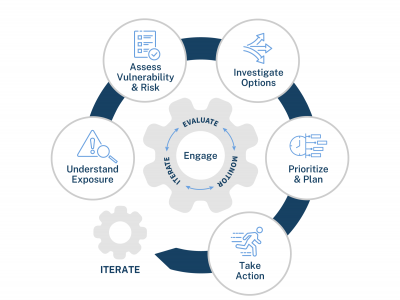
This model, centered around engagement and evaluation, perfectly encapsulates our goal for this lesson. Your digital resilience framework is not a final document but a process you will engage with continuously. You will monitor the environment, evaluate the performance of your strategies, and iterate to improve them. This proactive stance is critical because, as creator Justin Moore points out, your digital footprint is permanent.
10 Privacy & Safety Tips for Influencers
In his video on safety tips, Justin Moore makes a key point about why a long-term, evolving strategy is necessary from the very beginning.
Watch the short segment from his advice to creators. The core idea is that since nothing is ever truly deleted online, you must assume your actions and security posture will be relevant for years to come, making it essential to be careful and strategic from day one.
Structuring Your Review Cadence
To make this process manageable, we will break it down into a structured schedule based on frequency. This transforms the abstract idea of "staying vigilant" into a concrete set of recurring tasks. A security article from Privly provides an excellent template for this.
Content Creator Security Checklist: The Ultimate Guide - Privly
This checklist offers a practical schedule for security maintenance, which we will adapt and expand to cover your entire resilience framework.
First, read the brief introductory paragraph to understand the layered approach to security. Then, focus on the section titled "Review and Maintenance Schedule," which outlines monthly, quarterly, twice-yearly, and annual tasks. As you read, also look at the "Account Security" and "Monitoring and Response" checklists to see examples of tasks that fit into this schedule, such as reviewing sessions monthly and checking leak sites weekly.
Using this structure, we can build a comprehensive review schedule that covers both your defensive protocols and your ethical growth strategies.
Weekly Review (High-Frequency Monitoring)
This is your front line of awareness. The goal is quick, regular checks for immediate threats.
- Leak Monitoring: Perform manual checks or review automated alerts (like Privly or Google Alerts) for unauthorized use of your name, photos, or lingerie designs on leak sites or counterfeit storefronts.
- Mention & Tag Review: Briefly review mentions of your handles on platforms to catch the early stages of any negative conversations or potential dogpiling.
- Inbox Triage: Scan DMs and emails for any patterns that suggest stalking, love bombing, or other coordinated outreach.
Monthly Review (System Maintenance)
This is your system health check. The goal is to ensure your technical defenses are sound and your immediate environment is stable.
- Security Hygiene: As suggested in the Privly article, review active sessions on all major accounts and log out of any unrecognized devices.
- Review Subscriber/Follower Activity: Look for any unusual patterns in new followers or subscribers that might indicate a bot attack or a targeted follow campaign.
- Content Performance Quick-Look: Briefly review engagement on the past month's content. Are there any notable positive or negative outliers? This is a quick check, not a deep analysis.
Quarterly Review (Strategic Audit)
This is your deep-dive session. Here, you will analyze performance, audit your systems, and make strategic adjustments.
- Full Security & Privacy Audit: Conduct a comprehensive audit of your privacy settings on all platforms, as you learned in Module 2. Test your account recovery procedures. Change primary passwords.
- Threat Model Reassessment: Re-evaluate your personal threat model from Module 11. Have any new threats emerged? Have any old threats become more or less likely? For example, has a shift in community conversation made you a more likely target for moral policing?
- Ethical Engagement Playbook Analysis: This is where your Design of Experiments background becomes a powerful tool. Treat your content strategy as a series of experiments. Analyze the data from the past quarter:
- Which types of posts (e.g., design process, relationship commentary, personal story) generated the most authentic engagement (thoughtful comments, DMs) versus just vanity metrics?
- Did your "co-creation" posts (e.g., asking for feedback on a design) lead to higher community buy-in?
- What can you conclude from these "experiments" to inform your content strategy for the next quarter?
Annual Review (Long-Term Planning)
This is your CEO meeting with yourself. The goal is to look at the big picture and plan for the future.
- Tool & Service Evaluation: Are the security and analytics tools you're using still the best fit? Research new services that may have emerged.
- Policy & Protocol Update: Review and update your core documents: your crisis communication plan, your personal data compartmentalization strategy, and your ethical engagement playbook.
- Brand & Goal Alignment: Does your online presence still align with your long-term personal and business goals? Is the time and energy you're investing yielding the desired return, not just in metrics but in personal satisfaction and brand equity?
The Post-Incident Review: Learning from Experience
Beyond your scheduled reviews, the most critical learning opportunities come from unscheduled events—be it a security breach, a targeted harassment campaign, or even a major platform algorithm change. After any significant incident, a dedicated post-crisis evaluation is essential.
Crisis Management For Influencers - Meegle
This article from Meegle explains the importance of learning from crises to refine future strategies, which is the final piece of our resilience cycle.
First, read the section on interpreting post-crisis data. Then, review "Step 4: post-crisis evaluation and learning," which outlines the process. Finally, note the FAQ answer that recommends reviewing strategies quarterly or after any significant crisis event, confirming our approach.
A post-incident review is an after-action report. It is a structured, blameless analysis of what happened, what worked, and what needs to change.
Key Questions for a Post-Incident Review:
- Detection: How did we first become aware of the incident? Could we have detected it sooner?
- Response: Did our pre-planned protocol work as expected? Which parts failed? Which team members or tools were most/least effective?
- Impact: What was the actual damage (reputational, emotional, financial)? How did our audience and community react?
- Root Cause: What vulnerability (technical, strategic, or procedural) allowed this to happen?
- Lessons Learned: What specific, actionable changes must we make to our protocols, tools, or strategies to prevent or better mitigate this type of incident in the future?
For instance, if you were the target of a dog-piling campaign after posting a new lingerie design, your review would analyze the effectiveness of your comment filters, the timing of your response (or decision not to respond), and the community's reaction. The outcome might be to update your keyword mute list or refine your pre-drafted statement for such events.
Exercise: Your Personal Resilience Review Schedule
You have all the components. Now it's time to formalize your commitment. Create your personal review schedule based on the cadence we've discussed. This document will be the operational guide for keeping your digital resilience framework alive and effective.
Fill out the following template with at least one specific, actionable task for each category that is relevant to your unique online presence.
My Resilience Review Schedule
Guiding Principle: To maintain a dynamic and adaptive framework through continuous monitoring, evaluation, and iteration.
-
Weekly Tasks (Monitoring):
- Action 1: (e.g., Run reverse image searches on my top 3 most popular lingerie designs to check for counterfeits or unauthorized use.)
- Action 2: (e.g., Spend 15 minutes reviewing tags and mentions on Instagram and Twitter for any emerging negative narratives.)
-
Monthly Tasks (Maintenance):
- Action 1: (e.g., Review active login sessions on Google, Instagram, and Twitter, and log out all sessions except my primary devices.)
- Action 2: (e.g., Archive screenshots of any noteworthy positive or negative interactions from the month into my documentation folder.)
-
Quarterly Tasks (Strategic Audit):
- Action 1: (e.g., Perform a full privacy settings audit on Facebook and Instagram to ensure no new data is being exposed by platform updates.)
- Action 2: (e.g., Analyze my content "experiment" data: Compare engagement and comment sentiment on posts about relationship dynamics vs. posts about lingerie design to adjust my Q3 content mix.)
-
Annual Tasks (Strategic Planning):
- Action 1: (e.g., Review my list of "brand values" and assess whether my content from the past year has been consistently aligned with them.)
- Action 2: (e.g., Research and evaluate at least one new tool for social media analytics or security monitoring.)
-
Post-Incident Protocol (Learning & Adaptation):
- Trigger Condition: (e.g., A post gets "ratioed," a piece of content is reported and taken down, or I am the subject of a targeted negative post by another creator with a significant following.)
- Action 1: Within 72 hours of the incident's resolution, I will conduct a post-mortem using the 5 key questions (Detection, Response, Impact, Root Cause, Lessons Learned).
- Action 2: I will update my relevant protocols (e.g., my crisis comms plan, my comment filtering strategy) with any lessons learned within one week.
Conclusion
This lesson, and this course, concludes not with an end but with a beginning. You have moved from being a passive user of social media to a conscious, strategic architect of your own digital space. By committing to this schedule of review and adaptation, you ensure that your framework for safety and growth remains a powerful asset for years to come.
Key Takeaways:
- Resilience is a Cycle: True digital safety and influence are not static states but a continuous process of assessment, action, monitoring, and iteration.
- A Structured Cadence is Key: Breaking down reviews into weekly, monthly, quarterly, and annual tasks makes the process manageable and ensures all layers of your framework are maintained.
- Learn from Every Event: Post-incident reviews are your most valuable source of learning, allowing you to turn crises into opportunities for improvement.
You are now equipped not only to identify and defend against the full spectrum of digital manipulation but also to ethically and authentically build a thriving personal brand in a complex environment. Congratulations on completing this journey. May you navigate the digital world with the confidence, agency, and resilience you have worked to build.