Introduction
In our last lesson, we configured your digital armor by setting up the proactive and reactive tools on your social media accounts—filters, comment limits, and reporting mechanisms. You now know what tools are at your disposal. Today, we forge them into a coherent plan. The moments when a targeted online attack begins are chaotic and overwhelming. In such high-stress situations, rational thought can be difficult, which is why having a pre-defined procedure is critical.
This lesson's goal is to draft that procedure: an immediate triage checklist for the first 60 minutes of an attack. Drawing on your background in operations research, you can think of this as a contingency protocol for a sudden system overload. The objective is not to solve the underlying problem or "win" the fight in that first hour, but to stabilize the system—your accounts and your mental state—to prevent catastrophic failure and create the space for a more strategic, long-term response.
The Triage Mindset: Containment Over Combat
Before we build the checklist, we must establish the mindset. The first hour of a dog-pile or character assassination campaign is not the time for debate, engagement, or counter-attacks. It is a time for damage control. Engaging with a mob while you are its target is like trying to reason with a flash flood; you will be swept away.
Your immediate goals are purely defensive:
- Protect Your Mental State: The primary objective of a mob is to cause emotional distress and provoke a reaction. Your first priority is to insulate yourself from the flood of negativity.
- Control Your Digital Space: You need to regain control over who can interact with you and what is visible on your profiles.
- Preserve Evidence: Attacks can be fleeting, with harassers deleting their posts. Capturing evidence is a critical, time-sensitive task.
Every action in your triage checklist should serve one of these three goals. Any action that involves explaining, defending, or arguing with attackers is counter-productive in this initial phase.
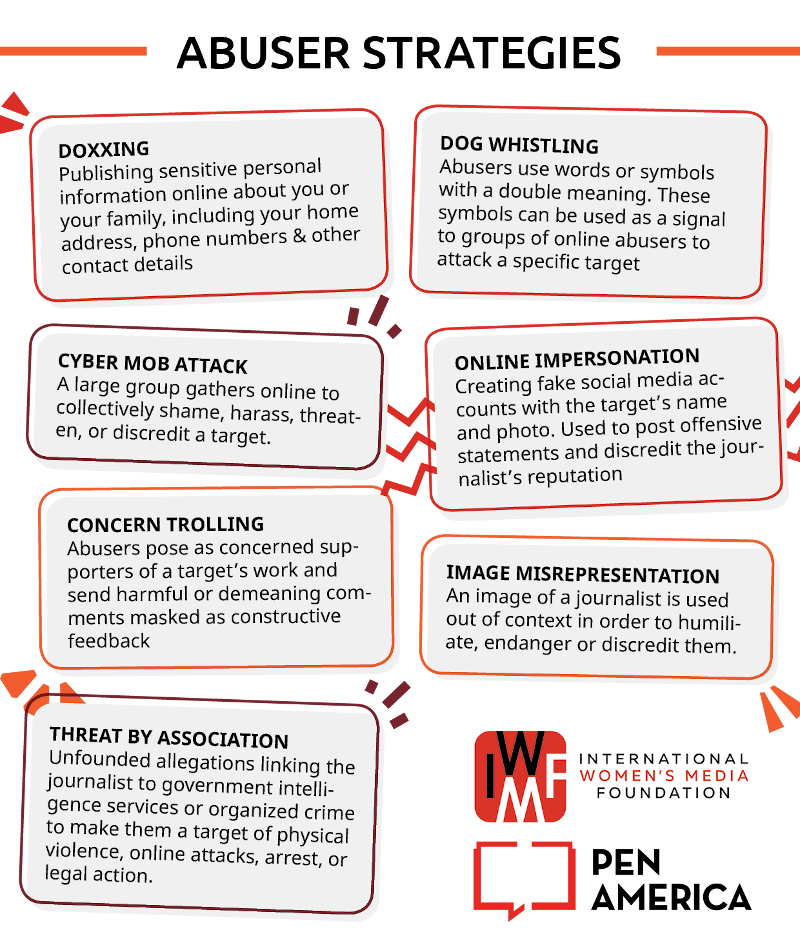
The image below, from PEN America and the International Women's Media Foundation, outlines some of the strategies you might face. Recognizing these tactics as part of a predictable playbook can help you depersonalize the attack and focus on your response protocol.
Your First-Hour Triage Checklist
When you recognize the signs of a coordinated attack—a sudden, massive influx of negative comments, DMs, and mentions, often from new or anonymous accounts—do not panic. Open your checklist and begin.
Step 1: Disengage and Activate Lockdown (Time: 0-10 minutes)
This is the most critical and often the most difficult step. Your immediate instinct might be to defend your work, whether it's a lingerie design or an essay on alternative relationships. Resist this urge.
- Action: Do NOT reply, quote-tweet, or engage in any way. Your engagement is the fuel they want. It signals that the attack is working and encourages others to join in.
- Action: Activate Instagram's "Limits" feature. As we covered in the last lesson, this is your emergency lockdown button. It will immediately staunch the flow of incoming negativity from non-followers and recent followers, who constitute the bulk of any digital mob.
- Action: Tighten privacy on other platforms. If the attack is happening elsewhere, change settings to restrict replies or comments to "followers only" or "people you follow." This shrinks the attack surface instantly.
Step 2: Document the Attack (Time: 10-30 minutes)
Before abusers can delete their posts or have them removed by the platform, you must create an evidentiary record. Your experience with research methodology will be valuable here; think of this as data collection under adverse conditions.
- Action: Create a dedicated, timestamped folder on a secure cloud drive (e.g., "2023-10-27_IG_Dogpile_BikiniPost").
- Action: Take comprehensive screenshots. Don't just capture the abusive comment. Capture the context: the comment itself, the username of the poster, the post it's under, and the time. If possible, click on the user's profile and screenshot that as well.
- Action: Use a screen recorder for any video-based harassment or rapidly changing comment threads.
- Action: Copy and paste URLs of abusive profiles and specific posts into a separate text file within your folder.
- Action: Prioritize the most severe abuse. Focus on documenting direct threats, doxxing (sharing of private information), and clear hate speech. Don't try to capture every single insult.
The PEN America report "No Excuse for Abuse" provides an excellent framework for understanding the importance of these reactive measures. We'll read the key sections now to ground our checklist in expert recommendations.
No Excuse for Abuse - PEN America
This report outlines a comprehensive set of strategies for dealing with online abuse. We will focus on the sections that directly inform our first-hour response protocol, particularly around documentation, support networks, and immediate containment.
First, read the section on Reactive measures for an overview. Then, focus on the subsection on Documentation. Pay close attention to the list of what to record: screenshots, URLs, username, timestamps. This is the "why" behind our Step 2. Next, jump back to the "Proactive measures" section and read the part on Rapid response teams. This explains the strategic importance of having a support network ready to go, which is our next step. Finally, read the subsection on the 'SOS button'. While this is a recommendation for platforms, we will adapt this concept into a personal protocol.
Step 3: Activate Your Rapid Response Team (Time: 30-40 minutes)
As the PEN America report highlights, online abuse is isolating. Activating your support network breaks that isolation and distributes the workload. This team should consist of 1-3 trusted friends whom you have designated in advance.
- Action: Send a pre-drafted message to your team. It can be simple: "Attack in progress on [Platform] regarding [Post]. Checklist initiated. Lockdown is on. I am disengaging. Need help with [choose one: monitoring DMs for real threats vs. noise / mass-reporting the worst accounts / emotional support]. Will update in 2 hours."
- Action (Optional/Advanced): Grant delegated access. If you have a trusted ally, consider using a password manager to securely share your login for a limited time so they can help manage DMs or block accounts on your behalf. This shields you from seeing the worst of the abuse while ensuring you don't miss important messages (e.g., a customer inquiry for your lingerie business amidst a flood of hate).
Step 4: Strategic Retreat and Assessment (Time: 40-60 minutes)
You have contained the immediate flood, started a record, and called for backup. Now, you must step away to regain your composure and ability to think strategically. As psychologist Elana Newman noted in the PEN America report, "In an emergency mode you're not thinking rationally." The goal of this step is to exit that mode.
- Action: Log out of your social media accounts.
- Action: Turn off all social media notifications on your phone.
- Action: Physically step away from your devices. Do something that grounds you for at least 30-60 minutes.
- Action: Decide on your next check-in. Tell yourself (and your response team) that you will not look at the platform again for a set amount of time (e.g., 3 hours, or until the next morning).
Your Customizable Triage Checklist
Here is the protocol in a simple, copy-and-paste format. Save this in a secure, easily accessible place on your phone or computer.
IMMEDIATE ATTACK TRIAGE CHECKLIST (First 60 Minutes)
Phase 1: Containment (0-10 min)
- STOP: Do not reply, engage, or post anything new.
- LOCKDOWN (Instagram): Activate the "Limits" feature.
- LOCKDOWN (Other Platforms): Restrict comments/replies to followers only.
Phase 2: Documentation (10-30 min)
- Create a secure, timestamped folder:
YYYY-MM-DD_Platform_Attack. - Screenshot the most severe abuse (threats, doxxing, hate speech). Include context and usernames.
- Save URLs of key abusive profiles/posts to a text file.
- Remind self: The goal is evidence, not a complete record of every insult.
Phase 3: Delegation (30-40 min)
- Send pre-drafted message to my Rapid Response Team: [Name 1], [Name 2], [Name 3].
- Specify the help needed: [Monitoring / Reporting / Support].
- Optional: Delegate account access to [Trusted Ally Name] for a set time.
Phase 4: Retreat (40-60 min)
- Log out of all social media accounts.
- Disable all social media notifications.
- Step away from devices for a minimum of one hour.
- Set a time for the next planned check-in: [Time/Date].
Conclusion
In this lesson, we transformed our knowledge of defensive tools into a clear, actionable emergency plan. A targeted online attack is a severe test of resilience, but a protocol acts as a circuit breaker, preventing emotional overload and allowing you to maintain control.
Key Takeaways:
- The first hour of an attack is for Containment, Documentation, and Delegation, not combat.
- Your primary goals are to protect your mental state, control your digital space, and preserve evidence.
- The triage checklist provides a sequence of rational actions: Lockdown, Document, Alert, Retreat.
- Pre-designating a Rapid Response Team is a crucial proactive step that you activate during the crisis.
You now have a plan for the first hour. But what comes next? In our next lesson, we will build directly on Step 2 of this checklist. We will "Establish a protocol for documenting harassment to support reporting to platforms or authorities," creating a more systematic and robust process for evidence-gathering that will serve you in any future escalations.