Hello! In our last lesson, you learned how to apply Ohm's law as a practical tool for circuit analysis. We saw how the relationship allows us to calculate voltage, current, or resistance, a skill you used to determine the correct value for a current-limiting resistor.
This lesson builds directly on that knowledge. We'll explore the concepts of electrical power and energy. Power, in essence, is the rate at which energy is used in a circuit. Understanding this is critical for your goal of building robotics and IoT devices. It allows you to answer essential questions like: "Will this component overheat and burn out?" or "How long will my robot's battery last?" By the end of this lesson, you will be able to calculate both the power consumed by a component and the total energy used by a circuit over time.
What is Electrical Power?
In physics, power is the rate at which work is done or energy is converted from one form to another. In an electrical circuit, components convert electrical energy into other forms, such as heat in a resistor or light from an LED. The rate of this energy conversion is electrical power, and its unit is the Watt (W). One Watt is defined as one Joule of energy per second (1 W = 1 J/s).
The most direct way to calculate power (P) in a DC circuit is by multiplying the voltage (V) across a component by the current (I) flowing through it.
This makes intuitive sense: the total power depends on both the "pressure" (voltage) and the "flow rate" (current).
The Three Power Formulas
While is the fundamental definition of electrical power, we can combine it with Ohm's law () to derive two other very useful forms of the power equation. Your background in mathematics and logic will appreciate the elegance of this derivation.
The following text from Lumen Learning's Physics course walks through this process clearly.
Electric Power and Energy | Physics
This reading explains how the three main formulas for electrical power are derived by combining the definition of power with Ohm's law.
Start by reading the section that begins just below Figure 1. This part shows how substituting Ohm's law into P=IV gives us P=V^2/R and P=I^2R. Then, review the Section Summary at the end, which concisely lists these key formulas.
To summarize, you now have three equivalent formulas to calculate power:
Choosing which formula to use simply depends on which two quantities (V, I, or R) you already know. The "Power Wheel" diagram below is a classic tool used by engineers and technicians as a quick reference for all the relationships between power, voltage, current, and resistance.

A comprehensive diagram showing the 12 formulas relating Power (P), Voltage (V), Current (I), and Resistance (R). Each quadrant provides three ways to calculate the quantity in the center.
Let's look at a very simple circuit to see these formulas in action. The image below shows a 9V battery connected to a 10Ω resistor.
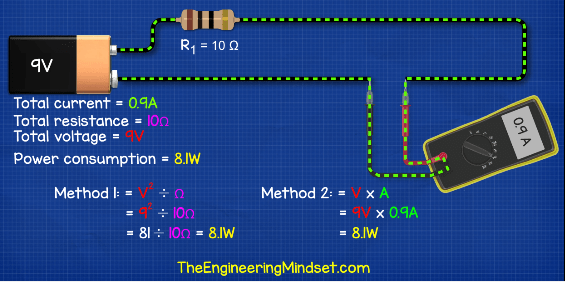
A simple DC circuit with a 9V source and a 10Ω resistor. The power consumption is calculated as 8.1W using two different methods, and a multimeter confirms the current is 0.9A.
First, we can find the current using Ohm's Law: .
Now, we can calculate the power dissipated by the resistor using all three formulas to prove they yield the same result:
Power Dissipation and Component Ratings
The calculations above show that the resistor is dissipating 8.1 Watts of power, converting electrical energy into heat. This brings up a critical practical point: every physical component has a maximum power rating. If you exceed this rating, the component will likely overheat and be destroyed. When you buy resistors, they will be specified with both a resistance value (e.g., 100Ω) and a power rating (e.g., 1/4W, 1/2W, 1W). You must always calculate the power your resistor will dissipate in the circuit to ensure you choose one with an adequate rating.
The following video provides excellent worked examples for calculating power in both series and parallel circuits. Crucially, it also demonstrates how to use a component's power rating to determine the maximum safe voltage or current for your circuit design.
Power Dissipation In Resistors, Diodes, and LEDs
This video from The Organic Chemistry Tutor demonstrates power calculations in detail and explains the practical importance of power ratings.
Please watch these three segments: First, watch the calculation for a series circuit. Notice how the total power delivered by the battery equals the sum of the power dissipated by each resistor, a direct consequence of the conservation of energy. Next, watch the example of a parallel circuit. This gives you a small preview of concepts we will cover in the next module. Finally, and most importantly, watch the section on maximum voltage and current. This directly addresses how to apply power ratings in a practical design scenario.
From Power to Energy
Power is the rate of energy use, but often we want to know the total energy consumed over a period. The relationship is simple: Energy is Power multiplied by time.
The standard scientific unit for energy is the Joule (J). As we know, 1 Watt = 1 Joule/second, so:
Energy (in Joules) = Power (in Watts) × time (in seconds)
While Joules are the fundamental unit, they are often too small for practical scenarios. For household electricity, a more convenient unit is the kilowatt-hour (kWh).
Energy (in kWh) = Power (in kilowatts) × time (in hours)
Your electricity bill is calculated based on how many kWh you consume. This reading explains the relationship between Joules and kilowatt-hours.
Electrical Energy, Power and Charge in an Electrical Circuit
This article from Electronics Tutorials defines electrical energy and shows how to calculate it in both Joules and kilowatt-hours.
Start at the heading Electrical Power Formula to review the relationship between Joules, Watts, and seconds. Then, read the following section and example, which demonstrates a calculation and introduces the kilowatt-hour.
Practice Problem
Let's apply these concepts. Imagine you are building a small robot that uses a motor rated at 12V. When running, the motor draws 0.5A.
- Calculate the power consumed by the motor.
- Your robot's battery runs for 2 hours before needing a recharge. How much energy (in both Joules and kilowatt-hours) did the motor consume in that time?
Try to solve this on your own before looking at the solution.
Solution:
-
Power Calculation:
- We know Voltage (V = 12V) and Current (I = 0.5A).
- Using :
-
Energy Calculation:
- In Joules:
- Power P = 6W
- Time t = 2 hours = 2 × 60 × 60 = 7200 seconds
- (or 43.2 kJ)
- In kilowatt-hours:
- Power P = 6W = 0.006 kW
- Time t = 2 hours
- In Joules:
Conclusion
In this lesson, we have connected the concepts of voltage and current to power and energy. This is a crucial step from simply analyzing circuits to designing them with real-world physical constraints in mind.
Key Takeaways:
- Electrical Power (P) is the rate of energy consumption, measured in Watts (W).
- Power can be calculated using three main formulas: , , and .
- Components have maximum power ratings that must not be exceeded, or they risk being damaged by heat.
- Electrical Energy (E) is the total power consumed over time (), measured in Joules (J) or kilowatt-hours (kWh).
You now have the fundamental calculation tools—Ohm's Law and the power formulas—to analyze simple DC circuits. In our next lesson, we will move on to another essential skill: reading and interpreting basic circuit schematic symbols and diagrams. This is the universal language of electronics, and mastering it will enable you to understand, build, and design the circuits for your future projects.