Introduction
In our previous lesson, we established a systematic method for translating a client's narrative into a set of co-created, measurable SMART goals. This process is crucial for converting ambiguous desires into concrete, trackable objectives. Now, we move to the final step of the diagnostic phase: consolidating all your findings into a single, coherent document.
This lesson focuses on the learning outcome: Produce a written diagnostic summary that forms the basis of the formal engagement plan. This summary serves as the bridge between your diagnostic work and the active coaching engagement. In clinical terms, this is often called a "case conceptualization"—a cognitive map that explains the client's situation. For your practice, it is also the foundational document that justifies your proposed plan, builds client confidence, and serves as a formal record of your initial assessment. You will learn to synthesize intake data, session observations, and the SMART goals into a professional report that becomes the cornerstone of the client relationship.
1. From Diagnosis to Document: The Role of the Conceptualization
Before drafting the summary, it's essential to understand its purpose. This document isn't merely your internal notes; it's a strategic tool. It demonstrates to the client that you have listened deeply, understood their unique dynamics, and have a clear, logical basis for the path forward. In your field, where clients are navigating complex emotional and logistical terrain, this clarity builds immense trust and differentiates your structured approach.
The video below explains the concept of case conceptualization from a clinical perspective. Think of it as the underlying theory of your specific client's case—a hypothesis about what is happening, why it's happening, and what factors are maintaining the situation.
Case Conceptualization and Treatment Planning
This video from Dr. Elizabeth L. Jeglic provides an excellent overview of case conceptualization as a scientific thinking process.
Please watch the following segments: What is Case Conceptualization? Watch the introduction from the beginning to understand its role in moving from a collection of symptoms to a coherent understanding. Why is it necessary? The segment from this timestamp explains how a conceptualization guides your interventions and allows you to adapt when things aren't working. This aligns with the experimental mindset you bring from your statistics background. The Clinical Summary. Watch the definition of a case formulation from this point. Note the emphasis on integrating data, identifying themes, and recommending treatments. A Visual Model. Finally, observe the template presented from this timestamp. This simple visual model—placing the presenting problem at the center with influencing factors around it—is a powerful way to organize your thinking.
This process of conceptualization transforms you from a coach offering disconnected advice to a consultant presenting a cohesive analysis and a targeted strategy.
2. A Systematic Framework: The "Eight P's" Model
To create a robust conceptualization, you need a structured model for organizing the vast amount of information you've gathered. The "Eight P's" model is an excellent framework for this. Given your background in operations research, you can view this as a multi-factor model for deconstructing a complex system—in this case, your client's relational dynamics.
Case conceptualization: Key to highly effective counseling
The article "Case conceptualization: Key to highly effective counseling" provides a clear, actionable framework called the "Eight P's".
First, read the introduction What is case conceptualization? to solidify its definition as a "cognitive map." Next, carefully study the section The eight P’s. This is the core of the framework. As you read, consider how each "P" applies to your client niche: Presentation: What are the client's self-reported issues? (e.g., "My husband seems withdrawn," "I feel jealous when my wife is on a date.") Predisposition: What historical factors make them vulnerable? (e.g., family background with rigid views on monogamy, insecure attachment style, personal history of anxiety.) Precipitants: What specific event or stressor triggered the request for coaching? (e.g., "Our first non-monogamous experience went badly," "A new job is adding stress to our lifestyle management.") Protective factors/Strengths: What resources do they have? (e.g., High motivation, strong communication in other areas, deep underlying affection, financial stability.) Pattern: What is the repeating, unhelpful sequence of events? (e.g., "Date occurs -> Husband experiences anxiety -> Husband asks probing questions -> Wife feels defensive -> Conflict erupts.") This is the core dynamic you aim to interrupt. Perpetuants: What keeps the pattern going? (e.g., Avoidance of difficult emotions, lack of a shared language for compersion and jealousy, secondary gains like increased attention during conflict.) Plan: What is the proposed intervention? This is where you insert the high-level SMART goals you co-created in the last lesson. Prognosis: Your professional forecast of the likely outcome, considering the balance of risk factors (like deep-seated insecurity) and protective factors (like high motivation).
This model provides a comprehensive, 360-degree view of the client's situation, ensuring you don't just focus on the presenting problem but understand its origins and reinforcing mechanisms.
3. Assembling the Diagnostic Summary Document
With your conceptualization structured by the "Eight P's," you are ready to write the summary. This document should be professional, concise, and client-facing. It synthesizes your analysis into a digestible narrative that leads logically to the engagement plan.
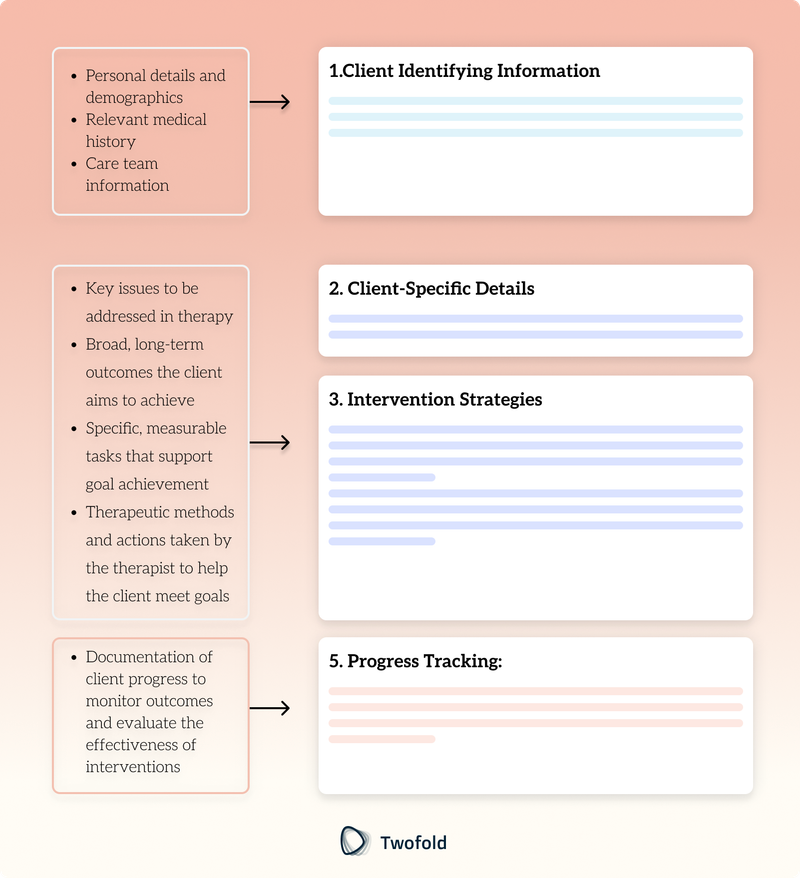
This image shows a high-level structure for a diagnostic summary, moving from client information to progress tracking. We will focus on creating the content for the first three sections.
The following resource provides an excellent, practical template for structuring this kind of report.
How to Write a Case Conceptualization: 10 Examples ...
The article "How to Write a Case Conceptualization" from PositivePsychology.com offers a clear, four-part structure for the final document.
Please read the sections titled 4 Things to Include and the subsequent outline. This structure provides the shell for your document. You will populate it with the insights from your "Eight P's" analysis: Background/Identifying Information: Basic client demographics and the referral question (their stated reason for seeking coaching). Corresponds to your Presentation and Precipitant findings. Strengths: A dedicated section to highlight the client's resources and positive attributes. This comes directly from your Protective Factors/Strengths analysis. Starting with strengths is a powerful way to frame the engagement positively. Limitations/Challenges: An objective description of the core issues and patterns. This is where you summarize your findings on Predisposition, Pattern, and Perpetuants. Diagnostic Impressions & Treatment Guidance (Your "Hypothesis & Plan"): This is the heart of the summary. You present your core hypothesis about what's driving the issues (e.g., "The primary challenge appears to be a mismatch between the couple's intellectual commitment to the lifestyle and their current emotional regulation skills, exacerbated by an avoidant communication pattern."). You then present the high-level plan, which consists of the SMART goals you've already defined. This structure transforms your analytical work into a clear, professional narrative. 4. Framing for Business: The Diagnostic Summary as a Proposal While the term "case conceptualization" comes from a clinical context, in a consulting practice, your diagnostic summary also functions as the "problem definition" section of a formal proposal. It sets the stage for the engagement letter and contract. This short video explains the key components of a consulting proposal. Notice the parallels between what a business client needs to see and what your coaching client needs to feel confident in your plan.
This structure provides the shell for your document. You will populate it with the insights from your "Eight P's" analysis:
- Background/Identifying Information: Basic client demographics and the referral question (their stated reason for seeking coaching). Corresponds to your Presentation and Precipitant findings.
- Strengths: A dedicated section to highlight the client's resources and positive attributes. This comes directly from your Protective Factors/Strengths analysis. Starting with strengths is a powerful way to frame the engagement positively.
- Limitations/Challenges: An objective description of the core issues and patterns. This is where you summarize your findings on Predisposition, Pattern, and Perpetuants.
- Diagnostic Impressions & Treatment Guidance (Your "Hypothesis & Plan"): This is the heart of the summary.
- You present your core hypothesis about what's driving the issues (e.g., "The primary challenge appears to be a mismatch between the couple's intellectual commitment to the lifestyle and their current emotional regulation skills, exacerbated by an avoidant communication pattern.").
- You then present the high-level plan, which consists of the SMART goals you've already defined.
This structure transforms your analytical work into a clear, professional narrative.
4. Framing for Business: The Diagnostic Summary as a Proposal
While the term "case conceptualization" comes from a clinical context, in a consulting practice, your diagnostic summary also functions as the "problem definition" section of a formal proposal. It sets the stage for the engagement letter and contract.
This short video explains the key components of a consulting proposal. Notice the parallels between what a business client needs to see and what your coaching client needs to feel confident in your plan.
How to Write Consulting Proposals - What You Need to Include
This video from Consulting Business School breaks down the structure of a professional consulting proposal.
Watch the following segments, thinking about how they map to the summary you are creating: Background Section (watch here): The speaker emphasizes "playing back to them that hey we understand your business." This is precisely the function of your summary of the presenting problem and client history. Executive Summary (watch here): A one-page overview of the problem, solution, outcome, timeline, and cost. Your diagnostic summary, when condensed, forms the narrative portion of this. Objective and Scope (watch here): Your SMART goals are the Objectives. Defining what is in and out of scope is critical for managing expectations. Deliverables/Outcomes (watch here): This is the "what am I going to get" question. Your SMART goals and the broader aim of improved relationship dynamics are the deliverables.
By understanding this dual purpose, you can write a summary that is both therapeutically sound and professionally compelling. It sets the stage for the formal agreement.

The diagnostic summary you create will directly inform the "Scope of Work" and "Fees/Payment Terms" sections of a formal document like this consulting engagement letter.
5. Example Application: The Case of "Alex & Ben"
Let's synthesize this with a practical example from your niche.
Client Couple: Alex (34, wife) and Ben (36, husband).
- Presentation: They want to improve how they handle Ben's jealousy, which has led to tense arguments after Alex goes on dates.
- Precipitant: A recent date where the post-date argument was particularly severe, leading them to seek help.
- Predisposition: Ben has an anxious attachment style stemming from a past infidelity in a previous relationship. Alex grew up in a very traditional environment and carries underlying guilt about her desires.
- Pattern: 1) Alex has a date. 2) Ben feels anxious and withdraws. 3) Alex returns, senses his withdrawal, and feels guilty/defensive. 4) Ben asks a series of rapid-fire, anxious questions. 5) Alex feels interrogated and shuts down. 6) Ben feels abandoned, confirming his fears.
- Perpetuants: Ben's avoidance of expressing his vulnerability directly (he expresses anxiety as interrogation). Alex's guilt prevents her from celebrating her experience, which Ben interprets as her hiding something.
- Protective Factors/Strengths: Deep love and commitment to each other, high motivation, both are intellectually aligned on the lifestyle goals, willing to do "homework."
- Plan (SMART Goal): "Over the next 3 dates (within 2 months), we will implement a 'post-date connection ritual' where we dedicate 15 minutes to non-evaluative connection before discussing the date. Success will be measured by a 100% reduction in post-date arguments and both partners rating their feeling of connection as a 4/5 or higher on a self-report scale."
- Prognosis: Good, given high motivation and strong foundational relationship. The primary obstacle is skill-building, which is highly coachable.
Drafting the Summary Document:
Diagnostic Summary: Alex & Ben
1. Background & Presenting Concern:
Alex (34) and Ben (36) have sought coaching to improve their management of jealousy and communication within their non-monogamous relationship structure. The primary presenting concern is a recurring pattern of conflict following Alex's dates, which causes distress for both partners and undermines their shared relationship goals. The immediate trigger for seeking support was a particularly difficult argument after a recent date.2. Strengths & Resources:
The couple presents with significant strengths, including a deep and explicit commitment to one another and a shared intellectual alignment on their desired lifestyle. Both partners are highly motivated, articulate, and have expressed a strong willingness to engage in new behaviors and complete between-session work. Their foundation of mutual respect is a critical asset for this engagement.3. Challenges & Dynamics:
The central challenge is a recurring, self-reinforcing communication pattern fueled by underlying individual factors. For Ben, this includes an anxious attachment style and unresolved anxieties from a past relationship. For Alex, this involves residual guilt related to her upbringing. This manifests in a predictable cycle post-date: Ben's anxiety leads to interrogative questioning, which triggers Alex's defensiveness, leading to mutual withdrawal and conflict. This pattern is perpetuated by an avoidance of direct emotional expression and a lack of established rituals for positive reconnection.4. Diagnostic Impression & Proposed Objectives:
The core issue is not a fundamental incompatibility but a deficit in specific emotional regulation and communication skills required to navigate the complexities of their chosen relationship style. The current pattern reinforces insecurity rather than building trust.Based on our diagnostic session, we have co-created the following initial objective:
- Primary Objective: To develop and implement a "post-date connection ritual" aimed at replacing the current conflict pattern with one of positive, secure reconnection. This will be trialed over the next three dates (anticipated within the next 8 weeks). Progress will be measured by a reduction in arguments and self-reported increases in feelings of connection, with specific metrics tracked weekly.
Conclusion
This lesson has equipped you with a structured methodology for producing a written diagnostic summary. This document is the capstone of your assessment phase, formalizing your understanding of the client's situation and providing a logical foundation for your engagement plan.
Key Takeaways:
- Conceptualize Before You Write: Use a framework like the "Eight P's" to organize your thoughts and form a coherent "theory" of the client's case.
- Structure for Clarity: Organize the final document into clear sections (Background, Strengths, Challenges, Plan) to create a professional and easy-to-understand narrative.
- Bridge Clinical Insight and Business Professionalism: Your summary serves both as a clinical conceptualization and the justification for a business proposal. Frame it accordingly.
- Synthesize, Don't Just List: The summary's power comes from weaving together intake data, session observations, and client goals into a cohesive story that explains the "why" behind the "what."
You are now prepared to transition from diagnosis to design. In our next lesson, we will officially enter Module 6, "Designing the Engagement Architecture." We will take the objectives defined in your diagnostic summary and use them to construct a detailed, session-by-session engagement plan for your clients.