Introduction
In our last session, you mastered the art of creating a diagnostic summary, a document that synthesizes client data and narrative into a coherent "case conceptualization." This summary answers the crucial questions of "what is happening?" and "why is it happening?". Now, we transition from diagnosis to design, focusing on creating the operational roadmap for the entire coaching journey.
This lesson addresses the learning outcome: Synthesize the diagnostic summary and client goals into a formal engagement plan document. This plan is the architecture of your consulting work. It takes the insights from your diagnostic summary and translates them into a structured, time-bound, and measurable series of actions. For your clients, it provides clarity and confidence; for you, it is the master project plan that guides every session and intervention, solidifying your practice as systematic and professional.
1. Anatomy of a Professional Engagement Plan
The engagement plan is more than just a schedule of meetings; it is a formal document that outlines the scope, deliverables, and terms of the client relationship. Think of it as the master blueprint for the entire project. Given your background in operations research, you can view this as defining the project's parameters, resources, timeline, and success metrics before execution begins.
The image below shows a high-level template for such a plan. Notice the columns for goals, timeline, responsibility, and success metrics—all core components of a structured project.
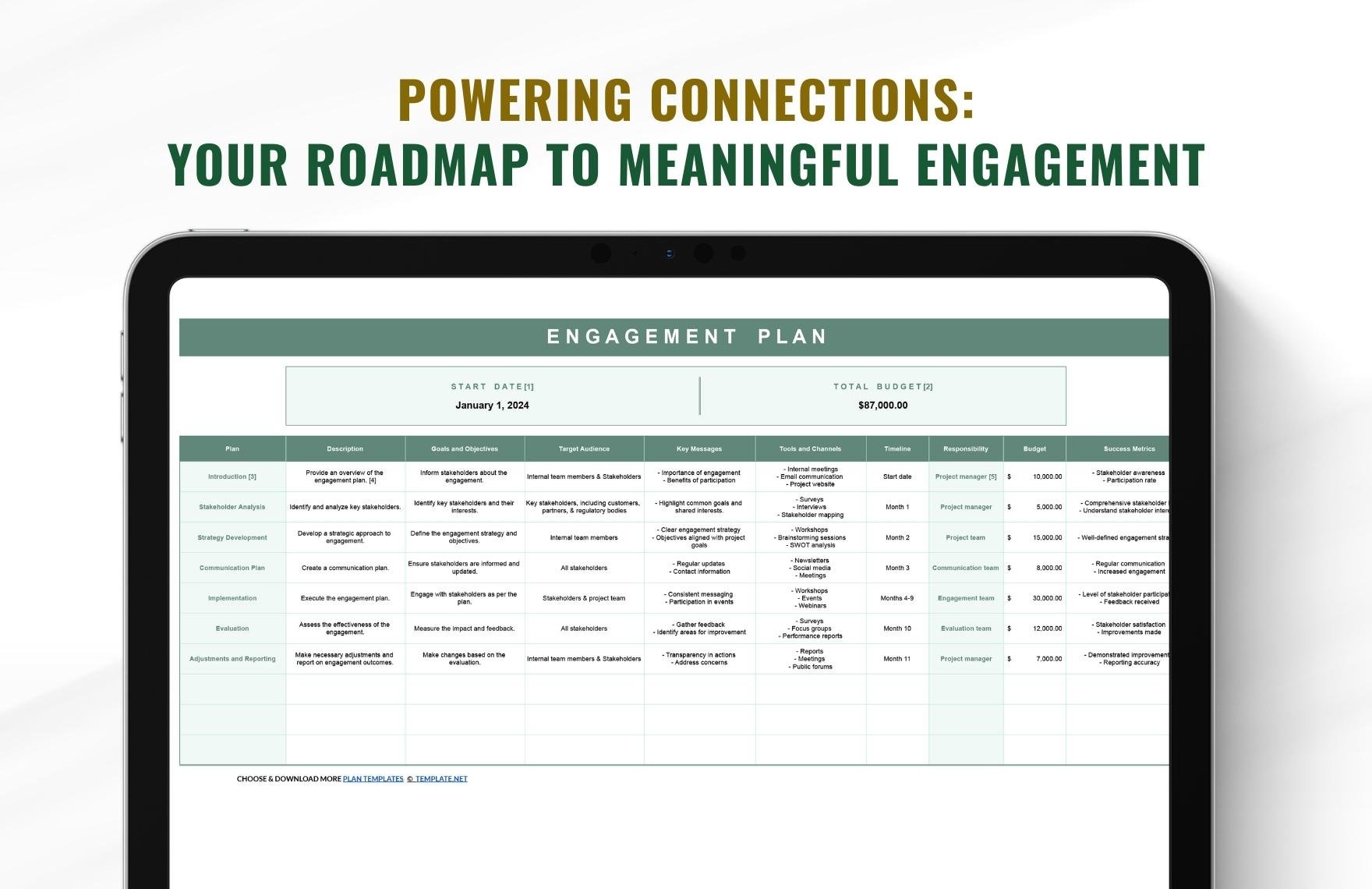
To build a comprehensive plan for your coaching practice, we'll use a detailed, step-by-step framework.
Client Engagement Plan Template | Iseo Blue
The article "Client Engagement Plan Template" from Iseo Blue provides an excellent, exhaustive list of components that constitute a professional plan.
First, read the section What Is the Content to get a complete overview of the 12 key elements. As you read, consider how each component translates from a corporate context to your one-on-one coaching practice: Executive Summary: A one-paragraph overview of the client's core challenge and the proposed coaching outcome. Client Analysis: This is your diagnostic summary. You can either attach it or include a condensed version here. Engagement Goals: These are the co-created SMART goals from your diagnostic session. Engagement Strategies and Tactics: The specific coaching models, exercises, and 'homework' you will use. Communication Plan: Defines session frequency (e.g., weekly), duration (e.g., 60 minutes), and between-session support (e.g., text, email). Roles and Responsibilities: Clarifies your role as coach and the client's role in being proactive and completing tasks. Timeline and Milestones: The sequence of the engagement, broken down by week or month. Budget: Your fee structure, payment schedule, and policy. Measurement and Evaluation: The Key Performance Indicators (KPIs) you will track. This is where your statistical expertise becomes a powerful asset. Risk Management and Contingency Plans: How you will adapt if an intervention isn't yielding results. This aligns with an experimental, data-informed approach. This structure transforms a vague promise of "help" into a well-defined professional service.
2. Framing the Plan as a Compelling Proposal
Before it is a signed agreement, the engagement plan is a proposal. Its purpose is to secure the client's buy-in by demonstrating that you have a clear, effective, and tailored path to their desired outcome. The language you use is critical. It must resonate with the client's own articulation of their problems and aspirations.
Coaching Proposal Template: Win Clients in 2026 - Bonsai
The article "Coaching Proposal Template" from Bonsai offers excellent guidance on structuring the narrative of your plan to be client-centric and persuasive.
Please read through the key elements described in the article, starting from What elements should your coaching proposal include? Pay close attention to these sections: Client's Concerns: The article emphasizes using the client's own language. Your plan should begin by "playing back" their struggles as you understood them in the diagnostic phase. This validates their experience. Desired Results & Benefits: This is where you frame the SMART goals not as technical objectives, but as transformative benefits. What will achieving these goals feel like for the client? Coaching Services: Here, you detail the specifics of your "package." This section makes the abstract service tangible. Next Steps: A clear call to action is essential. Tell the client exactly how to move forward: sign the agreement, process payment, and schedule the first official session. This removes friction and converts a prospect into a client.
By merging the comprehensive structure from Iseo Blue with the client-centric framing from Bonsai, you create a document that is both operationally robust and emotionally resonant.
3. Designing Your Core Coaching Package
A key part of the engagement plan is defining the "Coaching Services" or the "package" you are offering. This involves deciding on the duration, frequency, and intensity of the engagement. For a new, systematized practice, starting with a standardized core offering is highly efficient.
The following video provides a practical, field-tested model for a foundational coaching package. The logic behind its structure is very similar to designing a minimum viable product or a pilot study: it's long enough to prove efficacy but short enough to manage risk and allow for iteration.
How To Design Your First Coaching Package | A Key Step When Building A Consulting Business
In this video, business coach Luisa Zhou explains how to structure your first coaching package for maximum effectiveness and learning.
Watch these key segments: The 90-Day Standard (watch here): The video recommends a 90-day (3-month) package with weekly calls and between-session support. The rationale is that this timeframe is optimal for achieving significant results without over-committing the client or you. Results-Oriented Mapping (watch here): This is the most critical part for you. Instead of planning 12 individual sessions, you define the ultimate 90-day outcome and then work backward to set 2-3 major benchmarks for each month. This top-down, objective-driven approach is a cornerstone of project management and operations planning. Note how the speaker breaks down a large goal into monthly deliverables. The Path to Systematization (watch here): The speaker explains that after working with 3-5 clients, you will notice patterns. This allows you to create reusable content (worksheets, protocols, tracking tools) and make your delivery incredibly efficient. This directly aligns with your goal of systematizing your practice. You are essentially being paid to perform the initial "process discovery" for your own business.
This 90-day, benchmark-driven model provides an excellent, repeatable structure for your engagement plans.
4. Practical Application: Drafting the Engagement Plan for "Alex & Ben"
Let's now synthesize everything we've covered by drafting a formal engagement plan for Alex and Ben, based on the diagnostic summary from our previous lesson. This will serve as a concrete template you can adapt for your own clients.
Engagement Plan & Coaching Proposal
Client(s): Alex & Ben
Date: [Date]
Prepared by: [Your Name/Your Business Name]
1. Executive Summary
This document outlines a proposed 90-day coaching engagement designed to help Alex and Ben replace their current pattern of post-date conflict with a structured ritual of secure and positive reconnection. The plan focuses on building specific communication and emotional regulation skills to support the long-term health and enjoyment of their chosen relationship style.
2. Understanding Your Situation (Client Analysis Summary)
Based on our diagnostic session, the primary challenge is a recurring, painful communication cycle following Alex's dates. This cycle appears to be driven by Ben's underlying anxiety and Alex's feelings of guilt, which manifest as interrogation and defensiveness, respectively. The couple possesses significant strengths, including deep mutual commitment and high motivation, which are key assets for success. (The full diagnostic summary is available as Appendix A).
3. Desired Outcomes (Engagement Goals)
Our work together will be focused on achieving the following co-created objective:
- Primary Objective: To develop and implement a "post-date connection ritual" that replaces the current conflict pattern.
- Success Metrics (Key Results):
- Implement the ritual over the next 3 dates (within the 90-day engagement).
- Achieve a 100% reduction in major post-date arguments.
- Both partners consistently rate their feeling of connection post-ritual as a 4/5 or higher on a weekly tracking scale.
4. Proposed Coaching Program: The 90-Day "Relationship Re-Alignment"
This program is designed as a 3-month intensive to build and lock in new habits.
-
Timeline & Milestones:
- Month 1: Building the Foundation (Weeks 1-4):
- Focus: Introduce core concepts of emotional regulation and non-violent communication. Develop individual "anxiety management" and "guilt processing" toolkits.
- Milestone: By end of Month 1, both partners can successfully identify and de-escalate their emotional triggers in a non-date-related context, documented via a shared journal.
- Month 2: Ritual Design & Live Testing (Weeks 5-8):
- Focus: Collaboratively design the step-by-step "Post-Date Connection Ritual." Role-play and refine the ritual in session. Implement the ritual on the next available opportunity.
- Milestone: By end of Month 2, the ritual has been used at least once, with process data (what worked, what didn't) collected and reviewed.
- Month 3: Refinement & Integration (Weeks 9-12):
- Focus: Analyze tracking data from live tests to optimize the ritual. Work on making the process feel more natural and less scripted. Generalize the communication skills to other areas of the relationship.
- Milestone: By end of Month 3, the ritual is considered a reliable and positive habit, with success metrics (see section 3) consistently met.
- Month 1: Building the Foundation (Weeks 1-4):
-
Services Included:
- 12 weekly 60-minute coaching sessions conducted via secure video call.
- Unlimited email/text support between sessions for "in the moment" questions (with a guaranteed 24-hour response time).
- Customized KPI Tracking Tools (e.g., Google Forms/Sheets) to monitor connection scores, argument frequency, and ritual adherence.
5. Roles & Responsibilities
- Coach's Role: To provide frameworks, facilitate conversations, teach skills, and maintain accountability to the plan.
- Client's Role: To engage openly in sessions, practice skills between sessions, complete tracking assignments honestly, and provide feedback on the process.
6. Risk Management & Contingencies
The plan is a roadmap, not a rigid script. If a specific technique or the ritual itself is not effective (as determined by our weekly KPI review), we will dedicate the following session to analyzing the failure and collaboratively pivoting to an alternative strategy. This data-driven iteration is central to the process.
7. Professional Investment
The total investment for the 90-Day "Relationship Re-Alignment" program is [e.g., $X,XXX]. Payment can be made in full or in three monthly installments of [e.g., $Y,YYY].
8. Next Steps
To begin our work together:
- Please review and sign the attached Coaching Agreement.
- Submit the initial payment via the provided link.
- Upon receipt, you will be sent a link to schedule our first session.
Conclusion
You have now learned how to construct a formal engagement plan, the pivotal document that transforms your diagnostic insights into a structured, client-facing roadmap. This plan is the cornerstone of a professional, systematized consulting practice.
Key Takeaways:
- An engagement plan is a comprehensive blueprint covering goals, strategies, timeline, KPIs, and budget.
- Frame the plan as a client-centric proposal that demonstrates a clear understanding of their needs and a credible path to their goals.
- A 90-day, benchmark-driven structure is an effective and efficient model for a core coaching package.
- The plan must be a living document, with built-in mechanisms for measurement and adaptation based on performance data.
With this plan in hand, the next logical step is to zoom in on the "Timeline and Milestones" section. In our next lesson, you will learn how to design a session-by-session plan that logically sequences interventions based on client priorities, turning your monthly benchmarks into a week-by-week tactical guide.