Introduction
Welcome to the first lesson of your course on building a data-driven consulting practice. Your extensive experience has given you a deep, intuitive understanding of relationship dynamics in your niche. The goal of this course is to build upon that foundation, transforming your informal expertise into a systematic, defensible, and highly effective consulting methodology. This will not only enhance your service delivery but also create a powerful competitive advantage.
In this lesson, we will focus on the fundamental distinction between an informal coaching style and a structured, data-informed consulting lifecycle. We will explore what it means to adopt a consulting framework, see how a project management mindset can bring structure to your engagements, and establish how your quantitative background is the key to creating a truly data-driven practice. This first step is crucial for building the rest of your systematized workflow.
From Coaching to Consulting: Defining Your Role
To begin, it's important to clarify the distinction between coaching, counseling, and consulting. While these terms are often used interchangeably, they represent different approaches, particularly in a professional context. Your goal to systematize your practice and leverage data aligns most closely with a consulting model.
Take a look at the following table, which breaks down the key differences.
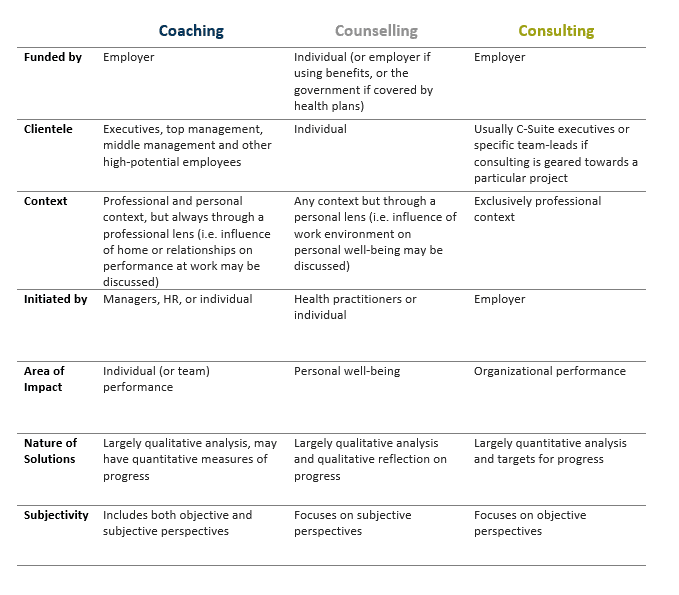
Pay close attention to the "Consulting" column. Notice the emphasis on:
- Context: Exclusively professional. For your practice, this means focusing on the operational and strategic aspects of the relationship, rather than general life coaching.
- Area of Impact: Organizational performance. In your case, the "organization" is the couple or relationship system. Your goal is to improve its efficiency, stability, and overall function.
- Nature of Solutions: Largely quantitative analysis and targets for progress. This is where your statistical background comes into play.
- Subjectivity: Focuses on objective perspectives. This implies moving from gut feelings to evidence-based insights.
Embracing this consulting identity is the first step toward building a more structured practice. It shifts the focus from purely subjective support to providing expert analysis and measurable solutions to improve the performance of your clients' relationship dynamics.
The Consulting Lifecycle: From Ad-Hoc to Architected
Informal coaching often operates in a reactive mode—addressing issues as they arise, relying on intuition and past experience. While valuable, this approach can be inconsistent and difficult to scale. A structured consulting lifecycle, in contrast, treats each client engagement as a formal project with distinct, repeatable phases.
This project-based mindset transforms your role from a reactive helper to a proactive architect of your client's success. This is a concept directly from your background in Operations Research, where the goal is to design and optimize a process for a predictable, high-quality outcome.
The diagram below shows a simplified model of a consulting engagement cycle.

While the numbering here is arbitrary, it illustrates a key idea: a consulting engagement is not a linear path but a structured, iterative process. You assess the situation, design a solution, help implement it, and then measure the results, which feeds back into the next cycle of assessment and refinement.
To understand what this looks like in practice, we can draw a powerful analogy from the world of project management. The following resource provides a detailed checklist for a project's lifecycle, from initial planning to final review. While the context is different, the principles are directly applicable to a structured consulting engagement.
Project Managers Checklist: 10 Phases for Success - Drum
This article from Drum lays out a comprehensive, phase-based approach to managing complex professional services projects. It perfectly illustrates the shift from reactive problem-solving to proactive, strategic execution that is central to this lesson.
First, read the introduction, Project managers checklist, to understand the core philosophy behind a structured framework. Then, jump to the end and read the concluding sections, From Checklist to Habit, which summarize the strategic advantage of this approach. Focus on how a systematic checklist moves you beyond "ticking boxes" toward creating a "predictable, repeatable process for delivering excellence."
As you read, consider how each phase of a project—pre-planning, kickoff, scope management, closure—could be mapped to a client engagement in your practice. We will be building out these specific phases for your niche throughout this course.
The Engine of Your Practice: Data-Driven, Hypothesis-Led Problem Solving
A structured lifecycle provides the what and when of your consulting process. The how and why come from making it data-informed. This is where you can build a formidable and unique value proposition by leveraging your advanced statistical skills.
Being data-driven means moving beyond intuition and using evidence to guide your decisions. It involves forming hypotheses, collecting data to test them, and remaining open to being wrong. This scientific mindset requires curiosity and intellectual humility.
The following resource is a transcript from a leadership roundtable on this exact topic. It offers valuable, high-level insights into the mindset and practice of data-driven decision-making.
Utilizing Data-Driven Decision Making | SuccessCOACHING
This article from SuccessCOACHING discusses the principles, benefits, and challenges of a data-driven approach in a client-facing business.
Please read the following key sections: Start with the "Top Takeaways" list near the beginning of the article. Focus on points 1, 2, 4, 5, and 6. These principles—testing hypotheses, aiming for continuous improvement, defining problems upfront, ensuring data quality, and maintaining curiosity—are the cornerstones of a data-driven practice. Next, read takeaway #7, on the need for both data types. This is critical; your quantitative analysis will tell you what is happening, but client narratives (qualitative data) will tell you why. Finally, read the discussion on curiosity and intellectual humility in the section titled Building a Data-Driven Team. This highlights the essential soft skills required to effectively use data.
The core mechanism for being data-driven in a consulting context is hypothesis-based problem solving. This may sound familiar from your academic research, but its application in business is more pragmatic and fast-paced. Instead of attempting to research every possible angle of a problem (an approach sometimes called "boiling the ocean"), you start by formulating an initial, educated guess—a hypothesis—based on the available information. Then, you focus your efforts exclusively on gathering the specific data needed to prove or disprove that hypothesis.
This approach is incredibly efficient. It allows you to cut through complexity and quickly arrive at actionable insights. The following video provides an excellent explanation of this methodology.
HOW TO SOLVE PROBLEMS - How do consulting firms work (hypothesis-based problem solving explained)
This video from Firm Learning explains the theory and practice of hypothesis-based problem solving, contrasting it with a more traditional academic approach.
Watch the following segments: The introduction explains what hypothesis-based problem solving is and why it's more effective in a business context than trying to find all the facts before forming a solution. Structuring the problem details the steps of breaking a problem down, forming hypotheses, and identifying the necessary analyses. Note the use of the MECE principle (Mutually Exclusive, Collectively Exhaustive), which will be a useful tool for you. The two-tiered structure summarizes the iterative process: structure the problem, conduct the analysis, then verify, reject, or revise your hypotheses and conclusions.
To give you a concrete, repeatable tool for implementing this, the McKinsey 7-Step framework is a classic consulting model for tackling complex problems. It provides a clear sequence of actions that aligns perfectly with the hypothesis-driven approach.
SOLVE Complex Problems With The 7-Step McKinsey Framework
This short video from Trish Lee provides a concise overview of the 7-step problem-solving framework used by top consulting firms.
Watch the full video (7-Step Framework), which is just under five minutes. Notice how the steps guide you from defining the problem and analyzing root causes (structuring) to creating a work plan, conducting analysis, and synthesizing a solution (the iterative analytical work).
Think of this 7-step framework as a micro-cycle that you can run at various points within your larger consulting engagement macro-cycle. For instance, during the "Assessment" phase, you might use this framework to diagnose a client's core challenge.
Conclusion
In this lesson, we have established the foundational concepts for transforming your practice. You've seen how shifting from an informal coach to a structured consultant creates a more professional and effective service. This is not about diminishing the value of your intuition and experience, but about augmenting it with a robust, repeatable system.
Here are the key takeaways:
- A Consulting Identity: Adopting a consulting model means focusing on the relationship as a system and using objective, often quantitative, methods to improve its performance.
- The Structured Lifecycle: Treating each engagement like a project, with clear phases from planning to closure, brings predictability, professionalism, and scalability to your work.
- Hypothesis-Driven Approach: This is the engine of a data-informed practice. By forming and testing hypotheses, you can leverage your analytical skills to solve client problems efficiently and create solutions grounded in evidence, not just opinion.
By integrating these three ideas, you begin the journey of creating a practice that is not only built on your unique expertise but is also systematic, evidence-based, and highly differentiated in the marketplace.
In our next lesson, we will build directly on this foundation. We will focus on how to translate this unique, structured approach into a compelling message for your ideal clients by learning to define a unique value proposition (UVP) that leverages your statistical expertise in relationship dynamics.