Introduction
In our last lesson, we architected the operational core of your practice by mapping your quantitative skills to a hypothesis-driven consulting lifecycle. We established how you'll deliver your unique value proposition using tools like personalized N-of-1 trials and a Bayesian framework for client learning. Now that you have a powerful and distinct service model, we need to understand the ecosystem in which it will operate.
This lesson focuses on positioning your practice strategically within the existing market of relationship coaching. To do that, we will design a competitor analysis framework tailored specifically to your niche. This isn't about mere imitation or 'spying'; it's a systematic investigation to benchmark existing services, identify their underlying methodologies, and, most importantly, pinpoint the underserved client segments and unmet needs where your data-driven approach will provide the most significant advantage. By the end of this lesson, you will have a structured tool to map the competitive landscape and clearly articulate where your practice fits and why it stands apart.
The Strategic Framework for Competitive Analysis
A robust competitive analysis is a structured, multi-step process that moves from a high-level market scan to a detailed, actionable strategy. It prevents you from getting lost in endless data gathering and instead focuses your efforts on what truly matters for positioning your practice.
A well-regarded approach, adapted from methodologies used by top consulting firms, breaks the process into three main parts: Assess, Benchmark, and Strategize. We will walk through a six-step plan that implements this approach.
How To Do Competitive Analysis (6-Step Framework and ...
This article from Slideworks provides an excellent, comprehensive overview of a professional-grade competitive analysis framework. It will serve as the foundation for the system we build today.
First, read the introductory section that outlines the three-part framework. Then, carefully review the description of all six steps, from "Define Your Objectives" through to the end of "Step 4. SWOT Analysis". We will adapt and apply each of these steps to your specific consulting niche.
To complement this reading with a more dynamic overview, the following video walks through a very similar process.
How To Conduct a Competitive Analysis (FREE Template)
This video from HubSpot Marketing offers a concise, step-by-step guide to conducting a competitive analysis. It's a great way to quickly internalize the flow of the process we're about to undertake.
Watch the video from the beginning through the explanation of the SWOT analysis, covering all six steps. Pay attention to the distinction between direct and indirect competitors, as this is particularly relevant in your field.
Now, let's translate this general business framework into a specific tool for your relationship consulting practice.
Step 1: Define Your Objectives and Scope
Your primary objective is clear: To identify the underserved niches and unmet client needs in the cuckold-hotwife lifestyle coaching market that are best addressed by a quantitative, evidence-based methodology.
Your scope will include:
- Competitors: Direct competitors (coaches specializing in this lifestyle) and key indirect competitors (general relationship therapists, well-known authors, popular online forums/communities).
- Geography: Primarily online/global, as that's where most of this coaching occurs.
- Time Horizon: A snapshot of the current landscape with an eye toward emerging trends over the next 1-2 years.
Step 2: Create an Industry Overview
Your "industry" is the niche market of relationship coaching for consensual non-monogamy, specifically the cuckold-hotwife dynamic. When creating your overview, consider these factors:
- Market Size & Growth: While hard numbers are unavailable, you can infer growth from the increasing visibility of these topics in mainstream media, the number of active online communities, and the proliferation of related content. Is the demand for guidance growing?
- Key Trends & Drivers: What are the prevailing conversations? Are they focused on beginners ("How do we start?"), logistics ("How do we manage our schedules?"), or advanced emotional topics (compersion, jealousy, long-term integration)? Is there a trend towards more structured, professional guidance versus informal peer advice?
- Regulatory/Ethical Environment: This is an unregulated field. Note the ethical codes that adjacent professions (like therapy) adhere to. This is an opportunity for you to differentiate by adopting a rigorous code of conduct and data privacy (which we will cover later).
Step 3: Identify and Prioritize Competitors
- Direct Competitors: These are other individuals or small groups offering coaching explicitly for this lifestyle. You can find them through keyword searches ("hotwife coach," "cuckold consultant"), on social media platforms, and through directories or podcasts that cater to this audience.
- Indirect Competitors: This group is arguably more significant.
- Therapists/Psychologists: Professionals who are "kink-aware" or specialize in non-monogamy. Their approach is clinical and therapeutic, not data-driven coaching.
- Content Creators: Popular authors, podcasters, and YouTubers who provide advice but not personalized, one-on-one engagement. They shape the narrative and client expectations.
- Peer Communities: Online forums and groups where individuals seek advice from peers. This is the primary "free" alternative to your service.
Prioritize your list into Tiers. Tier 1 should be the 3-5 most visible direct competitors whose service offerings you can clearly identify.
From Qualitative Benchmarking to Quantitative Mapping
The standard deep-dive is largely descriptive. Given your background, we can elevate this by incorporating more structured and quantitative benchmarking techniques. This allows for a more rigorous comparison and a clearer identification of market gaps.
Benchmarking Methodologies
The term "benchmarking" has a formal basis in performance measurement. A survey of these methods gives us a menu of approaches we can apply.
[PDF] Survey of Benchmarking Methodologies
This technical paper provides a detailed overview of various benchmarking methodologies, moving beyond simple comparison to more structured techniques. It gives us a more sophisticated vocabulary for our analysis.
Please read the section that provides an overview of five methodologies. Focus on understanding the conceptual differences between Performance Benchmarking (metric), Process Benchmarking, and Customer Survey Benchmarking. Then, read the descriptions of these "other methodologies" in more detail. This section covers the Model Company, Process, and Customer Survey approaches.
Here's how these formal benchmarking concepts apply to your practice:
- Performance (Metric) Benchmarking: This involves comparing services based on quantitative indicators. While you may not have access to competitors' "production data" (like client volume), you can create proxies:
- Price per hour/package
- Number of public testimonials or reviews
- Frequency of content output (blog posts, podcasts/month)
- Social media engagement rates
- Process Benchmarking: This is a crucial comparison for you. You will analyze your competitors' consulting process. The workflow we designed in the last lesson is your "process." Now, you benchmark it against others. Look for evidence of:
- A structured intake process (Do they have detailed questionnaires?)
- Goal-setting frameworks (Is there mention of co-creating objectives?)
- Session structure (Is it free-form conversation or a structured agenda?)
- Between-session work (Do they assign "homework"?)
- Outcome measurement (Do they talk about measuring success?)
- Customer Survey Benchmarking: This involves understanding customer perceptions of the different services available. While you can't survey your competitors' clients, you can analyze public-facing data. Scour reviews, forum discussions, and social media comments for themes. What do clients praise (e.g., "She was so empathetic")? What do they complain about (e.g., "It was good but we didn't have a clear plan")? This helps you map the perceived strengths and weaknesses in the market.
Visualizing the Market: Perceptual Mapping
The ultimate goal of this analysis is to find an unoccupied space in the market. A powerful statistical tool for visualizing this is perceptual mapping. This technique uses survey data to plot competitors on a two-dimensional map based on key attributes, revealing how they are perceived relative to one another. For you, this is a direct application of dimensionality reduction techniques like Principal Component Analysis (PCA) to a business problem.
Understand in Under 5: Perceptual Mapping
This video provides an excellent, concise explanation of perceptual mapping, including the underlying statistical method (PCA) and its strategic application.
Watch the entire video. Pay close attention to: The setup of the problem: a cruise line needing to differentiate itself in a crowded market. The data collection and analysis method: how they use surveys and Principal Component Analysis to identify underlying dimensions of perception. The strategic interpretation: how the final map reveals competitor clusters and, crucially, an unoccupied market position.

To apply this, you don't need to run a full-scale survey yet. You can create a hypothesized perceptual map based on your research. The key is choosing the right axes. For your practice, the most potent axes are likely:
- X-axis: Methodology (from Intuitive/Emotion-led on the left to Structured/Data-Driven on the right)
- Y-axis: Focus (from Psychological/Emotional Exploration at the bottom to Logistical/Practical Problem-Solving at the top)
Now, based on your research, plot your competitors on this map.
- Most therapists would be in the bottom-left quadrant (Intuitive, Psychological).
- Many existing coaches might be scattered in the bottom-left or top-left (Intuitive, with either a Psychological or Practical focus).
- Peer advice on forums is often in the top-left (Intuitive, Practical).
- Your practice, by design, would be firmly in the top-right quadrant (Structured/Data-Driven, Logistical/Practical Problem-Solving), likely with a strong secondary offering in the bottom-right (using data to understand emotional patterns).
This map visually demonstrates your unique position and becomes a cornerstone of your marketing message.
Designing Your Competitor Analysis Framework
Let's synthesize all this into a practical analysis template. The image below provides a generic structure, which we will now customize for your specific needs.
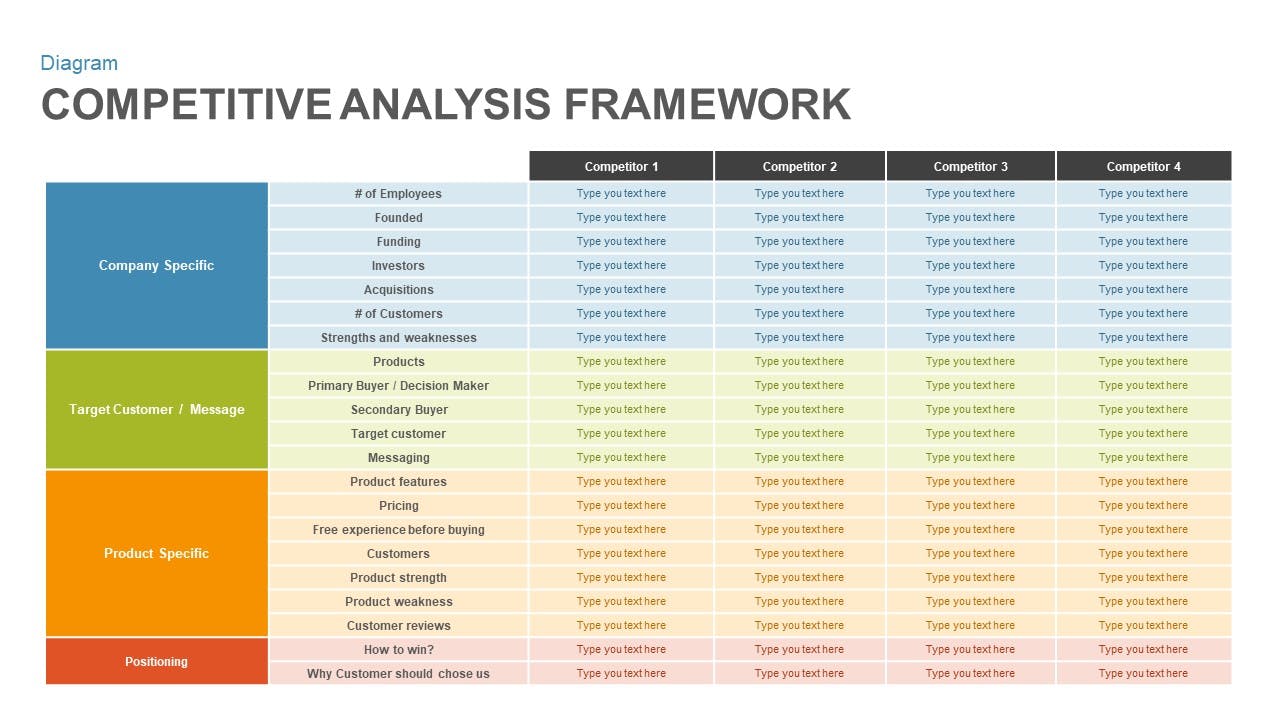
Here is a customized framework for you to use. For each of your Tier 1 competitors, you will fill out these fields based on your research.
Your Competitor Analysis Framework
| Category | Dimension | Data to Collect |
|---|---|---|
| Provider Profile | Founder's Background | What is their stated expertise (e.g., personal experience, psychology degree, coaching certification)? |
| Coaching Philosophy | What are their core beliefs about relationships and this lifestyle? Is it about freedom, communication, overcoming jealousy? | |
| Online Presence | Website quality, social media activity, content frequency and quality (blog, podcast, etc.). | |
| Target Client & Messaging | Ideal Client Profile | Who do they seem to be targeting (e.g., beginners, experienced couples, men, women, specific age groups)? |
| Unique Selling Prop. (USP) | What is their core promise? "I help you communicate better," "I help you overcome your fears." | |
| Keywords & SEO | What terms do they rank for in search engines? (Use tools like Semrush/Ahrefs). | |
| Service Offering (The "Product") | Service Model & Pricing | One-off sessions, multi-session packages, retainers? What are the price points? |
| Benchmarked Process | Intake: Is there a formal application/questionnaire? Goal-Setting: Is there mention of defining objectives? Methodology: Is it explicitly stated (e.g., based on a therapeutic model, intuitive)? Tools: What tools are mentioned (e.g., worksheets, communication exercises)? Outcome: How is success defined or measured? | |
| Scope of Service | Do they focus on communication, logistics, emotional processing, finding partners, etc.? | |
| Strategic Positioning | Stated Differentiators | How do they claim to be different from others? |
| Perceptual Map Position | Based on your research, where do they fall on the (Intuitive vs. Data-Driven) and (Psychological vs. Practical) axes? | |
| SWOT (vs. Your Practice) | Strengths: (e.g., strong emotional connection, large following). Weaknesses: (e.g., no clear process, vague outcomes, not scalable). Opportunities: (Untapped client segments they ignore). Threats: (Their strong brand recognition). |
Completing this framework for your top competitors will give you a rich, multi-faceted dataset to inform your own strategy. You will move beyond a simple feature comparison to a deep understanding of the market's methodologies, messaging, and perceived gaps.
Conclusion
Today, we've transformed the abstract idea of "analyzing the competition" into a systematic, multi-layered framework. You now have a process to not only gather intelligence but also to structure it in a way that reveals strategic opportunities.
Here are your key takeaways:
- Adopt a Structured Approach: Use the Assess-Benchmark-Strategize model to guide your analysis, ensuring you move from broad observation to specific, actionable insights.
- Benchmark Processes, Not Just Features: Your key point of comparison is your consulting process. Analyze how competitors handle intake, goal-setting, and session structure to highlight the rigor of your own methodology.
- Use Quantitative Tools for Strategic Vision: A hypothesized perceptual map, built on axes relevant to your value proposition (e.g., Methodology and Focus), is a powerful tool to visually identify the "blue ocean" for your services.
- Build a Custom Framework: Your analysis tool must be tailored to your industry. By focusing on dimensions like coaching philosophy, process benchmarking, and perceptual positioning, you gather data that is directly relevant to your strategic goals.
You now have a clear understanding of the competitive landscape and a confirmed, unoccupied position for your unique service offering. In our next lesson, we will turn our focus inward. Armed with the knowledge of which client needs are underserved, we will begin to develop a proprietary typology of client motivations and archetypes. This will be the first step in codifying your own extensive field experience into a structured system for diagnosing and serving your ideal clients.