Introduction
In our last lesson, we developed a structured diagnostic framework based on the "Relationship RADAR" to systematically identify your clients' challenges. You now have a powerful tool for understanding the what of their problems, separating them into the domains of Emotional Integration and Logistical Management.
This lesson moves from the what to the why and how. Our learning objective is to translate your tacit field experience into a written 'coaching philosophy' and a set of core principles. This isn't an abstract academic exercise; it's about forging the intellectual and ethical backbone of your practice. This philosophy will serve as your Standard Operating Procedure for decision-making, ensuring consistency, attracting your ideal clients, and clearly articulating the unique value you provide. It is the narrative that explains how your data-driven approach leads to meaningful transformation.
From Intuition to Intellect: Codifying Tacit Knowledge
Your extensive experience has given you a powerful form of "unconscious competence" or "tacit knowledge." You often know the right question to ask or the right path to suggest based on intuition honed over countless client interactions. The goal now is to make that unconscious competence conscious and explicit. A research paper from the International Journal of Evidence Based Coaching and Mentoring explores this exact challenge.
[PDF] Can coaching strategies help experts share expertise
This paper delves into the process of making expert intuition explicit. It provides a theoretical foundation for what we are about to do, validating the process of turning "gut feel" into a structured, communicable asset.
As you read, focus on these key concepts: In the introduction, pay attention to the distinction between the 'brain' of an organization (documented information) and the intuitive 'know how' that forms the basis of expertise. This is precisely what we aim to codify. In the section "The experience of intuition," notice how experts often use synonyms like experience and patterns for intuition. This aligns with your goal of building a data-driven practice, where you are essentially formalizing pattern recognition. Finally, study the "Babel Fish" section. This is a powerful metaphor for the translation process. Focus on the four sub-themes, particularly translating to conscious competence and translating for others. This is the essence of creating a coaching philosophy.
The key insight here is that your expertise is not random; it's a deeply internalized system of pattern recognition. Writing your philosophy is the act of 'translating' this system for yourself and, ultimately, for your clients.
A Framework for Your Philosophy: The Decision MAP
To structure this translation process, we'll use a framework that will appeal to your analytical mindset. The "Decision MAP" model, presented by Professor David Lane, deconstructs professional practice into three core components. It provides a logical and comprehensive structure for building your philosophy.
The three components of your MAP are:
- Mission (The "Why"): Your fundamental purpose. What are you ultimately trying to achieve for your clients?
- Attitudes (The "How"): The perspectives, beliefs, and values that inform your work. How do you view your clients, the nature of change, and your role in the process?
- Process (The "What"): The actions you take. What actually happens when you work with a client?
This next resource provides the detailed questions you will answer to build your MAP.
[PDF] Decision Making- challenges for professionals and clients
This presentation provides a practical, question-based framework for articulating a professional philosophy. It's designed to create a "compelling story of value."
Please review the slides to understand each component of the MAP framework: First, read the introduction on slide 2 to understand the three core areas. Next, focus on the questions defining the Mission on slide 15, starting with "What is the fundamental purpose...". Then, review the questions for Attitudes on slide 16, which cover beliefs, models, and your approach to evidence. Look at the question for Process on slide 21: "What process do you use?". Finally, read slide 20, which discusses how these three elements combine to create a compelling story based on negotiated practice. This is your end goal.
Exercise: Drafting Your Coaching Philosophy
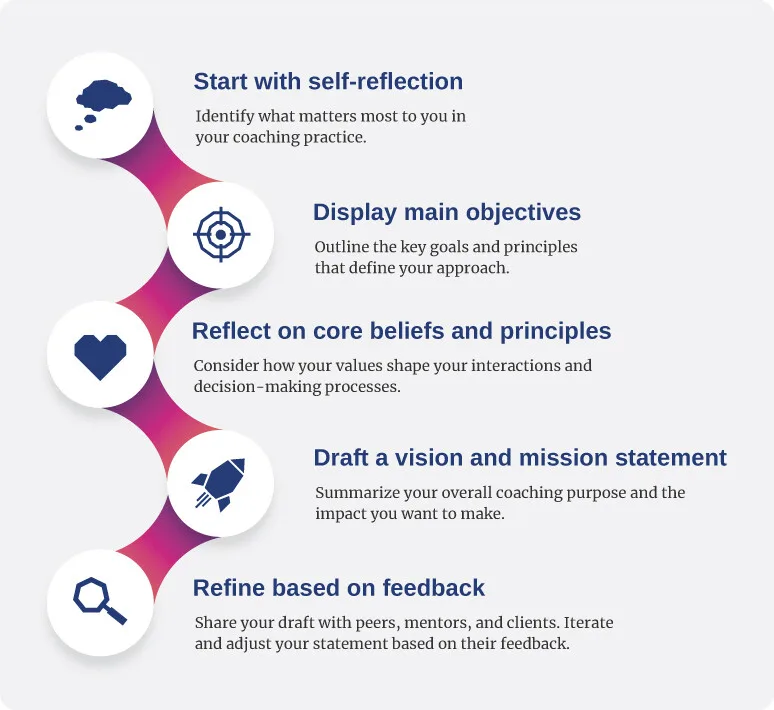
It's time to build your own philosophy. Use a document or the "three-ring binder" method suggested in the video below. This will be a living document that you refine over time. We will use the MAP structure, enriched with insights from two coaching experts.
Coaches: How to Developing a Winning Coaching Philosophy (10 Easy Steps!)
This video by Dr. Bhrett McCabe provides direct, actionable advice on why and how to write a coaching philosophy. It's motivational and packed with practical wisdom.
As you work through the exercise below, keep these key ideas from the video in mind: Why write it down? It acts as your SOP, preventing you from relying only on a fraction of what you truly know. Authenticity: The core message is to be authentic and genuine. Your philosophy should reflect who you are as a coach, not an imitation of someone else. Defining "Winning": Consider the segment on what battle you want to win. "Winning" for your clients might be emotional security, not just a numerical goal. Your Manifesto: Think of this philosophy as your personal manifesto—the principles you stand for. "Love-Based Leadership": Listen to the nuanced definition of love-based leadership as demanding more from your clients because you are invested in their goals, not coddling them. Value: Finally, internalize the message to never apologize for your value. A clear philosophy helps you own and communicate this value.
Part 1: Your Mission
Answer these questions to define your "Why."
- What is the fundamental purpose of your practice? (e.g., "To help couples integrate the cuckold/hotwife lifestyle in a way that is sustainable, emotionally secure, and enhances their primary bond.")
- What does "winning" mean for your clients? Go beyond surface goals. What are the deeper wins (e.g., overcoming jealousy, achieving logistical harmony, building unshakable trust)?
- What is the ultimate transformation you facilitate? (e.g., "Moving from chaotic exploration to intentional, structured, and joyful non-monogamy.")
Part 2: Your Attitudes
Answer these questions to define your "How."
- Your Beliefs:
- What do you believe about your clients' capacity for change and growth?
- What are your core ethical principles regarding confidentiality, consent, and client autonomy?
- How do you view challenges like jealousy or insecurity? (e.g., "As data points indicating a need for system adjustment, not as personal failings.")
- Your Models:
- How does your background in statistics and operations research inform your approach? (e.g., "I use principles of experimental design to test interventions and queuing theory to analyze time-management issues.")
- What is your stance on authenticity and vulnerability (for you and the client)?
- Your Approach to Evidence:
- How do you balance quantitative data (questionnaires, tracking) with qualitative data (client narratives)?
- How do you define "evidence-based" in your practice?
Part 3: Your Process
Answer these questions to define your "What."
- What are the high-level steps a client goes through with you? This is where you can integrate the data-driven framework.

- Describe your process using this cycle:
- Measure: How do you gather initial data? (This relates to future lessons on intake instruments).
- Visualize/Diagnose: How do you present this data back to the client and use it to diagnose issues? (This uses the RADAR framework from our last lesson).
- Optimize: What kinds of interventions or "homework" do you use to create change?
- Grow: How do you track progress and ensure the changes are sustainable?
- How does your process begin (initial call) and end (closing session)?
Take your time with this exercise. This document will become the bedrock of your marketing materials, your client agreements, and your session-to-session guide.
Conclusion
In this lesson, you have taken the critical step of codifying your expertise. By translating your tacit knowledge into an explicit, written coaching philosophy using the Mission-Attitudes-Process framework, you have created a foundational asset for your business.
Your key takeaways are:
- A formal coaching philosophy transforms intuitive "gut feelings" into structured, communicable, and defensible principles.
- The MAP framework (Mission, Attitudes, Process) offers a robust structure for defining your purpose, your beliefs, and your actions.
- Authenticity is paramount; your philosophy must reflect your unique background, style, and values, particularly your quantitative edge.
- This philosophy is a living document that provides clarity, ensures consistency, and powerfully communicates your value to potential clients.
In our next lesson, we will put this philosophy into immediate practical use. We will design a preliminary 'red flag' checklist for identifying client situations that are outside the scope of coaching. A strong set of core principles is your best tool for defining your professional boundaries and ensuring you only take on clients you are best equipped to serve.