Introduction
In our last lesson, you learned how to apply Statistical Process Control (SPC) to transform your Key Performance Indicators (KPIs) from static numbers into a dynamic monitoring system. By creating control charts for your client outcomes, you established a method for distinguishing the natural "noise" of your process from significant signals that warrant investigation. This provides you with continuous, real-time insight into your practice's effectiveness.
This lesson is the capstone of our final module. We will now integrate that continuous monitoring into a periodic, strategic review. Our objective is to conduct a quarterly practice review using a structured, data-informed self-assessment template. For a solo practitioner, this structured self-assessment is the equivalent of a board meeting: a dedicated time to step back from the day-to-day work of client delivery and act as the CEO of your own practice. You will learn to synthesize data, derive strategic insights, and set a clear, intentional course for the upcoming quarter, completing the cycle of building a truly self-improving practice.
From Monitoring to Managing: The Purpose of a Quarterly Review
Your control charts are the "voice of the process," telling you what's happening moment to moment. A quarterly review is your opportunity to listen to that voice, interpret what it's saying, and decide how to respond. It’s the structured ritual where you transition from being an operator within your system to being the architect of it.
The goal is not simply to report on what happened, but to drive strategic decisions. This process converts raw data from your Airtable database and control charts into a concrete action plan. The following resource provides a comprehensive corporate-level guide to Quarterly Business Reviews (QBRs). We will adapt its core principles to the context of your solo consulting practice.
Ultimate Guide to Quarterly Business Reviews (QBRs)
This guide from AmolinoAI breaks down the philosophy and best practices of effective QBRs. We will use it to establish the 'why' and 'how' of your self-assessment.
First, read the introduction to understand the core purpose. Next, review the table in the section on Challenges and Solutions. Pay particular attention to challenges like "Vague objectives," "Metric overload," and "Few actionable insights," as these are common pitfalls even for a solo practitioner. Then, study the table under Best Practices. Focus on the pillars of "Data-Driven Storytelling" and "Action Orientation." Finally, read the Conclusion, which succinctly summarizes the five key principles we will be applying.
As the guide emphasizes, the aim is to foster a culture of accountability (even to oneself), turn insights into action, and drive continuous improvement.
Designing Your Quarterly Practice Review Template
To ensure your review is structured and repeatable, you need a template. Drawing on your preference for practical frameworks, we will construct an 8-part template that guides you from data to decision. This structure is adapted from professional executive reporting but tailored for your unique practice. The article below provides an excellent, action-oriented foundation for this template.
QBR Presentation Template: Quarterly Reviews That Drive Action
This article by Winning Presentations offers a concise, 8-slide structure designed to drive decisions, not just report status. It's the perfect model for our self-assessment template.
Read the section The 8 Slides That Drive Action to understand the function of each part of the template. Then, review The “So What?” Framework, which is a powerful mental model for translating observations into insights.
Here is a customized version of that 8-part template for your quarterly practice review. You can build this out in a document or a slide deck.
Quarterly Practice Review Template
1. Executive Summary: The 30-Second Overview
- Performance: A single sentence summarizing the quarter (e.g., "Q3 was a period of process stabilization, with client outcomes showing predictable variation around a mean GAS of +0.59, slightly below the target of +1.0.")
- Key Insight: The single most important thing you learned (e.g., "The primary driver of below-target outcomes is not process failure, but a mismatch in service offering for clients experiencing high external life stress.")
- Top Priority: The most critical action for the next quarter (e.g., "Develop and pilot a 'Lifestyle Integration' module to address this gap.")
2. Practice Scorecard: The "What"
This section presents your key data. It should be visual and immediately understandable. This is where your SPC charts from the last lesson become a central exhibit.
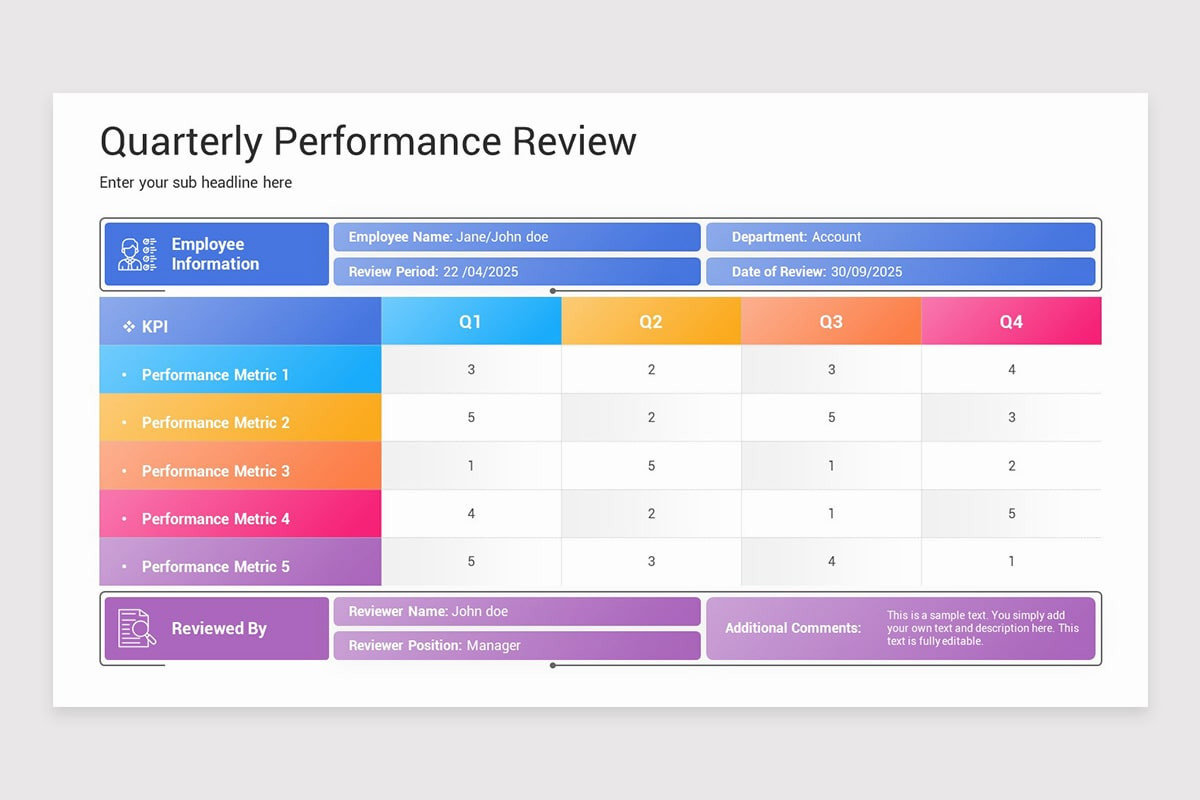
- Client Outcome KPI: Embed the I-MR chart for your average Goal Attainment Scaling (GAS) scores.
- Commentary: Is the process in control? What are the mean and control limits? How does the mean compare to your target?
- Client Success Rate KPI: Embed the P-chart for the proportion of clients achieving a "successful" outcome (e.g., GAS ≥ 0).
- Business Health KPIs:
- Client Acquisition: Number of new clients vs. target.
- Engagement Metrics: Average engagement duration, client satisfaction scores (from Module 9).
- Financials: Revenue, profitability.
3. Deep Dive - What Worked: Analyzing Success
Apply the "So What?" framework to your biggest wins.
- Result: "Client X achieved a GAS of +2.0, an outlier on the I-MR chart."
- Root Cause (Why?): "Analysis of session notes shows the 'future-self visualization' exercise was uniquely resonant."
- Insight (So What?): "Visual, forward-looking exercises are highly effective for clients with this specific archetype (e.g., 'The Visionary')."
- Implication (Now What?): "Incorporate this exercise into the standard toolkit for clients matching this archetype."
4. Deep Dive - What Didn't Work: Analyzing Misses
This is the most crucial part for learning. Be objective and non-defensive.
- Result: "The process mean for GAS remains at +0.59, below the target of +1.0."
- Root Cause (Why?): "A review of the 5 lowest-scoring clients this quarter reveals a common thread: all reported significant, unaddressed logistical friction with their 'vanilla' lives."
- Insight (So What?): "My current coaching framework is strong on emotional and relational dynamics but weak on practical, logistical support."
- Implication (Now What?): "Create a new 'Operational Efficiency' checklist and resource guide for clients."
5. Strategic Insights: Connecting the Dots
Synthesize the deep dives into broader conclusions.
- Observation: "The control charts show a stable, predictable process. This means to improve results, the system itself must be changed, rather than reacting to individual client outcomes."
- Observation: "There's an emerging typology of client needs: 'Emotional Integration' vs. 'Logistical Management'. My service is over-indexed on the former."
- Hypothesis: "Adding a structured logistical support component to my service offering could shift the entire process mean for GAS upwards by 0.2 points next quarter."
6. Next Quarter Priorities: The Action Plan
Translate insights into 3-5 concrete priorities.
- Priority 1: Design "Operational Efficiency" toolkit.
- Owner: Self
- Success Metric: Pilot with 3 new clients and achieve an average score of >4/5 on a feedback survey for the toolkit.
- Priority 2: Update client intake form (Module 4) to better diagnose logistical vs. emotional needs upfront.
- Owner: Self
- Success Metric: Be able to categorize 100% of new clients into a primary need category post-intake.
7. Risks & Dependencies
What could derail your plan?
- Risk: Developing the new toolkit may take more time than anticipated, reducing capacity for new clients.
- Mitigation: Block dedicated, non-negotiable "Practice Development" time in the calendar each week.
8. Commitment
This is your "ask" of yourself.
- "I commit to finalizing the 'Operational Efficiency' toolkit by the end of Month 1 and formally updating my service menu in Month 2."
The Review Process: A Ritual for Reflection
Having a template is the first step; committing to a process is what makes it effective.
- Preparation (Week before Quarter End):
- Data Freeze: Pull all relevant data for the quarter from your Airtable database. This includes final GAS scores, client satisfaction surveys, session notes, and financial data.
- Update Charts: Add the new data points to your SPC control charts. This is a critical step to see the latest trends.
- Draft the Review: Work through the 8-part template, filling in each section. This is your first pass at analyzing the data.
-
The Review Session (First week of New Quarter):
- Block 3 hours of focused, uninterrupted time. Treat this as a formal meeting with the CEO of your practice—yourself.
- Go through your drafted review document/slides. Challenge your own assumptions.
- Use the "So What?" framework relentlessly. Ask "why" five times.
- The goal is to move from a draft to a finalized set of priorities and a firm commitment for the next 90 days.
-
Activation (First week of New Quarter):
- As detailed in the AmolinoAI guide, the follow-up is everything.
- Immediately translate your "Next Quarter Priorities" into your task management system (e.g., Asana, Trello).
- Schedule the work. Block calendar time for the development tasks you've committed to. This makes your strategic plan tangible.
This entire process—Prepare, Review, Activate—creates a powerful rhythm that drives the evolution and systematization of your practice.
Conclusion
This lesson has equipped you with the final component of a self-improving practice: the structured quarterly review. By combining the continuous monitoring of SPC with the periodic, strategic sense-making of a QBR, you have created a complete feedback loop.
Key Takeaways:
- A quarterly review is a strategic ritual to work on your business, not just in it.
- A structured 8-part template (Summary, Scorecard, Wins, Misses, Insights, Priorities, Risks, Commitment) provides a repeatable path from data to decision.
- Your SPC control charts are not just for monitoring; they are the central evidence in your scorecard, revealing the health and stability of your core processes.
- The "Prepare, Review, Activate" process ensures that insights are translated into concrete actions that improve your practice over time.
You have now completed the entire course, moving from foundational principles to building a fully systematized, data-driven consulting workflow. You have the tools to define your value, codify your expertise, acquire and onboard clients, design and execute engagements, and most importantly, create a practice that learns and improves with every client. The cycle of continuous improvement is now in your hands.