Introduction
Welcome to Module 4, "Designing Diagnostic Instruments." In the previous module, we focused on establishing the professional container for your practice, culminating in a lesson on setting and maintaining clear boundaries. With that essential framework in place, we now shift our focus to crafting the specialized tools you will use within that container. Your ability to create robust, data-driven instruments is a cornerstone of the unique value proposition you offer your clients.
This lesson addresses the first and most critical step in that process: defining the psychometric goals of your client intake process. Before writing a single question, you must be clear about what you are trying to measure and what constitutes a "good" measurement. For your practice, this means moving beyond simple information gathering to designing an instrument that is consistent, accurate, and defensible. Given your background in statistics, you can think of this as establishing the design specifications and performance criteria for a sophisticated measurement tool, much like you would before beginning a formal experiment.
1. From Data Gathering to Psychometric Measurement
At its core, a client intake form gathers data. However, to truly leverage your expertise, your intake must be more than a simple questionnaire; it must be a psychometric instrument. Psychometrics is the science of measuring psychological attributes, such as traits, abilities, and, in your case, relationship dynamics.
A document from the Society of Occupational Medicine, though focused on a different field, provides an excellent and concise definition of the core principles.
[PDF] Psychometric Assessments in Occupational Health What they are ...
This guide offers a clear, professional overview of what constitutes a psychometric assessment.
Please read the introduction and the section titled "What are psychometric assessments?". Pay close attention to the four defining features it lists. These four features are the fundamental psychometric goals you will set for your own instrument.
As the reading highlights, for your intake to qualify as a psychometric instrument, it must be designed with four primary goals in mind:
- Reliability: It must produce consistent and stable results.
- Validity: It must accurately measure what it claims to measure.
- Freedom from Bias: It must be fair and yield accurate results for all your clients.
- Standardization: It must be administered and scored in a consistent way.
Let's dissect each of these goals and translate them into the context of your relationship coaching practice.
2. Deconstructing the Core Goals: Reliability and Validity
Reliability and validity are the two pillars of psychometric quality. Understanding them is not merely an academic exercise; it is fundamental to creating an intake process that generates data you can trust to inform your coaching strategy.
The following video provides a clear and intuitive explanation of these two concepts.
Reliability and Validity in Appraisal
This video, "Reliability and Validity in Appraisal," offers excellent analogies to distinguish between these two critical concepts.
First, watch the explanation of reliability, paying attention to the scale analogy. This perfectly illustrates that consistency does not equal accuracy. Then, watch the definition of validity, which establishes it as the measure of accuracy.
Goal 1: Reliability (Consistency)
As the video explained, reliability is about consistency. If a client were to take your intake questionnaire on a Monday and again on a Wednesday (assuming no major life events in between), the results should be very similar. An unreliable instrument is like an elastic tape measure; the readings are meaningless because they are not repeatable.
For your practice, the goal of reliability means you are aiming for an instrument that consistently measures the underlying constructs, minimizing random error. We will cover the statistical methods for assessing this (e.g., test-retest reliability, internal consistency via Cronbach's alpha) in a later lesson when we design the pilot test for your instrument. For now, the goal is to intend to build a tool whose results are stable and dependable.
Goal 2: Validity (Accuracy)
Validity is about accuracy: Does your instrument measure what you claim it measures? A reliable tool can be consistently wrong, but a valid tool must be reliable. Validity is the more complex and, ultimately, more important goal.
There are several facets of validity to consider for your intake instrument, all of which are interconnected.
Reliability and Validity in Appraisal
This same video also provides a breakdown of the different types of validity.
Watch the segment from the different types of validity. Focus on the definitions of content, criterion, and construct validity.
Here is how these types of validity apply directly to your goals:
-
Content Validity: This addresses whether your questions are a representative sample of the domain you want to measure. Your goal is to ensure the instrument covers all critical aspects of your clients' situations: relationship history, communication patterns, logistical challenges with the lifestyle, emotional integration, individual motivations, etc. Your codified expertise from Module 2 is the foundation for ensuring strong content validity. You, as the subject matter expert, will be the primary judge of this.
-
Construct Validity: This is the most critical type of validity. It asks whether your instrument accurately measures the abstract, hypothetical constructs you're interested in (e.g., "relationship satisfaction," "emotional jealousy," "logistical efficiency"). Establishing construct validity is a rigorous process, as demonstrated in academic research.
For an example of how this is done at a high level, the following paper on the Relationship Assessment Scale (RAS) is illuminating. You don't need to read it in full, but understanding its purpose is valuable.
Psychometric functioning, measurement invariance, and external ...
This academic paper is a case study in rigorously evaluating the psychometric properties of a relationship measurement tool. It showcases the application of concepts you are familiar with, such as CFA and IRT.
Read the introduction starting from the second paragraph. This establishes why measuring relationship satisfaction requires psychometrically sound tools. Then, skim the section titled "The current study." Notice the specific psychometric properties the researchers aim to assess: unidimensionality, measurement invariance, item functioning (using IRT), and various forms of validity. This is the level of rigor that underpins well-established psychological instruments.
- Criterion Validity: This concerns how well your instrument's scores predict a real-world outcome. For example, a key goal for your intake could be that low scores on a "Relationship Stability" subscale should be statistically correlated with a client's self-reported intent to end the relationship. The RAS paper you just reviewed does exactly this, correlating RAS scores with the "intent to continue the current relationship." This makes the measurement actionable.
3. Broadening the Goals: Standardization and Bias
Beyond reliability and validity, two other goals are crucial for professional application.
Goal 3: Standardization
Standardization means that the assessment is administered and scored in the same way for every client. This ensures that differences in scores are due to actual differences between clients, not variations in the assessment process. For a digital questionnaire, this goal is relatively easy to achieve by ensuring instructions are clear and the scoring algorithm is fixed.
Goal 4: Minimizing Bias
This goal is about fairness and equity. Your instrument should not systematically disadvantage any particular group of people. For your niche, this is particularly important. Questions must be worded inclusively, avoiding assumptions about gender, sexual orientation, or the specific configuration of a client's relationship.
The concept of measurement invariance, which you saw in the RAS paper (LINK), is the formal statistical method for testing this. The researchers tested whether the scale functioned the same way across genders, relationship types (formal vs. informal), and even countries. While you may not perform a multi-group CFA on your own instrument initially, the goal is to write items that are conceptually invariant and fair to the diverse clients you serve.
4. A Framework for Your Intake's Psychometric Objectives
So, what should your intake instrument actually do? The "Five Ps" model, adapted from clinical practice, provides an excellent framework for defining the core domains your instrument needs to measure validly and reliably.
The video below, while geared toward mental health, offers a fantastic structure for any diagnostic assessment.
How To Structure A Mental Health Intake Assessment
The video "How To Structure A Mental Health Intake Assessment" lays out a comprehensive approach to gathering and synthesizing client information.
Watch the following three segments to understand a practical framework for your intake goals: First, watch the brief section on identifying clinically relevant information. This sets the stage for a holistic assessment. Next, watch the introduction to the clinical formulation, where the "five P's" are introduced. This provides a powerful synthesis model. Finally, watch the detailed explanation of the predisposing, precipitating, and perpetuating factors from this section.
Based on this framework, the psychometric goal of your client intake process is to reliably and validly measure the Five P's of your client's situation:
- Presenting Problem: What is the primary complaint, in the client's own words? Your instrument must capture this and begin translating it into measurable terms (e.g., frequency, intensity, impact on life domains).
- Predisposing Factors: What in their history makes them susceptible to this issue? (e.g., family background, previous relationship patterns).
- Precipitating Factors: Why now? What was the trigger that led them to seek coaching?
- Perpetuating Factors: What factors maintain the problem? (e.g., poor communication habits, unresolved conflicts, external stressors).
- Protective/Positive Factors: What are their strengths? (e.g., strong communication skills in other areas, high motivation, existing support systems).
Defining your intake's purpose as the measurement of these five domains gives you a clear and comprehensive set of psychometric objectives.
5. A Checklist for Defining Your Goals
To bring this all together into an actionable format, you can use a checklist. This checklist, while designed for evaluating existing tests, serves as an excellent proactive guide for defining the goals of a new one.
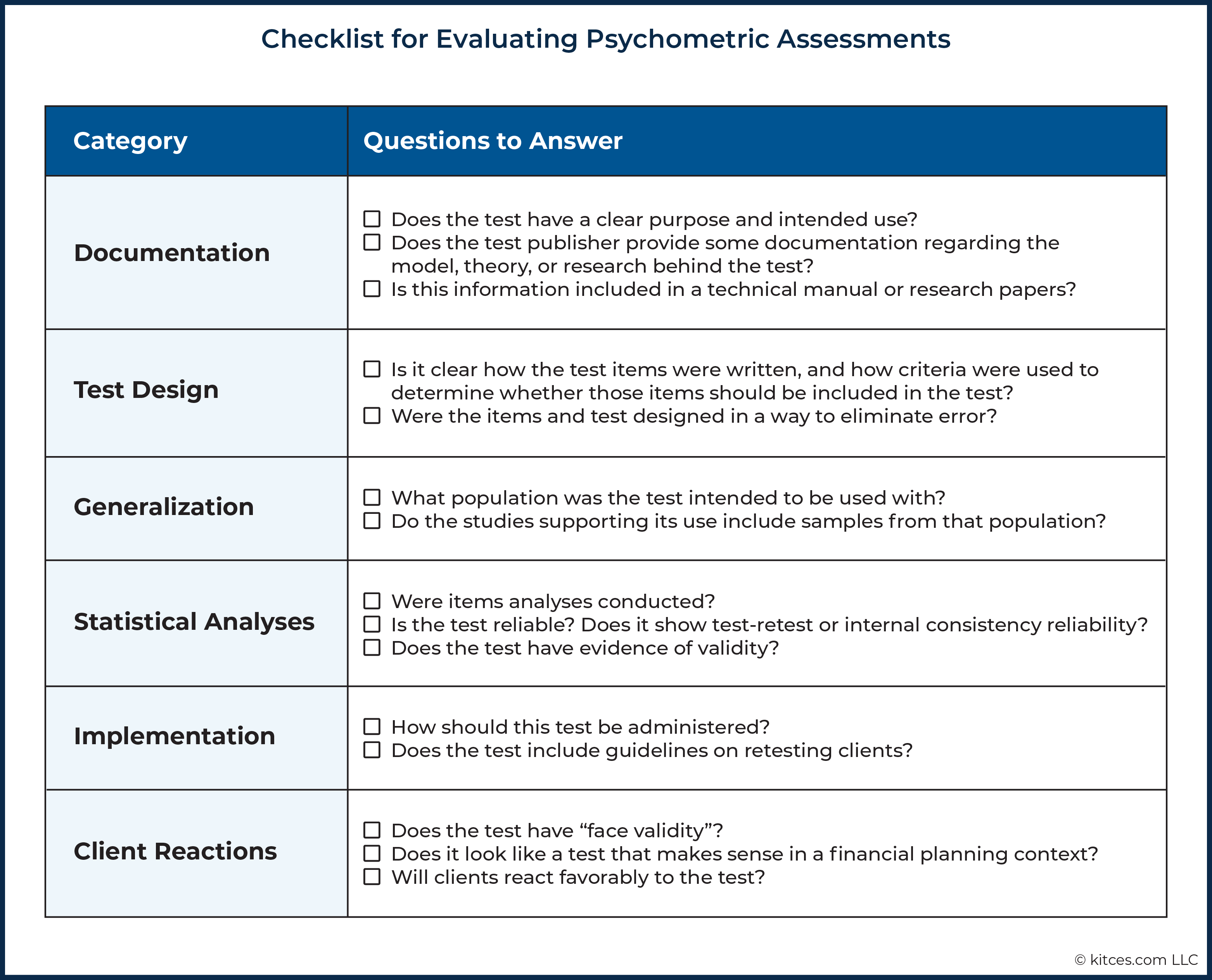
Before you write your first question, you should have a clear answer for each of these categories:
- Documentation: What is the clear purpose of your intake? (e.g., To measure the 5 P's to inform a data-driven coaching plan).
- Test Design: What constructs will you measure? What criteria will you use to decide if a question is good or bad? (This relates to content validity).
- Generalization: Who is your target population? (e.g., Individuals/couples in or exploring the cuckold/hotwife lifestyle).
- Statistical Analyses: What is your plan for ensuring reliability and validity? (e.g., A pilot test using Cronbach's alpha and correlating scores with client outcomes).
- Client Reactions: Will the instrument have face validity? Will clients find it relevant and professional?
Conclusion
In this lesson, we have moved from the general concept of an intake form to a specific, professional standard. You have learned to define the psychometric goals of your client intake process, which is the essential first step in building a powerful diagnostic tool.
Here are the key takeaways:
- The goal of your intake is not just to gather information, but to measure key constructs about your client's situation.
- The four primary psychometric goals for your instrument are that it must be Reliable, Valid, Standardized, and Free from Bias.
- Validity is multifaceted: you must consider content validity (Are the questions relevant?), construct validity (Does it measure the right concept?), and criterion validity (Does it predict real-world outcomes?).
- The "Five Ps" framework provides a structured way to define the specific domains your instrument needs to measure: Presenting Problem, Predisposing, Precipitating, Perpetuating, and Protective factors.
By setting these goals before you begin writing, you lay the foundation for an instrument that is not only effective but also a clear demonstration of your unique, data-driven approach to relationship coaching.
In our next lesson, we will begin the practical work of applying these goals. We will draft questions to capture client goals, relationship history, and key lifestyle integration variables.