Welcome back. In our last session, we explored how to use stream of consciousness to depict a character's fracturing composure during the tension beat. We saw how internal chaos can manifest in small, involuntary physical "tells," escalating the scene's pressure.
This lesson builds directly on that foundation. Now that you can render a character's internal state, we will focus on weaponizing the gap between that inner world and their spoken words. Our learning outcome is to write dialogue where a character's subtext, revealed through internal thought or action, directly contradicts their spoken words. This is the art of subtext—making characters say one thing while meaning another. It is the engine of psychological tension and emotional realism, particularly in the complex relational dynamics of a vee.
The Power of What Isn't Said
At its core, subtext is the meaning simmering beneath the surface of the text. It's what characters imply but don't state, and what the reader infers from the contradictions between words, thoughts, and actions. In dialogue-heavy prose like yours, mastering subtext is what separates flat, expository conversations from layered, compelling exchanges.
This infographic provides a clear distinction between the explicit facts of a scene (context) and the implicit meaning (subtext).
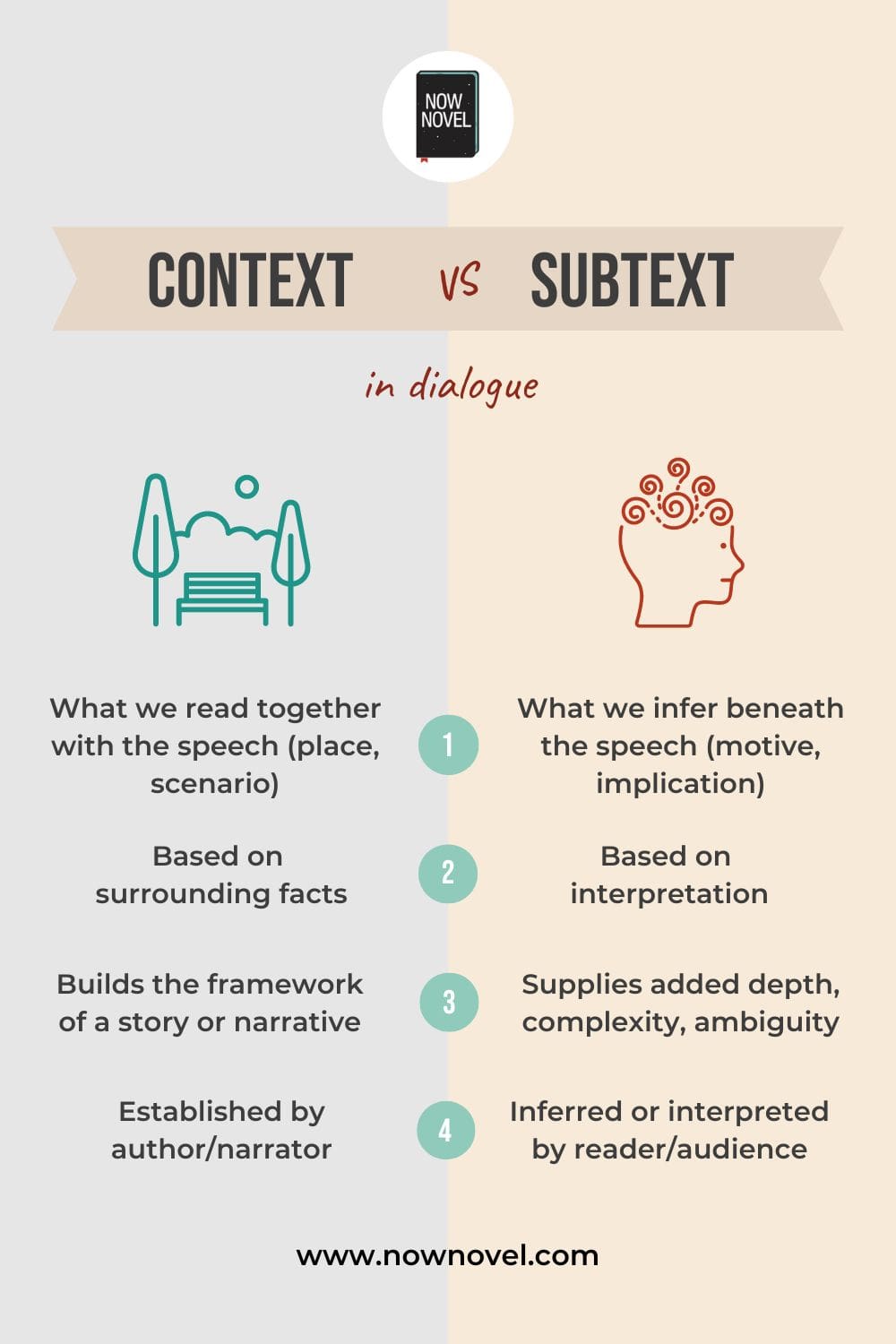
As a relationship analyzer, you are intimately familiar with this principle. People rarely articulate their deepest insecurities, desires, or resentments directly. Instead, they communicate through coded language, loaded questions, and non-verbal cues. Your task as a writer is to dramatize this very human behavior on the page.
Let's begin by formally exploring this concept.
How to Write What's Not Written (Subtext) - September C. Fawkes
This article by September C. Fawkes offers a fantastic introduction to subtext, focusing on how contradiction creates layered meaning.
Please read the following sections: Start with the definition and the example of Mr. Henderson. This clearly illustrates the basic principle of words saying one thing while actions say another. Next, read the section "Why Subtext Creates Tension". This explains the psychological effect on the reader. Finally, carefully study the section on Contradiction. Pay close attention to the example of Phillip, the boy with the tattoo, from Nancy Kress's work. It's a perfect demonstration of dialogue ("No," "I won't") being directly contradicted by internal feeling ("his grin flashed," "nerves thrilled").
The key takeaway is that subtext thrives on contradiction. When a character's words are at odds with their actions, body language, or as we'll see, their private thoughts, the reader is invited to deduce the truth. This active interpretation creates a much deeper engagement with the story.
A Framework for Constructing Contradictory Dialogue
As you prefer, let's establish a formulaic framework for building this effect into your scenes. You can think of this as a four-step process for encoding subtext.
- Define the True Intent: Before writing the dialogue, state the character's raw, unfiltered goal or emotion in one sentence. This is for your eyes only. For example: "I feel threatened by his expertise and want to undermine him."
- Craft the Social Mask (Dialogue): Write the line of dialogue. This is the "mask" the character presents to the world. It should be polite, neutral, or even outwardly positive—the opposite of their true intent. For example: "That's fascinating. You're clearly an expert in this."
- Reveal the Internal Leak (Internal Thought): Immediately follow the dialogue with the character's true thought, using the free indirect discourse or stream of consciousness techniques we've practiced. This explicitly reveals the contradiction to the reader. Use italics for clarity. For example: He loves this, doesn't he? The little lecture. Making me feel like an idiot.
- Show the External Tell (Action/Body Language): Accompany the dialogue and thought with a small, physical action that betrays the hidden emotion. This action "leaks" the subtext. For example:
She took a slow sip of her wine, her knuckles white around the stem of the glass.
This structure creates a powerful trifecta for the reader: they hear the lie, they see the truth in the character's mind, and they see the physical evidence of the internal conflict.
Let's examine a professional example of this in action.
The Art of Masterful Fiction Dialogue
This article by C. S. Lakin demonstrates how to transform "on-the-nose" dialogue into subtext-rich exchanges. The "After" passages are what we want to focus on.
Please read the section that begins with the "After Passage" featuring Tyler and Reese. Start your reading at the heading "After Passage:" and pay very close attention to the paragraph of Reese's internal thought. Notice how her spoken words are simple and evasive ("Yeah," "It isn't"), while her internal monologue reveals life-or-death stakes. This is a masterclass in using internal thought to create a vast chasm between spoken words and unspoken reality.
Concrete Example: Contradiction in the Vee
Let's return to our polyandrous triad: Maya (the hinge/pivot, a lingerie designer), Evan (the architect), and Leo (the writer).
Situation: Last lesson, Leo's insecurity about his place in the vee caused him to misread a conversation between Maya and Evan. His internal turmoil resulted in him spilling water in the kitchen. Maya followed him, concerned. The tension is high.
Now, we'll use Maya as the POV character to demonstrate her attempt to manage the situation with contradictory dialogue. Evan re-enters the scene.
1. Maya's True Intent: "This is a disaster. Leo is spinning out, Evan is cluelessly making it worse, and I'm stuck in the middle trying to prevent a complete meltdown."
2. The Social Mask (Dialogue) & 3. The Internal Leak (Internal Thought):
Evan walks into the kitchen, carrying the blueprints he and Maya were looking at earlier. He sees the spilled water and Leo's rigid posture.
"Everything okay in here?" Evan asks, his brow furrowed with genuine, if misplaced, concern. "Leo, if we were boring you with all that structural talk, my apologies. It’s just shop talk."
Maya forces a bright, airy laugh. "We're perfectly fine!"
Fine. We are the furthest thing from fine. Can't you read the room, Evan? That 'shop talk' is the entire problem. And Leo, standing there like a statue, you're just as bad. Say something. Say anything real.
"Leo was just about to get some fresh air," she continues, turning a brilliant smile on Leo. "Weren't you, honey? Clear your head before you dive back into that chapter."
Get him out of here before one of you says something that can't be unsaid. I can't hold this together by myself.
4. The External Tell (Action/Body Language):
Maya grabs a dish towel and begins wiping the counter where Leo spilled the water. Her movements are sharp, efficient, and a little too aggressive for the small puddle. She scrubs at a spot that is already clean, her back to both men, creating a wall with her own body.
"See?" she says, her voice still light, but the word is clipped. "All better."
In this beat, Maya's dialogue ("perfectly fine," "clear your head") is a deliberate act of de-escalation and misdirection. Her internal thoughts, however, reveal her true state of desperation and frustration. The aggressive way she cleans the counter is the physical manifestation of her suppressed anger, a "tell" that contradicts her cheerful tone. She is performing calmness while internally screaming. This is the essence of using subtext to build tension.
Conclusion
Today we have moved from depicting a character's internal state to actively using it to create dramatic contradictions in your scenes. You now understand that the most powerful dialogue often hides more than it reveals.
Here are the key takeaways:
- Subtext is the unspoken meaning. It lives in the gap between what a character says and what they truly feel or intend.
- Contradiction is the engine of subtext. You create it by pitting dialogue against internal thought and physical action.
- The four-step framework (True Intent -> Social Mask -> Internal Leak -> External Tell) provides a reliable method for constructing these layered moments.
- This technique makes characters more realistic and deepens reader engagement by asking them to interpret the scene, much like navigating a real-life social dynamic.
In our next and final lesson for this module, we will refine this skill by focusing on what happens in the spaces between the words. We will explore how to deploy silence, pauses, and fragmented dialogue to externalize unspoken tension, giving you complete mastery over the rhythm and weight of your characters' conversations.