Welcome back. In our previous lesson, we focused on creating subtext by building a contradiction between a character's spoken words and their true internal state. You learned to use free indirect discourse and physical "tells" to reveal the truth simmering beneath a socially acceptable mask.
This lesson completes our module on narrative voice by examining what happens in the gaps between the words. Our objective is to deploy silence, pauses, and fragmented dialogue to externalize unspoken tension between vee characters. If the last lesson was about the conflict between words and thoughts, this one is about the tension conveyed when words fail, break, or disappear entirely. You will learn to treat the empty spaces in conversation not as voids, but as active, pressure-filled components of a scene.
The Information in Absence
Given your background in statistics and systems analysis, you know that the absence of an expected event or data point is often as significant as its presence. A zero-value in a dataset isn't just nothing; it's information. In a queuing model, a sudden halt in arrivals or an unusually long service time is a critical signal about the system's state.
Dialogue operates on a similar principle. A smooth, back-and-forth conversation establishes a baseline rhythm. When that rhythm is disrupted by a sudden pause, an interruption, or stark silence, it signals a shift in the underlying emotional or power dynamics. The reader instinctively feels this disruption as tension. The two primary tools for punctuating these disruptions are the ellipsis and the em dash.
This image provides a simple, effective visual guide to their distinct functions.
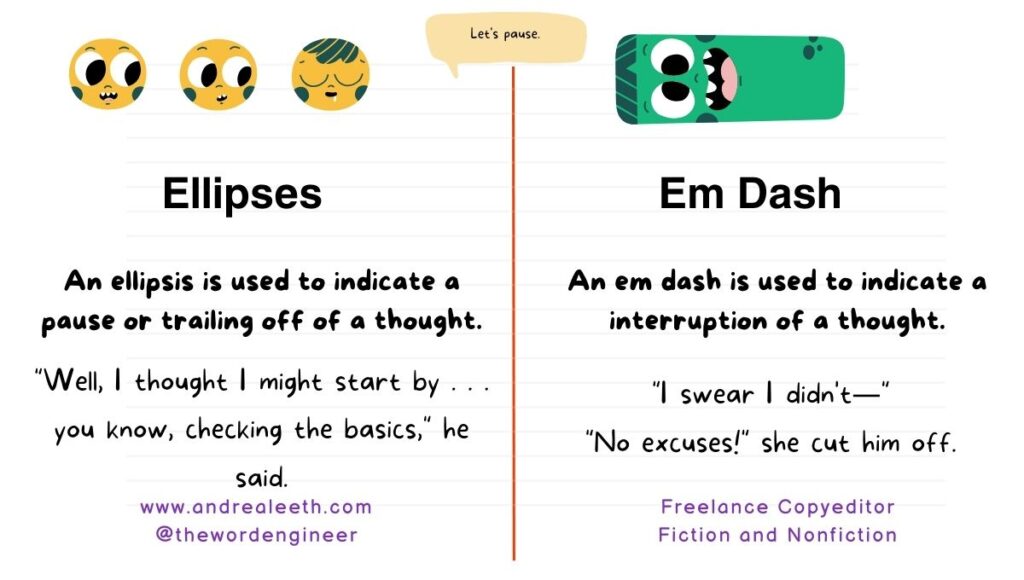
Now, let's explore the application of these tools in more detail.
How to write dialogue with ellipses and dashes - The Blue Garret
This article from The Blue Garret provides excellent, clear-cut examples of how these punctuation marks function in prose to control rhythm and reveal character.
Please read the following two sections: First, read the section "Ellipses dramatize thinking". Notice how the examples show hesitation, a search for words, and a thought that is deliberately left incomplete for the other character to infer. Next, read "Dashes create urgency". Focus on how the em dash is used to show one character breaking into another's speech, creating a sense of urgency and conflict.
As the article demonstrates, the ellipsis (...) generally represents a thought faltering, while the em dash (—) represents a thought being forcefully cut off, either by the speaker themselves or by another character.
A Framework for Weaponizing Silence
In keeping with your preference, here is a formulaic framework for using these techniques to inject tension into a dialogue exchange.
-
The Hesitation (Ellipsis): Use an ellipsis to show a character censoring themselves, struggling to find the right words, or trailing off because the thought is too difficult or dangerous to complete. This externalizes internal conflict and invites the reader to speculate on what was left unsaid.
- Example: "I just thought that maybe we could... you know. Never mind."
-
The Interruption (Em Dash): Use an em dash to show one character talking over another. This is a direct play for power in a conversation. It can show urgency, disrespect, or a desperate need to control the narrative. The character who interrupts is trying to seize control of the scene's direction.
- Example: "The reason I didn't call is because—" "Because you didn't think I mattered enough to deserve a call."
-
The Fragmented Exchange (Curt Lines): Use a series of short, clipped, one-line paragraphs. This creates a staccato rhythm that feels like a verbal sparring match. Each line is a jab, and the lack of descriptive text between them makes the exchange feel stark and hostile.
-
The Weighted Silence (Action Beat): This is your most powerful tool. A character asks a direct question, and instead of a verbal reply, the other character performs a deliberate action. This silence is deafening. The action, no matter how small, becomes the answer, and it often carries far more weight and menace than words could.
- Example: "Are you going to tell him?" she asked. He said nothing, just picked up his keys from the table and walked out the door.
This next resource provides excellent examples of interruptions and fragmented exchanges.
Writing tense dialogue: 5 ways to add arresting tension - Now Novel
This article from Now Novel provides practical, example-driven methods for building tension. We'll focus on two that directly relate to fragmented dialogue.
Please read the following sections: Focus on tip #1, "Keep exchanges short and curt". The Deon Meyer example perfectly illustrates the tense, probing rhythm of a fragmented exchange. Then, read tip #4, "Use interruptions". This reinforces the use of the em dash to show characters cutting across each other, which you've noted is common in three-person dynamics where alliances can shift mid-conversation.
Concrete Example: The Dialogue Cracks
Let's return to our vee: Maya (the hinge), Evan (the architect), and Leo (the writer).
Situation Recap: The tension over Leo's insecurity escalated, he spilled water, and Maya tried to smooth it over by telling him to "get some fresh air." Her words were cheerful, but her internal thoughts and actions were frantic. The scene ended with her saying, "All better," while aggressively cleaning an already-clean counter.
Now, we'll see that performance fail as the dialogue itself begins to fracture. Maya remains the POV character.
"All better," I said, my voice a sliver of glass I hoped they'd mistake for a bell.
Evan’s gaze shifted from me to Leo, who hadn't moved. "Leo? Is something wrong?"
Leo was a statue carved from silence. He finally looked at me, his eyes bypassing Evan completely. "You want me to get some air," he said. It wasn't a question.
"I just thought..." Don't you dare do this here. "...it might help you clear your head. Before you go back to the chapter."
"The chapter's not the problem, Maya."
The dish towel in my hand was suddenly damp and heavy. Evan stepped forward, placing a hand on Leo's shoulder. "Hey, man, if this is about the blueprints—"
"It's not about the blueprints," Leo snapped, shrugging off Evan's hand. He turned his full attention back to me. "It's about you. Deciding what I need. Managing me."
The air thickened. My carefully constructed wall of cheerful denial crumbled. Evan opened his mouth to speak again, a protest forming on his lips, but I held up a hand. A tiny, pleading gesture. He stopped.
"Leo," I began, but the name was all I had. The rest of the sentence wouldn't come. What could I say? You're right? You're wrong? Please stop?
He just stared at me, waiting.
The only sound in the kitchen was the slow, steady drip... drip... drip... from the faucet I hadn’t turned off completely. Each drop landed in the silence like a judgment.
Analysis of the Techniques:
- Hesitation (Ellipsis): Maya tries to repeat her excuse, but it trails off ("I just thought..."). This shows her resolve faltering as she realizes her attempt at misdirection has failed.
- Fragmented Exchange: The dialogue is short and sharp. "The chapter's not the problem, Maya." "It's not about the blueprints." Each line dismisses the previous one, escalating the confrontation.
- Interruption (Implicit): Leo cuts Evan off ("It's not about the blueprints—"). We show this with a sharp line of dialogue and a physical action (shrugging off his hand), which is just as effective as an em dash. Evan's next attempt to speak is halted by Maya's gesture—a non-verbal interruption.
- Weighted Silence (Action Beat): The scene ends not with a word, but with the sound of the dripping faucet. This amplifies the unbearable silence between the three characters. The sound fills the space that should be occupied by resolution, instead promising only more tension. Leo's simple act of staring and waiting is more powerful than any accusation he could voice.
Conclusion
In this lesson, you've added the final tools to your subtext toolkit. You now understand how to manipulate the very structure and rhythm of dialogue to create tension. By treating pauses, interruptions, and silences as deliberate narrative choices, you can make your conversations feel layered, realistic, and psychologically charged.
Key takeaways from today:
- Dialogue's rhythm is a source of tension. Disrupting the expected flow with pauses or interruptions signals conflict to the reader.
- Ellipses (...) show hesitation or self-censorship, revealing a character's internal conflict.
- Em dashes (—) show interruptions, externalizing a power struggle between characters.
- Stark silence, punctuated by an action beat, is often the most potent way to convey extreme tension, forcing the reader to interpret the unspoken.
This concludes our module on Narrative Voice and Subtext. You are now equipped with a sophisticated set of techniques to render character interiority and complex social dynamics.
In our next module, we will begin applying this entire skillset to the first of your narrative frameworks: The Misunderstanding Triangle. You'll see exactly how to use free indirect discourse to establish the initial misreading, contradictory dialogue to show the pivot character withholding information, and fragmented dialogue to dramatize the moment the damage becomes real.