Introduction
Welcome back. In our previous lesson, we established Heidegger's crucial departure from the philosophical tradition by replacing the concept of the 'subject' with Dasein. We saw that Dasein is not a thinking substance separate from the world, but a unique kind of being—the being that we are—for whom its own existence is an issue. We concluded by noting that the fundamental constitution of Dasein is Being-in-the-world.
Today, we will dissect this core Heideggerian concept. Our goal is to describe 'Being-in-the-world' as the unitary, fundamental structure of Dasein. The hyphens in the term are philosophically significant: they indicate that this is a single, indivisible phenomenon. While we will analyze its components to understand it, the primary objective is to grasp their inseparability and how they form a unified whole, which stands in stark contrast to the traditional subject-object model.
1. Moving Beyond the "Ghost in the Machine"
To appreciate Heidegger's concept, we must first solidify our understanding of what it aims to replace: the Cartesian model of a mind (res cogitans) separate from a physical world (res extensa). This model posits a mind "inside" a body, which is "inside" the world, creating a series of philosophical puzzles about how a non-physical mind can interact with a physical body and how it can have certain knowledge of an external world.
The following reading offers a very clear critique of this model and sets the stage for Heidegger's alternative.
Being And Time: Being-In-The-World - James Still
This article, 'Being And Time: Being-In-The-World' by James Still, provides an accessible entry point into Heidegger's critique of Cartesian dualism.
Please read the first five paragraphs of the article, ending just before the line, 'We do not live as “thinking subjects”...'. Focus on the problem of the 'ghost in the machine' and Heidegger's rejection of the need to prove an external world.
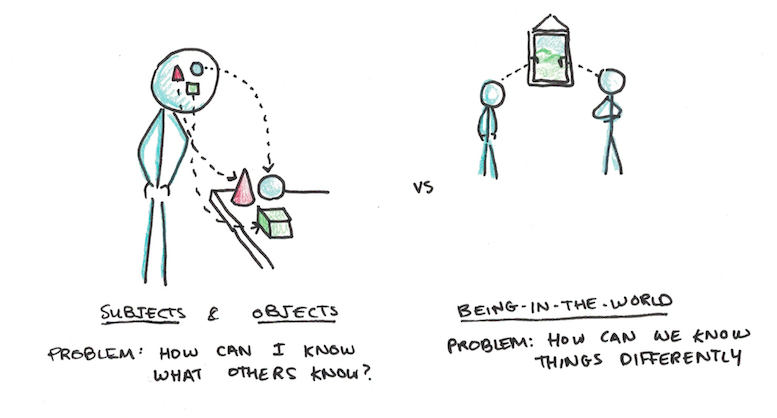
Heidegger's move is to dissolve this problem rather than solve it. He argues we are not encapsulated subjects who first exist and then go "outside" to encounter a world. Instead, our primary way of being is already "outside," engaged with and absorbed in a world.
This fundamental shift is captured visually in the diagram below.
2. The Unitary Structure of Being-in-the-World
Heidegger's term for Dasein's fundamental constitution is In-der-Welt-sein. The hyphens signal that this is a single, unified structure. Dasein isn't a being and in a world; its very being is Being-in-the-world.
For the purpose of analysis, however, Heidegger shows that this unitary phenomenon has three structural components that are equiprimordial—meaning they are equally fundamental and mutually dependent. You cannot have one without the others.
The Stanford Encyclopedia of Philosophy provides a concise and authoritative overview of this structure.
Martin Heidegger - Stanford Encyclopedia of Philosophy
This section from the Stanford Encyclopedia of Philosophy entry on Heidegger formally lays out the structure of Being-in-the-world.
Please read section 2.2 Being-in-the-World. Focus on the definition of Being-in-the-world as a 'unitary phenomenon' and identify its three constituent parts.
As the text states, the three structural moments are:
- The 'World': The "wherein" Dasein dwells.
- The 'Who': The self that exists in the mode of Being-in-the-world.
- 'Being-in': The relational character that binds the 'who' and the 'world'.
Let's examine each of these in turn, always remembering that we are artificially separating them for clarity; in experience, they are one.
3. The Three Moments of Being-in-the-World
A. The 'World' as Worldhood (Weltlichkeit)
When Heidegger speaks of 'world', he does not mean the scientific conception of the universe—the collection of all existing things. That is a derivative and theoretical view. The primordial meaning of 'world' is a context of meaning, a structured web of relationships, equipment, and purposes in which we are absorbed.
To understand this, Heidegger introduces a critical distinction between two ways entities can show up for us.
An Introduction to Heidegger: Being and Time
This video, 'An Introduction to Heidegger: Being and Time', clearly explains the difference between how we relate to tools in use versus objects of theoretical contemplation.
Please watch the segment from 03:55 to 06:31. Pay close attention to the critique of Descartes' view of the wax and the distinction Heidegger draws between the 'present-at-hand' and the 'ready-to-hand'.
As the video explains:
- Present-at-hand (Vorhanden): This is how we encounter objects when we adopt a theoretical, detached stance. We look at their properties (color, weight, shape). This is the mode of being for objects of science.
- Ready-to-hand (Zuhanden): This is how we primarily encounter things in our everyday, practical engagement. We don't stare at the hammer; we use it to hammer a nail. The hammer is part of an 'equipmental totality'—it makes sense only in relation to nails, wood, a project, a workshop, etc.
For Heidegger, our primary mode of Being-in-the-world is one where we are absorbed in a world of the ready-to-hand. This network of equipment, tasks, and purposes is what he calls worldhood (Weltlichkeit). The world is not a box of things, but this meaningful context for our activities.
B. 'Being-in' as Familiarity and Absorption
Just as 'world' does not mean the physical universe, 'in' does not mean simple spatial location, like water being 'in' a glass. Dasein's 'Being-in' is an existential term describing a mode of dwelling, of being familiar with, and absorbed in the world.
The following reading uses a classic example to clarify this distinction.
Being And Time: Being-In-The-World - James Still
Returning to James Still's article, this section clarifies the unique meaning of 'in' as it applies to Dasein.
Please read the section that begins with 'As for being in...'. Focus on the distinction between the 'categorial' and 'ontological' meanings of 'in', and how the chair-and-wall example illustrates this.
To be 'in' the world, for Dasein, means to be at home in it, to inhabit it. This familiarity is not a cognitive state but our very way of being. It's the non-reflective, skillful way you navigate your room in the dark or drive a familiar route. Heidegger argues this familiarity is constituted by an equiprimordial unity of:
- Disposedness (Befindlichkeit): Our affective attunement, or mood, which discloses how things matter to us.
- Understanding (Verstehen): Our practical grasp of possibilities and our ability to get things done.
- Discourse (Rede): The articulation of meaning that allows the world to be intelligible.
We will explore these components in more detail in future lessons. For now, it is enough to see that 'Being-in' refers to this rich, absorbed familiarity with a meaningful world.
C. The 'Who' as Being-with (Mitsein)
Finally, who is this being that is in the world? In the last lesson, we identified it as Dasein. But Dasein is never alone. Being-in-the-world is fundamentally Being-with others (Mitsein). The world we inhabit is always already a shared, public world. The equipment we use (hammers, computers, roads) refers to others, and our very identity is defined in relation to them (as a student, a friend, a citizen). This social dimension is not an add-on to an otherwise isolated self; it is part of Dasein's fundamental constitution.
4. Synthesis: Being-in-the-World as Care (Sorge)
When we bring these three moments back together, we see a picture of Dasein as a being that is always already outside itself, absorbed in a shared, meaningful world of practical engagements. Heidegger gives this entire unified structure of Being-in-the-world a name: Care (Sorge).
This is not 'care' in the sense of 'worrying', but in the broader sense of being engaged, concerned, and involved with the world, others, and oneself.
This final video clip summarizes this pragmatic, caring engagement.
Heidegger's Being and Time: Dasein, Being in a World
Daniel Bonevac's lecture on 'Dasein, Being in a World' provides a good synthesis of this idea of our pragmatic relationship to the world.
Please watch from 04:50 to 09:33. Focus on how 'caring' is presented as the fundamental relationship between Dasein and the world, and how our engagement is primarily pragmatic, not epistemic (knowing).
Our fundamental relationship to the world is not that of a knowing subject to a known object, but of a concerned being engaged in projects. We are "thoroughly absorbed" and "entwined" in the world, not detached spectators. This is the essence of Being-in-the-world.
Conclusion
In this lesson, we have unpacked Heidegger's central concept of Being-in-the-world. We have moved beyond the traditional subject-object dichotomy and described a more primordial, unitary structure that defines our existence.
Key Takeaways:
- Being-in-the-world is the single, unitary, and fundamental structure of Dasein, intended to replace the Cartesian model of a mind separate from the world.
- Though unitary, it can be analyzed through its three equiprimordial (mutually dependent) components:
- Worldhood: The world is not a collection of objects but a meaningful network of equipment and purposes, where things are primarily encountered as ready-to-hand (for use) rather than present-at-hand (for observation).
- Being-in: This is not spatial containment but a mode of existential absorption and familiarity with the world.
- The Self: The 'who' of Dasein is fundamentally a Being-with others in a shared public world.
- The entire structure of Being-in-the-world is named Care (Sorge), highlighting our primary mode of being as one of practical and concerned engagement.
Preview of the Next Lesson:
We have now introduced the crucial distinction between the ready-to-hand and the present-at-hand. In our next lesson, we will dedicate our entire session to a deeper analysis of these two modes of engagement, exploring how they structure our experience of the world and how we shift between them.