Introduction
Welcome back. In our last lesson, we established Merleau-Ponty's 'primacy of perception' thesis. We learned that for him, the perceived world is not a chaotic jumble of sensations but the structured, foundational reality upon which all science, logic, and abstract thought are built. The key takeaway was that perception is a "nascent logos"—the very birthplace of meaning.
This leads to a crucial question: If the perceived world is not a chaos, what is its structure? Today, we will explore the most fundamental organizing principle of our perceptual experience. Our learning outcome is to describe the figure-ground structure of the perceptual field.
This concept, which Merleau-Ponty borrows from Gestalt psychology, is not merely a feature of our visual system. For him, it reveals the basic way consciousness operates and how we are present to a world.
The World is Not a Mosaic
Before we define the concept, let's look at a classic example that instantly demonstrates it.
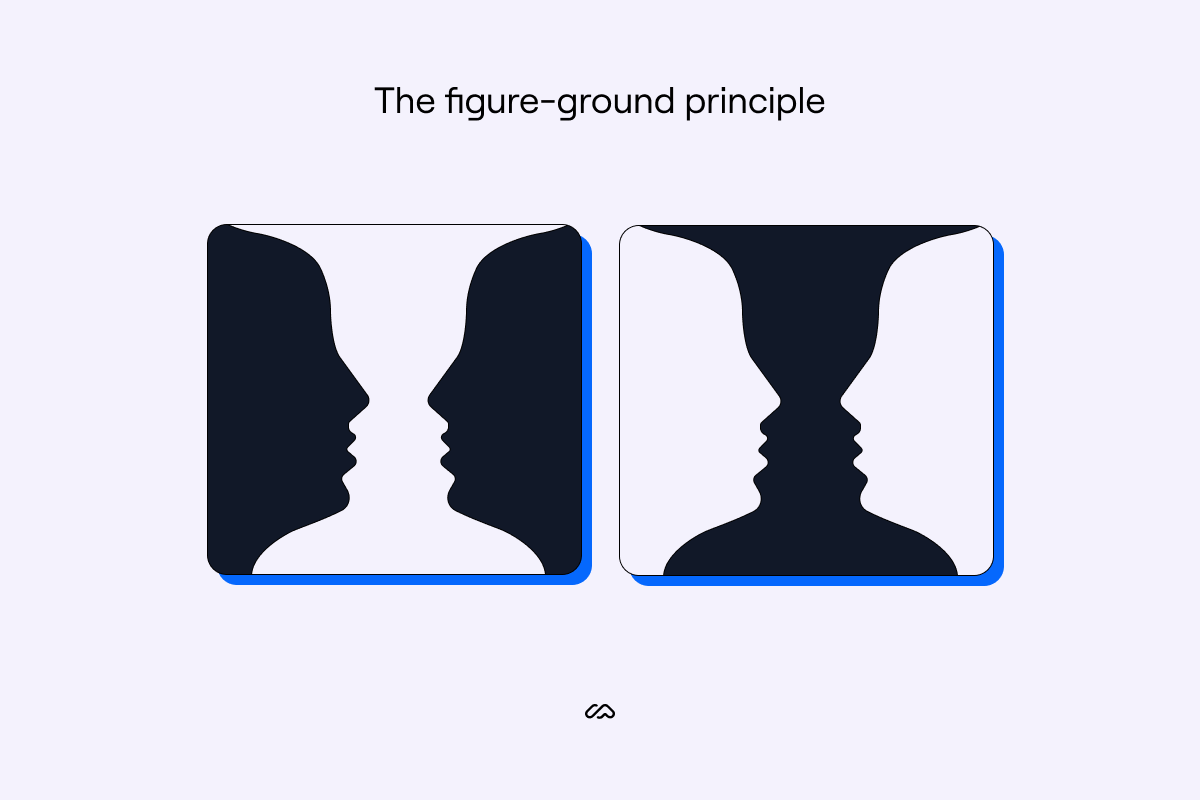
This illusion reveals something profound about all perception. We do not experience the world as a flat mosaic of disconnected color patches. Instead, our perception actively and spontaneously carves the world up into objects of focus—the figure—and the backdrop against which they appear—the ground.
For a concise introduction to this fundamental distinction, let's turn to a short video explanation.
Maurice Merleau-Ponty's Theory of Perception
The Overthink Podcast provides a very clear and direct summary of the figure-ground distinction as Merleau-Ponty uses it.
Please watch the segment from 03:32 to 04:32. The speakers clearly define the figure-ground structure as an inherent and constant feature of any perceptual field.
As the video explains, this is not limited to vision. When you focus on a single voice in a noisy room, that voice becomes the auditory figure against the ground of ambient chatter. The structure is universal to perception.
A Phenomenological Description
While Gestalt psychology identified this structure, Merleau-Ponty takes it from a psychological curiosity to a cornerstone of his philosophy. He is interested in describing, from a first-person perspective, what it is like to experience a figure against a ground. His analysis begins by dismantling the classical idea of a pure "sensation."
Let's turn to his masterwork, Phenomenology of Perception.
In the introduction to his book, Merleau-Ponty uses the simple example of a 'white patch against a homogeneous background' to show that even the most elementary perception is already structured.
Please read the section titled 'Sensation as impression,' starting from 'Consider a white patch...' and ending with '...is inconceivable as a moment of perception.' Focus on the descriptive language Merleau-Ponty uses to characterize the relationship between the figure (the patch) and the ground.
Merleau-Ponty's description is dense. To unpack it with the precision it deserves, we will use an excellent video lecture by philosopher John Russon, who walks through this exact passage.
Merleau-Ponty, Phenomenology of Perception, 1: What is Phenomenology?
Professor John Russon provides a rigorous, step-by-step analysis of Merleau-Ponty's text, which will help clarify the key phenomenological features of the figure-ground relationship.
Please watch from 39:14 to 45:06 and then from 52:14 to 55:20. The first segment analyzes the 'white patch' example. The second segment formalizes this into the figure-ground structure and explains its necessity for perception.
Combining Merleau-Ponty's text with Russon's analysis, we can extract the defining characteristics of this structure:
- The Figure is Dense and Formed: The figure (the white patch, the vase) appears "denser," more "resistant," and more substantial than the ground. It has a definite form or structure.
- The Border Belongs to the Figure: As you saw in the Rubin's vase image, the contour line that separates figure from ground is perceived as belonging to the figure. It defines the figure's shape, not the ground's.
- The Ground is Undifferentiated: The ground appears to continue uninterrupted behind the figure. It lacks the same level of detail and structure; it is more amorphous.
- Structure is Pre-personal: This organization is not something you consciously decide to do. It happens automatically. As the SEP article on Merleau-Ponty notes, Gestalt is a "spontaneous organization of the sensory field" (Resource LINK). We don't perceive meaningless data and then apply a "figure-ground" judgment; we perceive in a figure-ground way from the start.
The Philosophical Significance: Indeterminacy as a Positive Phenomenon
Why is this simple structure so important? Because it reveals that the perceived world is fundamentally different from the objective world described by science. The objective world is imagined as a collection of determinate objects in a uniform space, where everything is, in principle, equally real and specific. The perceived world is not like this.
The crucial philosophical insight is that the indeterminacy of the ground is a positive and necessary phenomenon. The background isn't just "stuff I'm not paying attention to." Its vagueness is what allows the figure to stand out with clarity.
Russon touches on this in the next part of his lecture, using Sartre's famous example of looking for his friend Pierre in a café. When you are looking for Pierre, every other person in the cafe recedes into an indeterminate background of "not-Pierre." They are not perceived as determinate individuals who you then judge to be "not Pierre." Rather, their very mode of appearance is that of a vague, undifferentiated ground.
Merleau-Ponty, Phenomenology of Perception, 1: What is Phenomenology?
Let's continue with Professor Russon's lecture as he explains the positive role of indeterminacy in the perceptual field.
Please watch from 55:20 to 1:00:31. This section uses Sartre's cafe example to illustrate how our intentions structure the field, and it concludes by introducing indeterminacy not as a failure of perception, but as an essential, 'positive phenomenon'.
This is Merleau-Ponty's powerful argument against both empiricism and intellectualism:
- Against Empiricism: We do not start with a collection of determinate sensory points and build up a figure. The figure-ground whole is the most basic sensible given.
- Against Intellectualism: We do not perceive a field of equally determinate objects and then use "attention" or "judgment" to select one as the figure. The field is given to us as already differentiated into a determinate figure and an indeterminate ground.
The indeterminacy of the ground is not a flaw in our perception that needs to be corrected by more precise measurement or closer attention. It is the essential condition for having a focused, meaningful experience at all. The clarity of the figure is bought at the price of the ground's ambiguity.
Conclusion
Today, we have analyzed the most basic structure of the perceived world. We have moved from a simple psychological definition of figure-ground to a rich phenomenological description of its essential characteristics and philosophical importance.
Key Takeaways:
- The perceptual field is not a flat mosaic but is inherently organized into a figure (a focused, structured object) and a ground (its indeterminate backdrop).
- This structure is the "most basic sensible given," not the result of a later intellectual judgment.
- The figure is characterized by its density, form, and defined borders. The ground is characterized by its positive indeterminacy, appearing to continue behind the figure.
- This structure reveals a fundamental difference between the perceived world (organized by relevance and focus) and the objective world (conceived as uniformly determinate).
- The figure-ground principle provides definitive evidence against classical theories of perception, showing that meaning and structure are present from the very beginning of our contact with the world.
Preview of the Next Lesson:
In our last few lessons, we have systematically dismantled the intellectualist account of perception and established Merleau-Ponty's positive alternative, rooted in the primacy of a structured perceptual field. Now, you are equipped to engage with these ideas critically. In our next lesson, we will transition from exposition to argumentation. Your task will be to formulate a critical question or objection related to Merleau-Ponty's critique of intellectualism, using the concepts we have developed as your tools.