Introduction
Welcome to the first lesson of our new module, "The Lived Body as Subject." In the previous module, we concluded our study of Merleau-Ponty's starting point by examining his critiques of traditional theories of perception and formulating critical questions about his framework. We saw his sustained argument that perception is not a mental judgment imposed upon sensory chaos, but a direct, meaningful engagement with a world that is already structured.
Now, we move from critique to construction. We will delve into what is arguably the most central and original contribution of Merleau-Ponty's philosophy: his theory of the lived body. This module will unpack how he reconceives the body not as an object in the world, but as the very subject of experience—the vehicle of our being-in-the-world.
Today's lesson addresses the foundational step in this project: distinguishing between the 'objective body' (in German, Körper) and the 'lived body' (Leib). Understanding this distinction is the key to unlocking Merleau-Ponty's entire philosophy of embodiment and his solution to the age-old mind-body problem.
The Problem of Dualism and a New Vocabulary
For centuries, Western philosophy, particularly since Descartes, has tended to treat the body as a machine—a complex physical object subject to the laws of anatomy and physiology. This creates a seemingly unbridgeable gap between this physical body and the conscious, thinking mind. Merleau-Ponty argues this is a "pseudo-problem" born from a flawed starting point. His solution is to change the terms of the debate, beginning with a more careful description of how we actually experience our bodies.
To get a quick overview of this shift, let's watch a few short clips.
Merleau-Ponty, The Phenomenology of Perception
The Overthink Podcast provides a concise introduction to Merleau-Ponty's project and the core distinction he borrows from Husserl to move beyond mind-body dualism.
Please watch from 00:09 to 00:32, then from 05:17 to 06:36. Pay close attention to the definition of the two German terms, Körper and Leib, and how this distinction helps Merleau-Ponty frame the body as something that is neither a pure subject nor a pure object.
As the video explains, the two key terms are:
- Körper: The body as a third-person, objective, material thing.
- Leib: The body as a first-person, living, subjective experience.
Let's now explore each of these in more detail.
The Objective Body: Körper
The Körper is the body as an object of science. It is the body a surgeon operates on, the body an anatomist dissects, the body a physiologist studies. It is understood as:
- A physical object among other objects in space.
- Composed of distinct parts (
partes extra partes- parts outside of parts). - Governed by universal, third-person causal laws (physics, biology, chemistry).
- Something I have.
This is the body as conceived from the natural attitude—that default posture we discussed in the modules on Husserl, where we take the world and the objects within it, including our own bodies, as simply being 'out there', independent of our experience.
The Lived Body: Leib
The Leib, in stark contrast, is the body as we experience it from the inside, in the first person. It is not an object we observe, but the very perspective from which we observe. The Leib is:
- The center of my world, the "zero-point" of all my spatial and temporal orientation.
- A unified, indivisible power for acting in the world. It is my capacity, my "I can."
- Known not through observation but through lived, pre-reflective awareness.
- The subject that I am.
Merleau-Ponty's crucial insight is that our primary experience is of the Leib. The Körper is a secondary abstraction, a way of thinking about the body that has its uses in science but fundamentally misrepresents our lived reality.
A Phenomenological Deconstruction of the Body-as-Object
Why isn't our body just another object? Merleau-Ponty argues that a careful phenomenological description reveals that the body has characteristics incompatible with the status of an object. Professor John Russon provides a lucid, systematic analysis of this point.
Merleau-Ponty, Phenomenology of Perception 3: The Habit Body (Phenomenology Lecture 7)
In this lecture, John Russon explains the common mistake of treating the body as an object and then walks through a rigorous phenomenological argument showing why our lived experience of the body defies this categorization.
Please watch from 15:04 to 30:13. \nFirst, focus on the distinction between the body as my point of view on the world versus the body as one object in that world (the surgeon's view). \nThen, pay close attention to the arguments he presents from Merleau-Ponty about why the body cannot be an object: Its constant, invariant presence versus the possible absence of an object. Its defiance of exploration; it is always 'with me', never truly 'in front of me'. The 'transcendental' necessity of its presence as the condition for experiencing any 'empirical' facts at all. This last point, given your mathematical background, relates to the idea of a necessary condition or axiom for a system of experience.
Russon's analysis demonstrates that the lived body is not just a special object; it is a different kind of entity altogether. It is the transcendental condition for the possibility of there being objects for me in the first place. An object is defined by its ability to be absent from my perspective, but my body is the one "thing" that can never be absent. It constitutes my perspective.
Formalizing the Distinction
To ground these concepts in more formal academic language and trace their origins in Husserl, let's turn to a chapter by the phenomenologist Dermot Moran.
Lived Body, Intercorporeality, Intersubjectivity: The Body as a Phenomenological Theme
In this chapter, Dermot Moran provides a scholarly account of the phenomenological theme of the body, clearly defining the Körper/Leib distinction and placing it within Husserl's wider philosophical project.
Please read the first three sections of the chapter (up to the paragraph that begins 'Following Fichte...'). Section 1 (Introduction): Note how the lived body is presented as the pre-reflective unity that sustains consciousness. Section 2 ('The Husserlian phenomenological tradition...'): Focus on Husserl's 'paradox' of the human being as both 'in the world' (like a Körper) and 'for the world' (as a Leib that constitutes meaning). Section 3 ('The starting point...'): Pay close attention to the explicit definitions of Körper and Leib, and the phrase partes extra partes used to describe the objective body.
This reading solidifies the distinction by showing its roots in the founder of phenomenology, Husserl, and introduces related concepts like the body's role in creating space rather than merely occupying it.
Synthesis and Visualization
We can summarize the distinction with the following table:
| Feature | Objective Body (Körper) | Lived Body (Leib) |
|---|---|---|
| Perspective | Third-person (impersonal, "it") | First-person (subjective, "I") |
| Mode of Relation | Something I have | The subject I am |
| Relation to Space | An object in geometric space | The center of lived space (zero-point) |
| Composition | Collection of parts (partes extra partes) | A unified, synergistic whole |
| Epistemology | Known through external observation, science | Known through pre-reflective, lived awareness |
| Paradigm | A corpse on an autopsy table; anatomical model | My own body as I reach for a cup or walk |
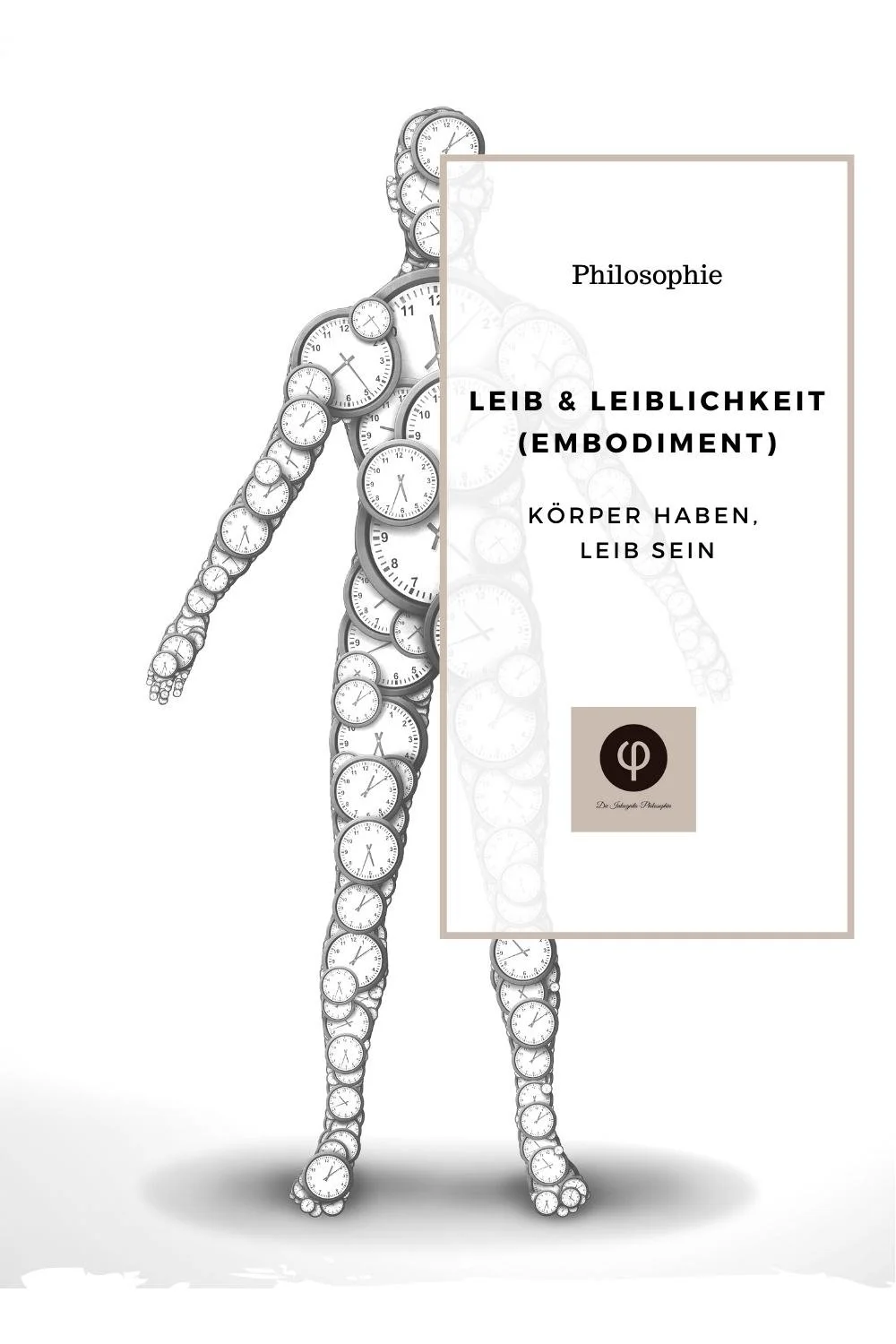
The following image provides a powerful visual metaphor for this distinction.
Conclusion
Today we have established the crucial distinction between the objective body (Körper) and the lived body (Leib). This is not merely a terminological preference; it is the lynchpin of Merleau-Ponty's entire phenomenological project. By refusing to begin with the body-as-object, he avoids the trap of mind-body dualism and opens up a new way of understanding subjectivity as fundamentally embodied.
Key Takeaways:
- The objective body (Körper) is the body as a third-person object of science, a physical entity in the world.
- The lived body (Leib) is the body as experienced from the first-person perspective, as the subject and center of our world.
- Phenomenological analysis reveals that the lived body is our primary reality; its presence is a constant, "transcendental" condition for all experience, not just another "empirical" fact.
- For Merleau-Ponty, traditional philosophy and science make the mistake of treating the abstract Körper as more real than the concrete Leib, leading to intractable problems like dualism.
Preview of the Next Lesson:
Having distinguished the lived body from an object, our next step is to understand how it works. How does the lived body achieve its seamless, pre-reflective unity and its capacity for goal-directed action? In the next lesson, we will explore Merleau-Ponty's answer: the concept of the 'body schema.'